饭团会动了,但它只是一张平面图。转过来时,背面长什么样?The rice ball moves, but it is only a flat picture. What should its back look like when we turn it?
第 1 步:点连线,线围面Step 1: Vertices, edges and faces
想从不同方向看它,先存什么?What must we store to view it from different angles?
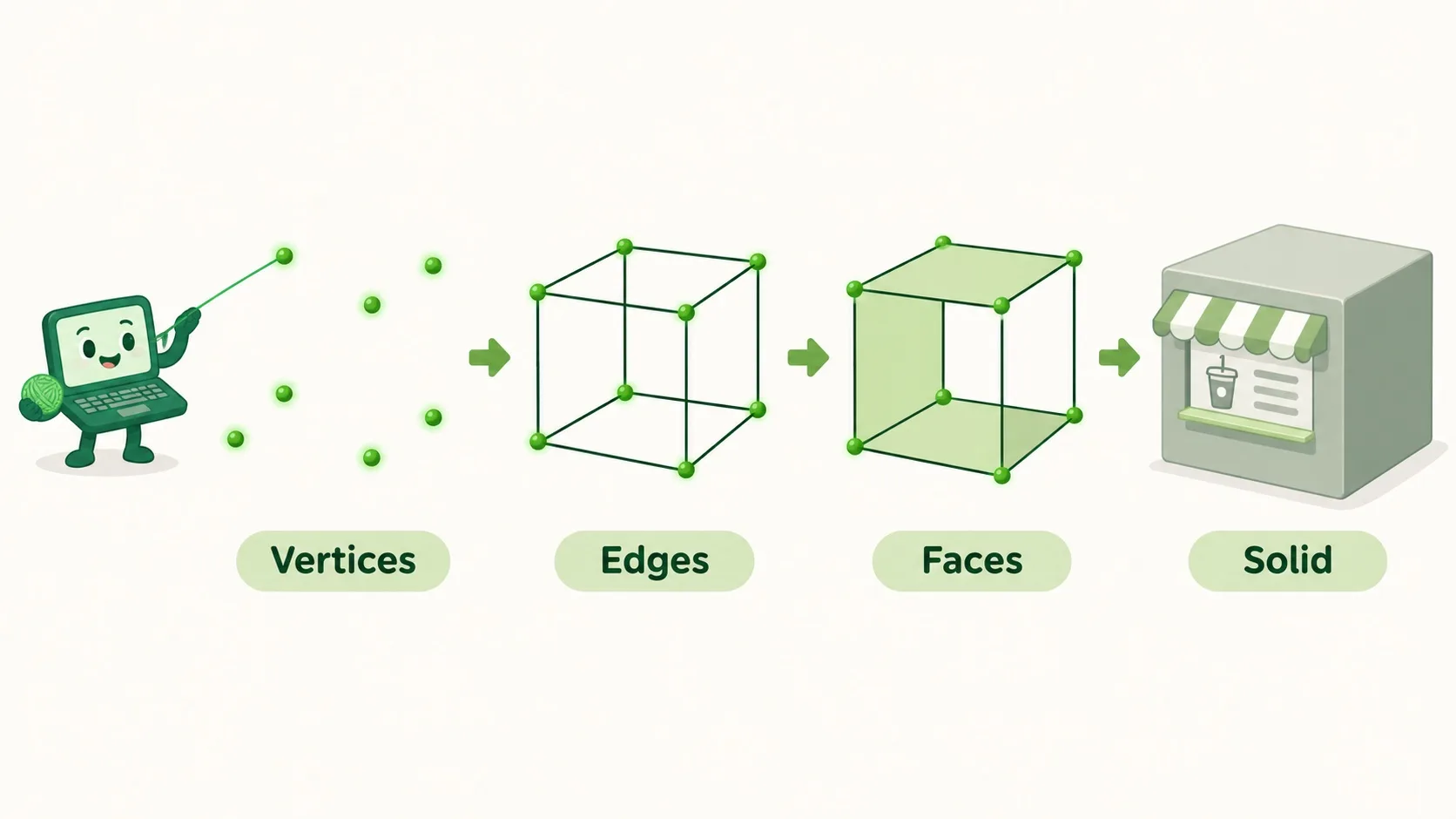
网格建模先记录空间中的点。每个点都有三个位置坐标。连起两个点得到边,围成表面得到面。许多面拼出饭团的外形。图里的小亭子也能这样搭。网格存的是表面,不是塞满的实体。要拿去打印,还得检查表面闭合和厚度。A mesh starts with vertices, each positioned using three coordinates. Edges connect vertices, and faces form a surface. Many faces outline the rice ball, just as they can form a tiny kiosk. A mesh represents a surface, not automatically a filled solid. A printable object also needs appropriate thickness and a closed, valid surface.
第 2 步:面数与形状的取舍Step 2: The detail trade-off
多加一些面,饭团会怎样?What changes when we add more faces?
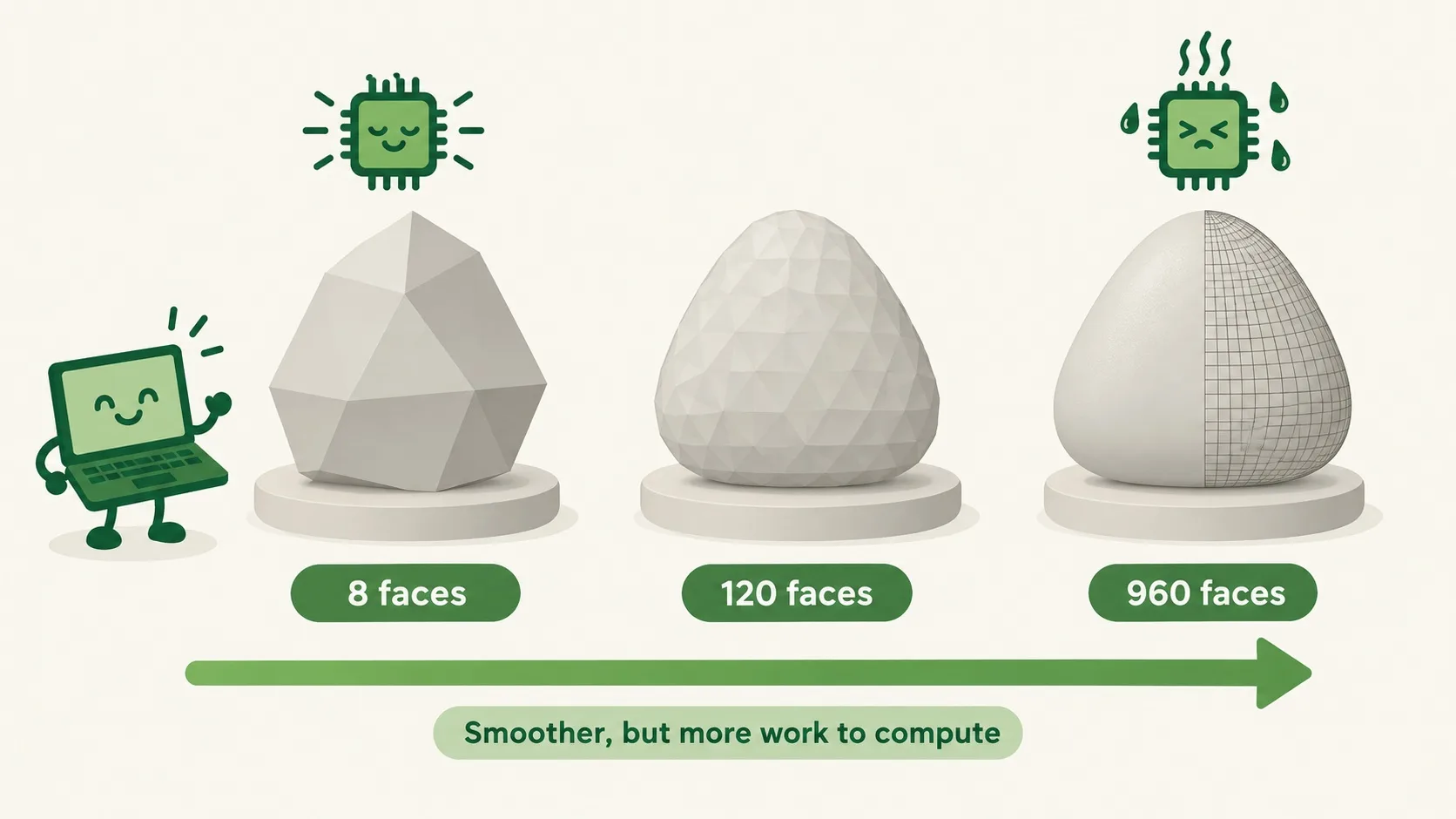
少量平面拼成的饭团有棱角。沿曲面细分后,轮廓通常更圆滑。但仅增加面数,不会自动修好坏形状。更多几何也增加处理负担。远处配角可以简化,近景主角需要细节。互动用规则网格示范这种取舍,圆滑度只是教学指标。A rice ball built from a few flat faces looks angular. Subdividing along a curved shape can smooth its silhouette, but extra faces do not automatically fix a poor shape. More geometry also costs processing. Distant props can be simpler than a close-up hero. The regular mesh below illustrates this trade-off; its smoothness score is a teaching measure.
第 3 步:形状和皮肤分开Step 3: Shape and surface appearance
白色模型怎样变成海苔饭团?How does the plain model become a seaweed rice ball?
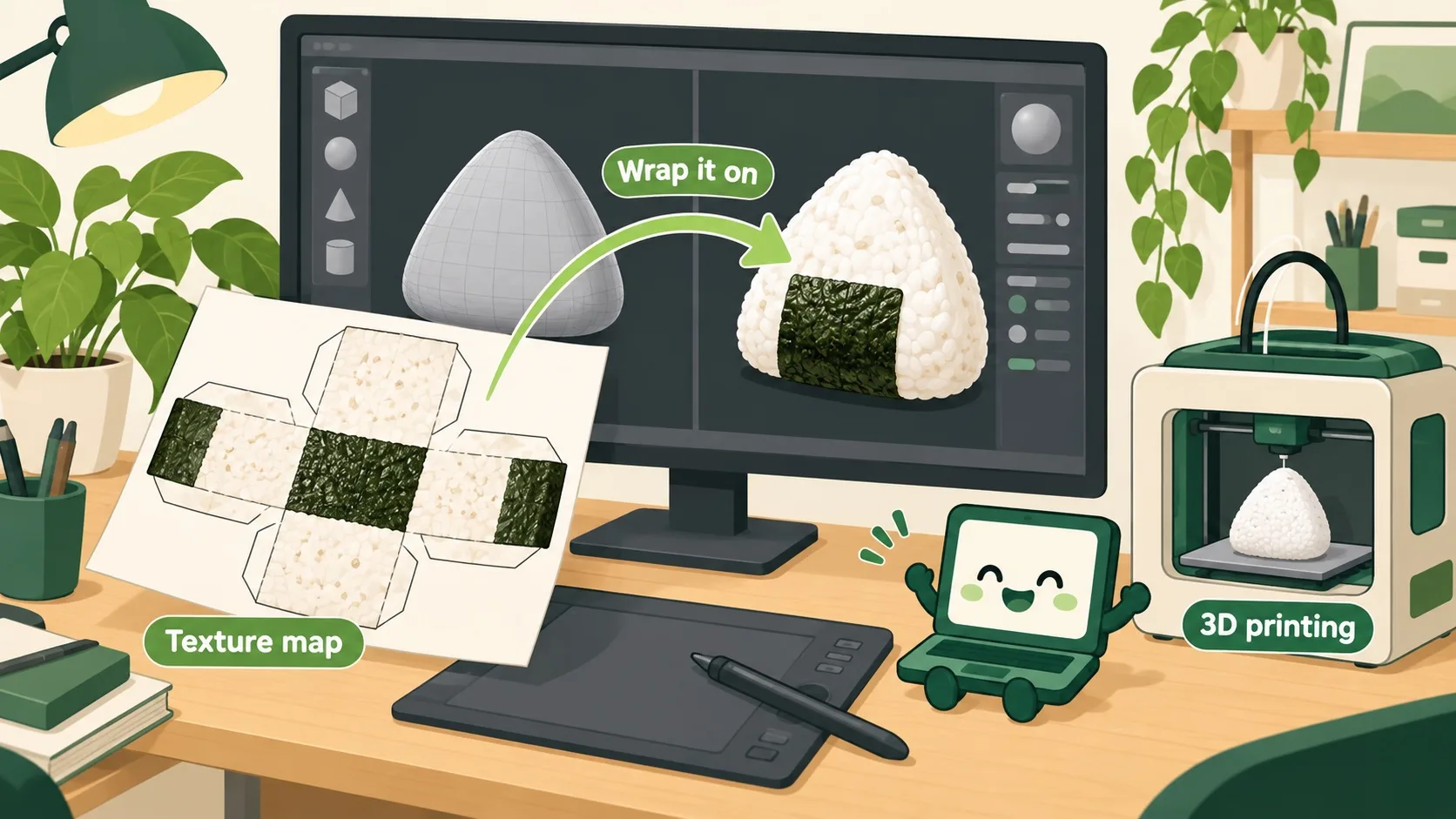
小禾把一张平面图片贴到模型上。贴图记录颜色,材质描述反光等表现。展开坐标告诉软件哪里贴哪里。海苔的颜色不必靠新增几何表示。但要做突起的米粒,可能还需几何或着色技巧。做动画、游戏或打印,对模型的要求也不同。He maps a flat image onto the model. Textures can store color; materials describe appearance such as reflections. Mapping coordinates connect the image to the surface. Seaweed color need not add geometry, while raised grains may need geometry or shading techniques. Animation, games and printing each impose different requirements.
🎮 饭团建模订单🎮 Rice-ball modeling orders
切换点、线、面与皮肤,拖动细分,完成不同预算的订单。Switch between vertices, edges, faces and skin. Adjust detail to fulfill orders with different budgets.
一句话记住它:Remember: 三维模型描述空间形状,贴图和材质描述表面。A 3D model describes shape; textures and materials describe its surface.
点、边、面构成网格。Vertices, edges and faces form a mesh.细节需要和处理成本平衡。Detail must be balanced against processing cost.可渲染不等于可直接打印。Renderable does not mean ready to print.
 Back to tree