🏗️ 公理系统:从几条假设盖起整座大楼🏗️ Axiomatic Systems: A Tower Built from a Few Assumptions
上一片哥德尔让我们看到系统的边界。可边界里面,数学大厦为什么能盖得又高又稳?小算盘机器人 🧮 回到工地:一切要先从「约定好的几条假设」开始。Last leaf, Gödel showed us the boundary of formal systems. But inside that boundary, why does the tower of mathematics stand so high and so firm? The little abacus robot 🧮 returns to the building site: everything starts from a few agreed assumptions.
第 1 步:先打好五块地基石Step 1: lay the five foundation stones
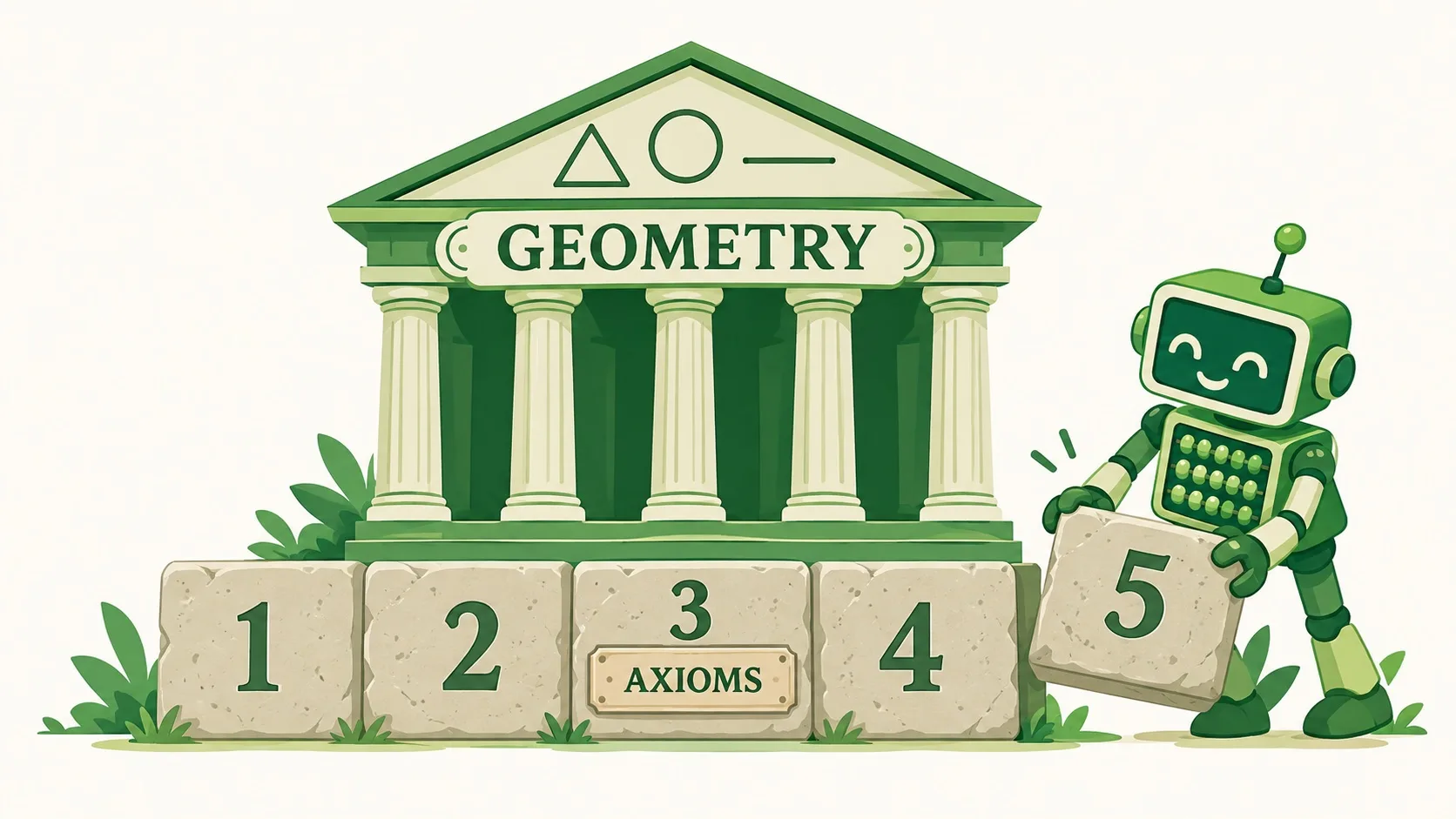
盖楼先打地基——欧几里得为几何选了 5 块石头。Builders lay a foundation first — Euclid picked five stones for geometry.
公理 = 约定好的出发点:有的看起来不证自明,有的干脆就是一种选择。欧几里得挑了 5 条:① 过两点能画一条直线;② 线段可以任意延长;③ 以任意点为圆心都能画圆;④ 所有直角都相等;⑤ 过直线外一点恰有一条平行线。就这 5 块石头,撑起了整座几何大厦。An axiom is an agreed starting point: some look obviously true, others are simply a choice. Euclid picked five: (1) a line can be drawn through any two points; (2) a segment can be extended; (3) a circle can be drawn with any center; (4) all right angles are equal; (5) through a point off a line, exactly one parallel passes. Just five stones — and they hold up the whole tower of geometry.
五块石头,怎么长成几百层的大楼?How do five stones grow into a tower hundreds of floors high?
第 2 步:定理从地基里长出来Step 2: theorems grow from the ground
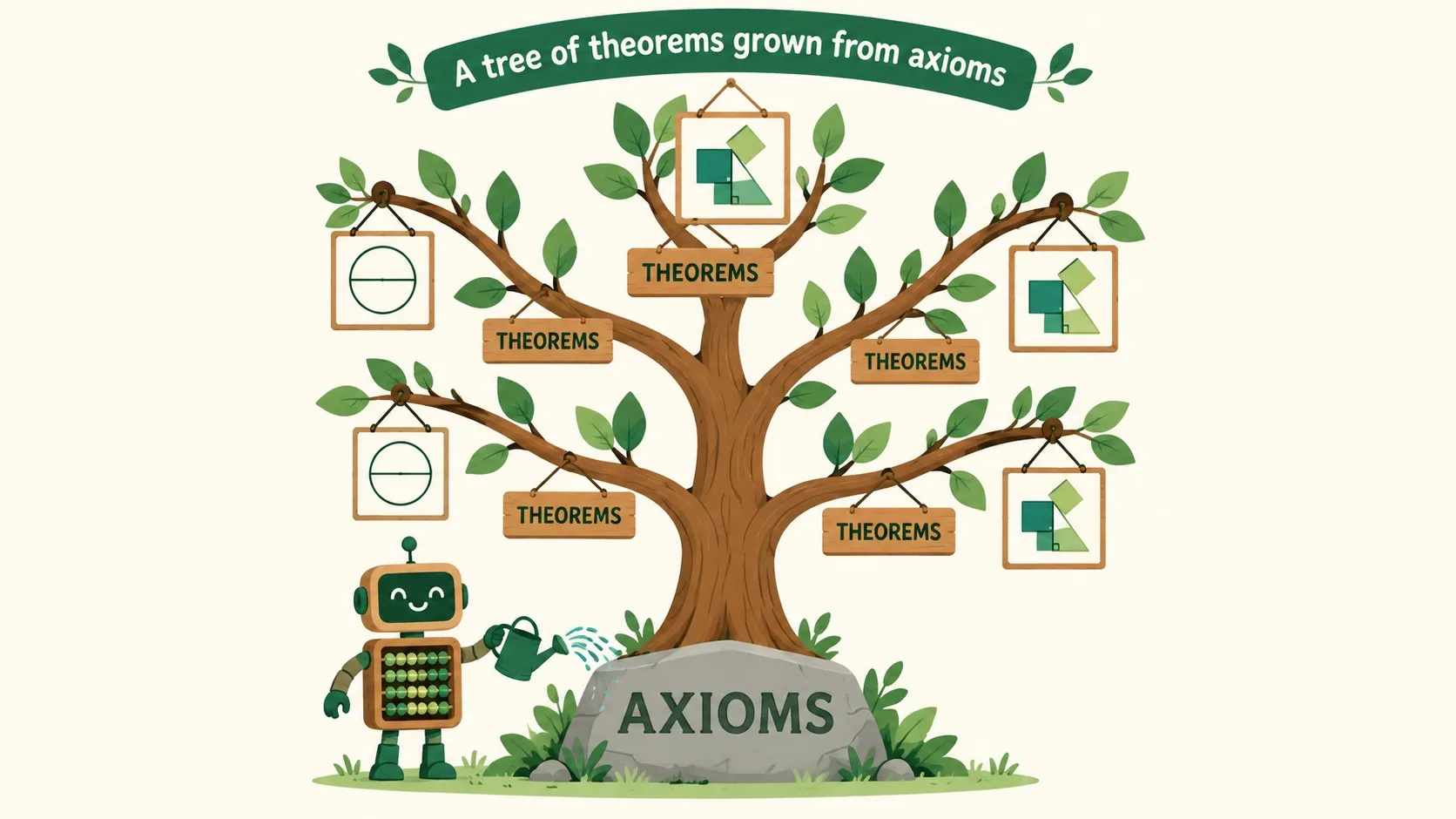
定理 = 从公理出发、一步不错地推出来的结论。像一棵树:根是公理,枝干是定理;勾股定理、三角形内角和 180°,都是这样长出来的。妙处在于:只要地基稳、推导对,结论就永久可靠,不用每次重新验算。几条假设,换来一整片可靠的领土——这就是公理系统的力量。A theorem is a conclusion derived from the axioms, one painstaking step at a time. It is like a tree: the axioms are the root, the theorems are the branches; the Pythagorean theorem and “angles of a triangle sum to 180°” grow this way. The beauty: as long as the root is solid and the steps are valid, the conclusions stay reliable forever — no re-checking needed. A few assumptions buy you a whole continent of certainty — that is the power of an axiomatic system.
那要是把第 5 块石头换掉呢?So what if someone swaps out that fifth stone?
第 3 步:换一块石头,世界全变Step 3: swap one stone, the world changes
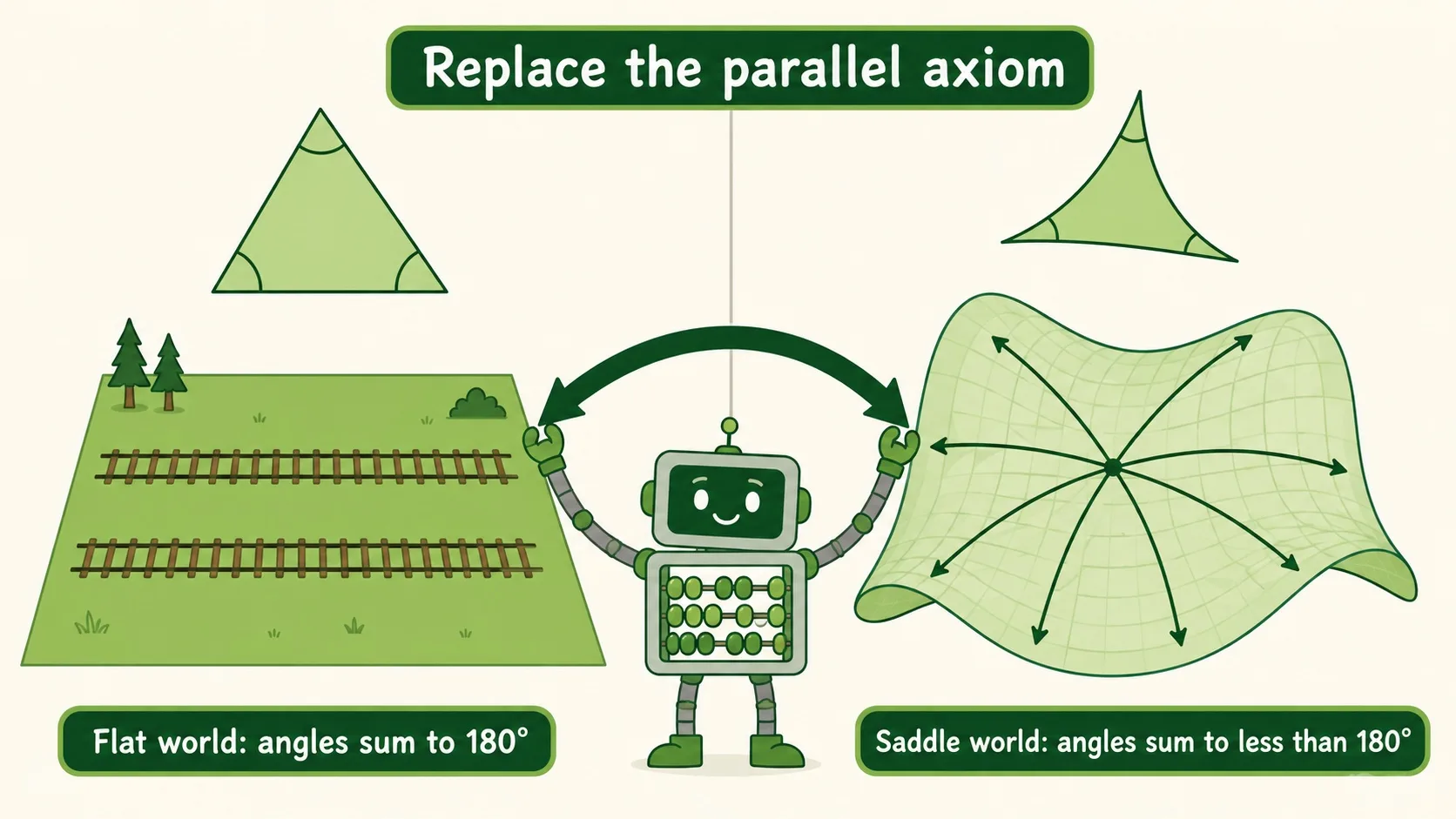
两千年来,数学家一直想从其他 4 条推出平行公理,全都失败。后来人们干脆换掉它:改成「过直线外一点可以画很多条平行线」,得到罗巴切夫斯基几何——在马鞍一样的世界里,三角形内角和小于 180°;改成「一条都画不出」,就是球面几何。同一套推理,全新的世界,而且同样自洽。原来公理不是「真理」,而是「选择」。For 2000 years mathematicians tried to derive the parallel axiom from the other four — and always failed. So they swapped it out: change it to “through a point off a line, many parallels pass” and you get Lobachevsky's geometry — in a saddle-like world, triangle angles sum to less than 180°; change it to “none passes” and you get spherical geometry. The same reasoning, a brand-new world, just as consistent. Axioms are not truths — they are choices.
🎮 你来搭大楼(1 分钟)🎮 Your turn: build the tower (1 minute)
道理讲完了。帮小算盘 🧮 挑对 3 块地基石,再亲手换掉平行公理,看世界怎么弯。Theory done. Help the little robot 🧮 pick 3 right foundation stones, then swap the parallel axiom yourself and watch the world bend.
一句话记住它:公理 = 约定好的出发点,定理 = 从它推出来的结论;换一条公理,就换一个世界。Remember it in one line: axioms are agreed starting points, theorems are what you derive from them — swap one axiom and you swap a whole world.
公理不证自明、或干脆是一种选择,是整个系统的地基Axioms are self-evident or simply chosen — they are the foundation of the system定理从公理一步一步推出来:欧几里得 5 条公理盖出几何大厦Theorems are derived step by step: Euclid's 5 axioms built the tower of geometry换掉平行公理得到非欧几何:世界变了,但依然自洽(罗巴切夫斯基)Swap the parallel axiom and get non-Euclidean geometry: a different yet consistent world
内容参考 OpenStax 等公开教材,多来源核对 · AI 生成、人工审核 · 发现错误欢迎指正,帮这片叶子长得更好。Based on OpenStax and other open textbooks, cross-checked across sources · AI-generated, human-reviewed · Spotted a mistake? Tell us — help this leaf grow.
 Back to tree