⚖️ 化学方程式:用符号写反应,还要两边配平⚖️ Chemical Equations: Reactions in Symbols, Balanced on Both Sides
上一片把物质分成了单质和化合物。可物质不会一直安分——它们会“变身”。这一片学会用一行符号,把变身过程完整写下来。Last leaf sorted substances into elements and compounds. But substances never sit still — they transform. This leaf shows how one line of symbols can capture a whole transformation.
第 1 步:一行符号,写下一次变身Step 1: One line of symbols captures the change
先看最基础的:怎么把一次反应“记”成一行字。Start with the basics: how does a reaction get written down as one line?
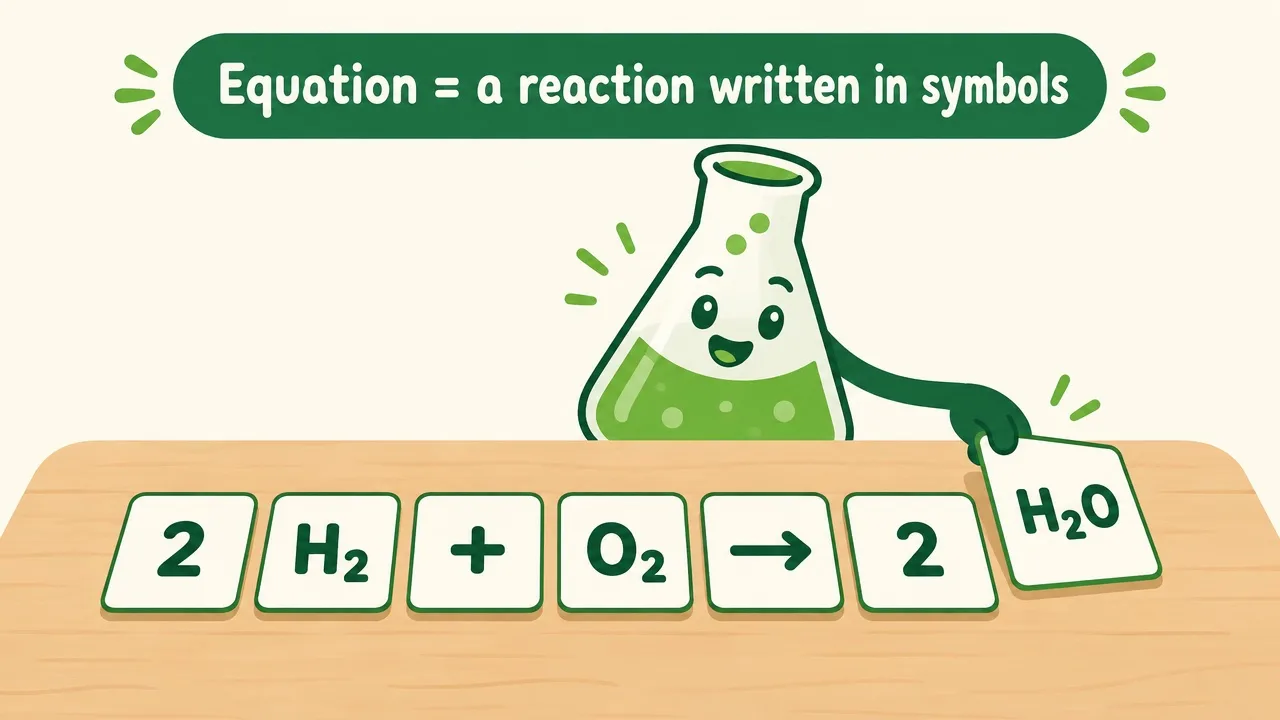
卡片上写着物质的符号:氢气 H₂、氧气 O₂、水 H₂O。把它们按“反应物 → 生成物”排好,中间放一个箭头,就得到 H₂ + O₂ → H₂O。箭头读作“生成”:左边是原料,右边是产物——化学方程式就是反应的简写,全世界通用。The cards carry substance symbols: hydrogen H₂, oxygen O₂, water H₂O. Line them up as “reactants → products”, put an arrow in between, and you get H₂ + O₂ → H₂O. The arrow reads “produces”: left side is the ingredients, right side is what you get — a chemical equation is a reaction's universal shorthand.
可刚写的 H₂ + O₂ → H₂O,左右两边真的一样吗?But is H₂ + O₂ → H₂O really the same on both sides?
第 2 步:两边原子要一样多Step 2: Both sides must hold the same atoms
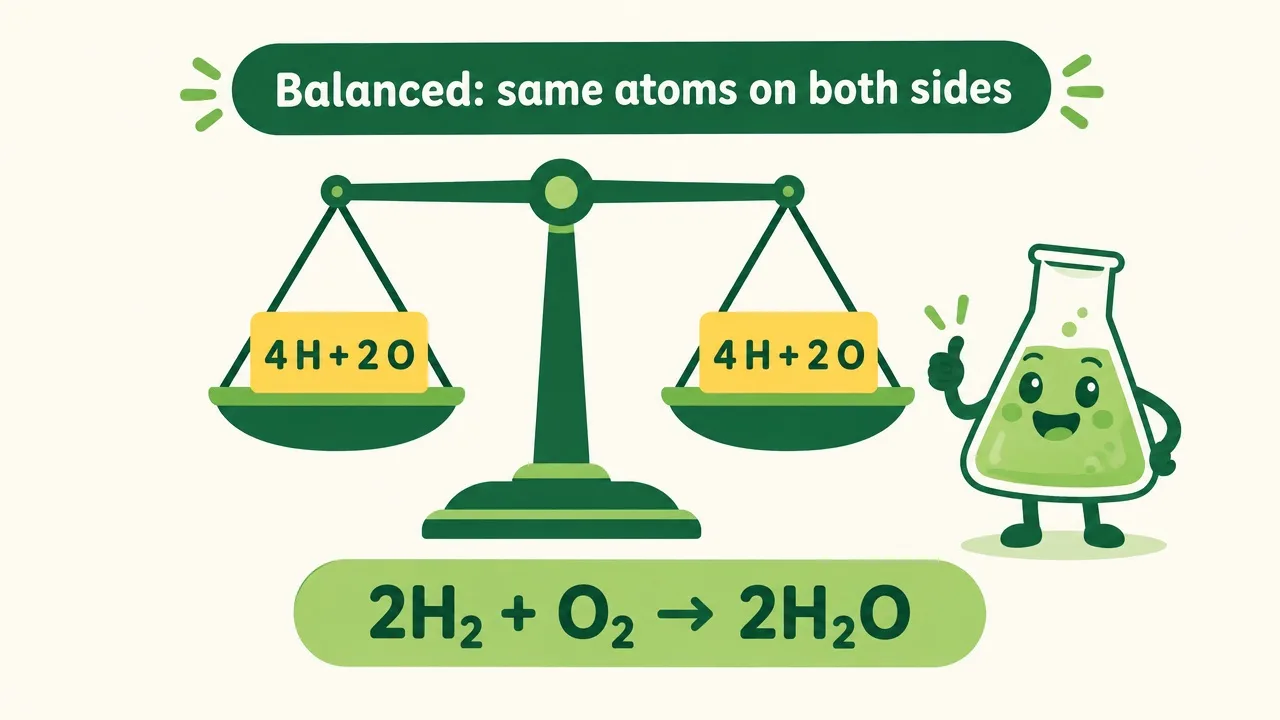
数一数:左边 2 个 H、2 个 O;右边却是 2 个 H、1 个 O——少了一个氧!原子不会凭空产生或消失,这就是质量守恒。配平像调天平:在物质前面添系数,写成 2H₂ + O₂ → 2H₂O,左边 4 个 H、2 个 O,右边也正好一样。注意:改的是前面的系数,不能动下标——H₂O 改成 H₂O₂,就变成另一种物质了。Count them: the left has 2 H and 2 O; the right has 2 H but only 1 O — one oxygen short! Atoms are never created or destroyed (conservation of mass). Balancing is like leveling a scale: add coefficients in front of substances to get 2H₂ + O₂ → 2H₂O — now 4 H and 2 O on the left, exactly the same on the right. Remember: only coefficients change; subscripts are untouchable — turn H₂O into H₂O₂ and it becomes a different substance.
配平了就完事了吗?实验室的记录本上,为什么还要写更多东西?Balanced — done? Then why does a lab notebook still write extra notes?
第 3 步:真实实验室的记录Step 3: How a real lab records it
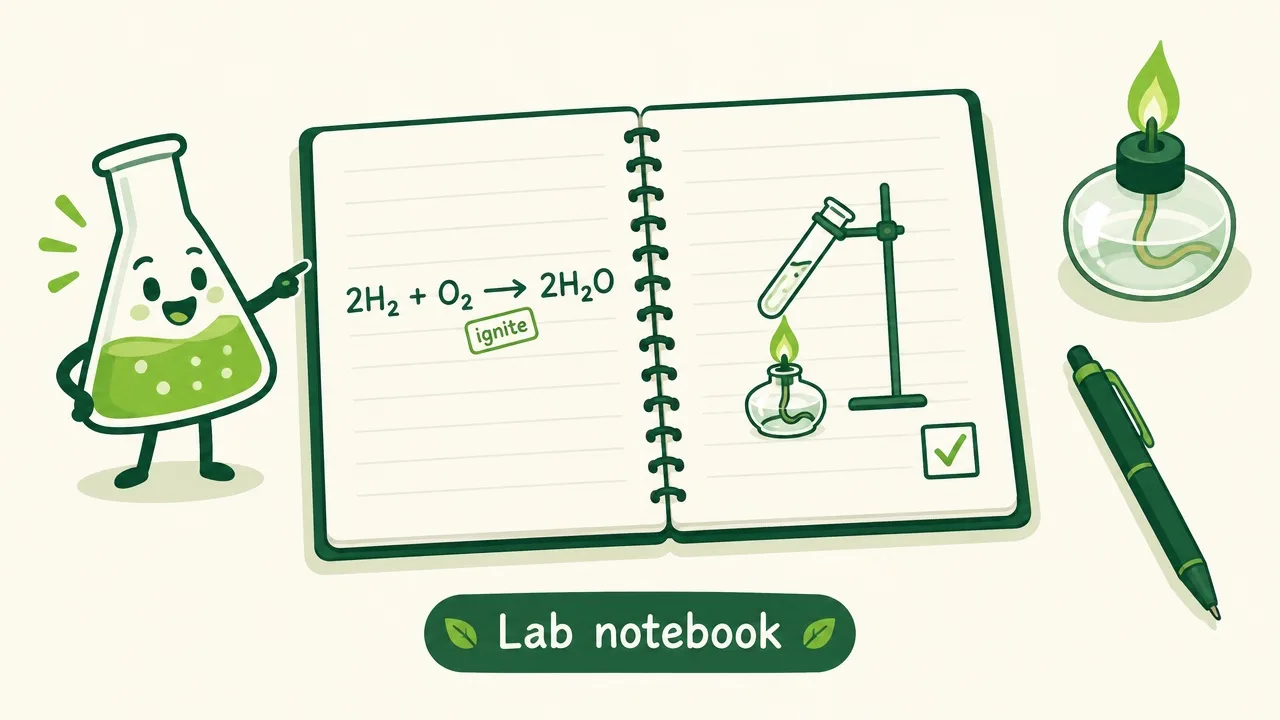
真实记录还要写条件和现象:燃烧标“点燃”,过氧化氢分解标“MnO₂”催化,加热用“△”;冒出的气体标“↑”,沉下的固体标“↓”。读一行方程式,就像读一张完整工单:原料、条件、产物,全都在上面。A real record also notes conditions and signs: “ignite” for burning, “MnO₂” as catalyst for hydrogen peroxide, “△” for heating; gases that escape get “↑”, solids that settle get “↓”. Reading an equation is like reading a full work order: ingredients, conditions, products — all in one line.
🎮 配平实验室(调系数,让天平水平)🎮 The Balancing Lab (level the scale)
下面 4 个反应,拖动化学式前面的系数滑块,让两边每种原子的数量完全相等。Four reactions below: drag the coefficient sliders until both sides hold exactly the same number of every atom.
一句话记住它:化学方程式 = 用符号和箭头把反应写下来;配平 = 让两边每种原子个数相等——只动系数,不动下标。Remember it in one line: a chemical equation writes a reaction in symbols and an arrow; balancing makes every element count equal on both sides — change coefficients, never subscripts.
写法:左边反应物、右边生成物,箭头读作“生成”Format: reactants left, products right, the arrow reads “produces”配平:先数原子,再添系数;系数取最简整数比Balancing: count atoms, then add coefficients; use the simplest whole-number ratio条件与符号:点燃 / 加热 / 催化剂,↑ 表示气体、↓ 表示沉淀Conditions & signs: ignite / heat / catalyst; ↑ for escaping gas, ↓ for settling solid
内容参考 OpenStax 等公开教材,多来源核对 · AI 生成、人工审核 · 发现错误欢迎指正,帮这片叶子长得更好。Based on OpenStax and other open textbooks, cross-checked across sources · AI-generated, human-reviewed · Spotted a mistake? Tell us — help this leaf grow.
 Back to tree