🎲 古典概型:数一数就知道概率🎲 Classical Probability: Just Count
上一片我们认识了随机事件:结果说不准,事先不知道会怎样。但有一类情形能算得清清楚楚——只要每个结果机会一样,数一数就知道概率。Last leaf we met random events — outcomes you can't predict in advance. But one big family of them can be pinned down exactly: when every outcome is equally likely, you just count.
第 1 步:袋子里有 5 个球Step 1: Five balls in a jar
先看最简单的实验:从袋子里摸一个球。Start with the simplest experiment: draw one ball from the jar.
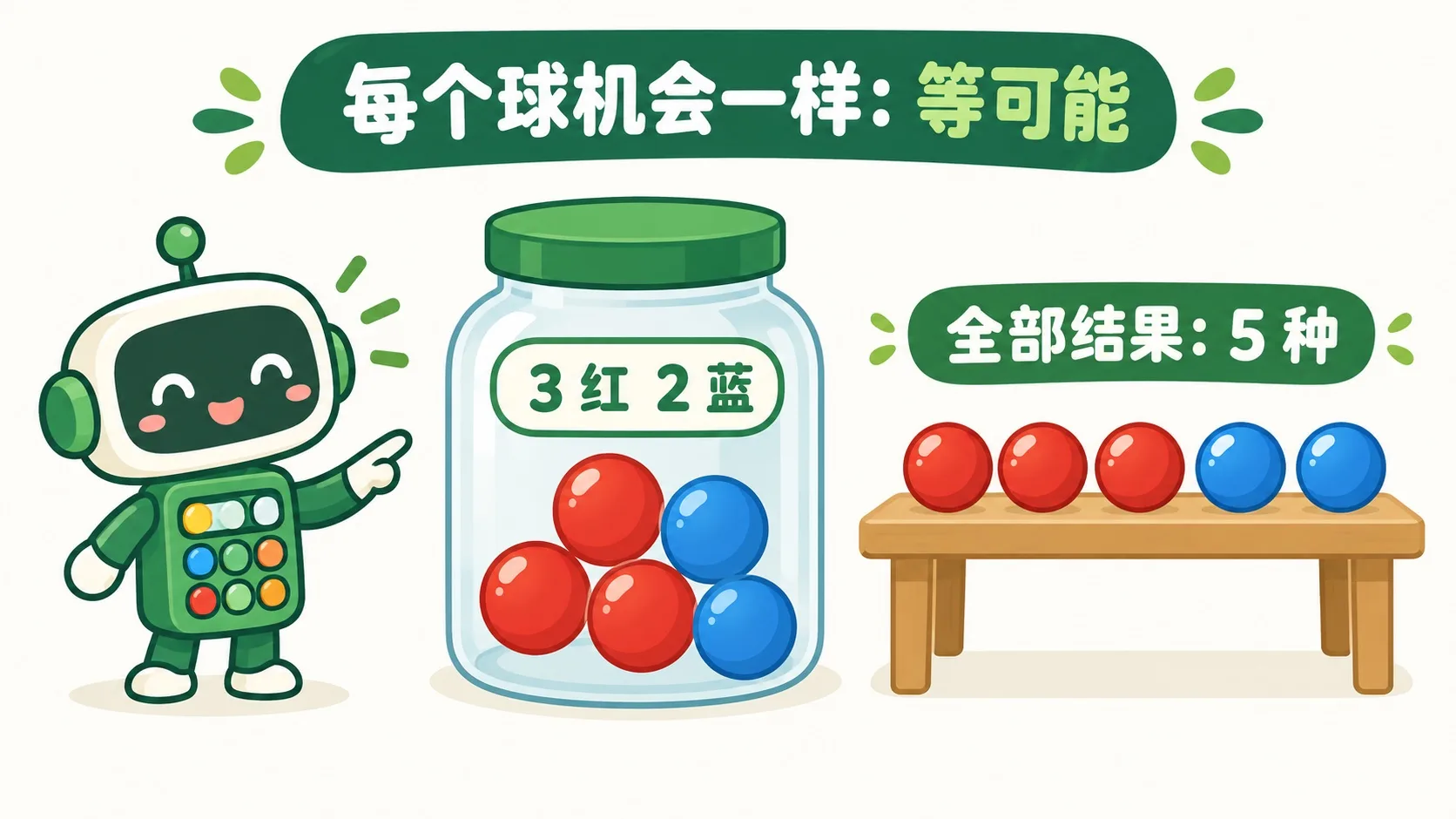
小算盘机器人准备了 1 个透明罐:里面 3 个红球、2 个蓝球,大小重量一模一样。每个球被摸到的机会完全一样,这叫等可能。把所有可能的结果排出来,正好 5 种——红球占了其中 3 种。The little abacus robot fills a clear jar with 3 red balls and 2 blue ones — same size, same weight. Every ball has exactly the same chance of being drawn: that's equally likely. Lay all outcomes in a row and you count 5 — and 3 of them are red.
数出了结果,概率怎么算?Now that we can count, how do we turn it into a probability?
第 2 步:概率 = 有利结果 ÷ 全部结果Step 2: Probability = wanted outcomes ÷ all outcomes
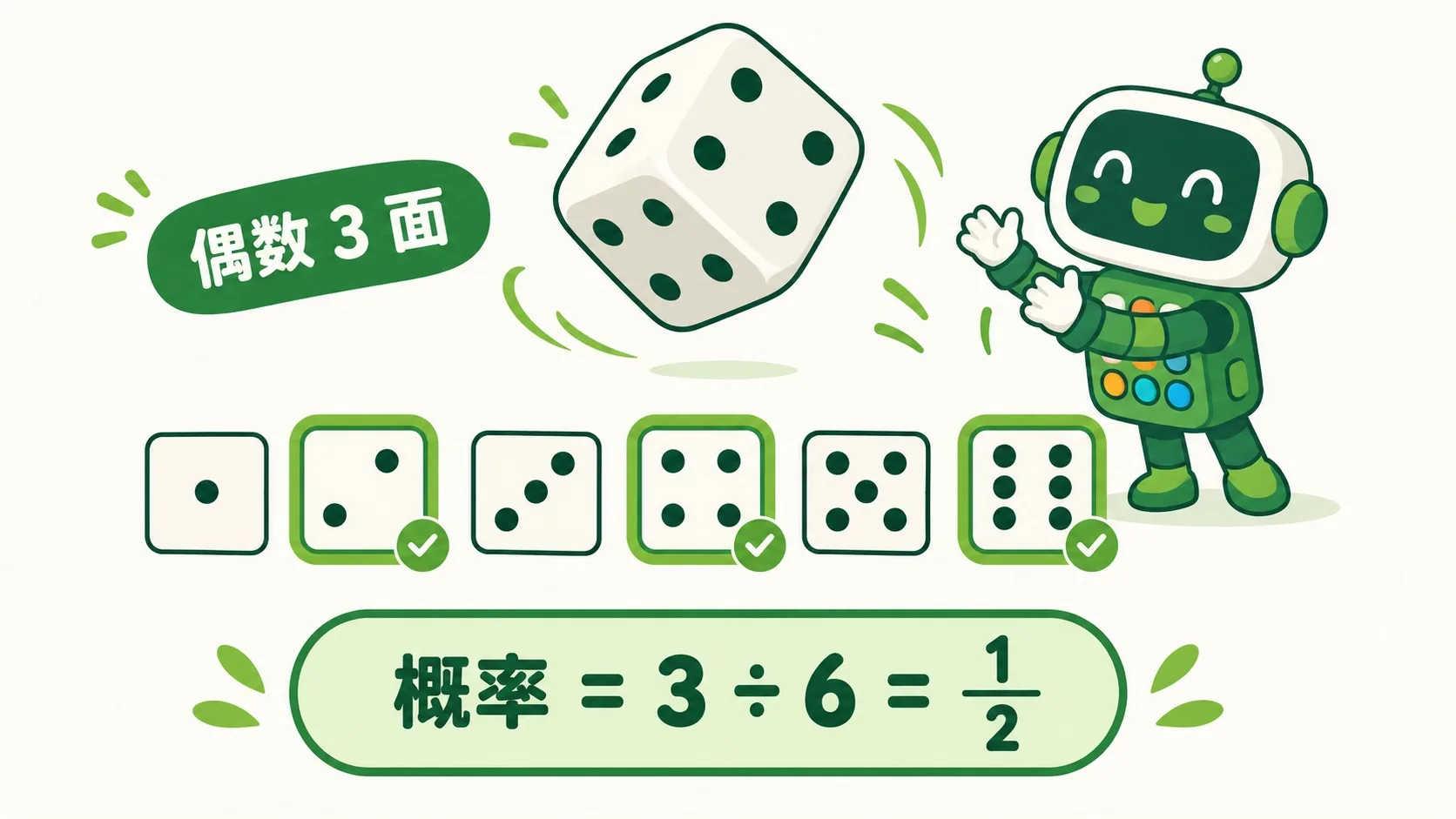
拿骰子练手:6 个面机会一样,偶数有 2、4、6 共 3 面,所以 P(偶数) = 3 ÷ 6 = 1/2。套回袋子:P(红) = 3 ÷ 5。分子是“你要的结果数”,分母是“全部结果数”——这就是古典概型的全部秘密。Practice with a die: all 6 faces are equally likely, and the even faces are 2, 4 and 6 — three of them, so P(even) = 3 ÷ 6 = 1/2. Back to the jar: P(red) = 3 ÷ 5. Numerator: the outcomes you want. Denominator: all outcomes. That is the whole secret of classical probability.
那这个“数一数”的办法,什么时候会失灵?So when does counting stop working?
第 3 步:前提是“每份一样大”Step 3: The fine print — “equally likely”
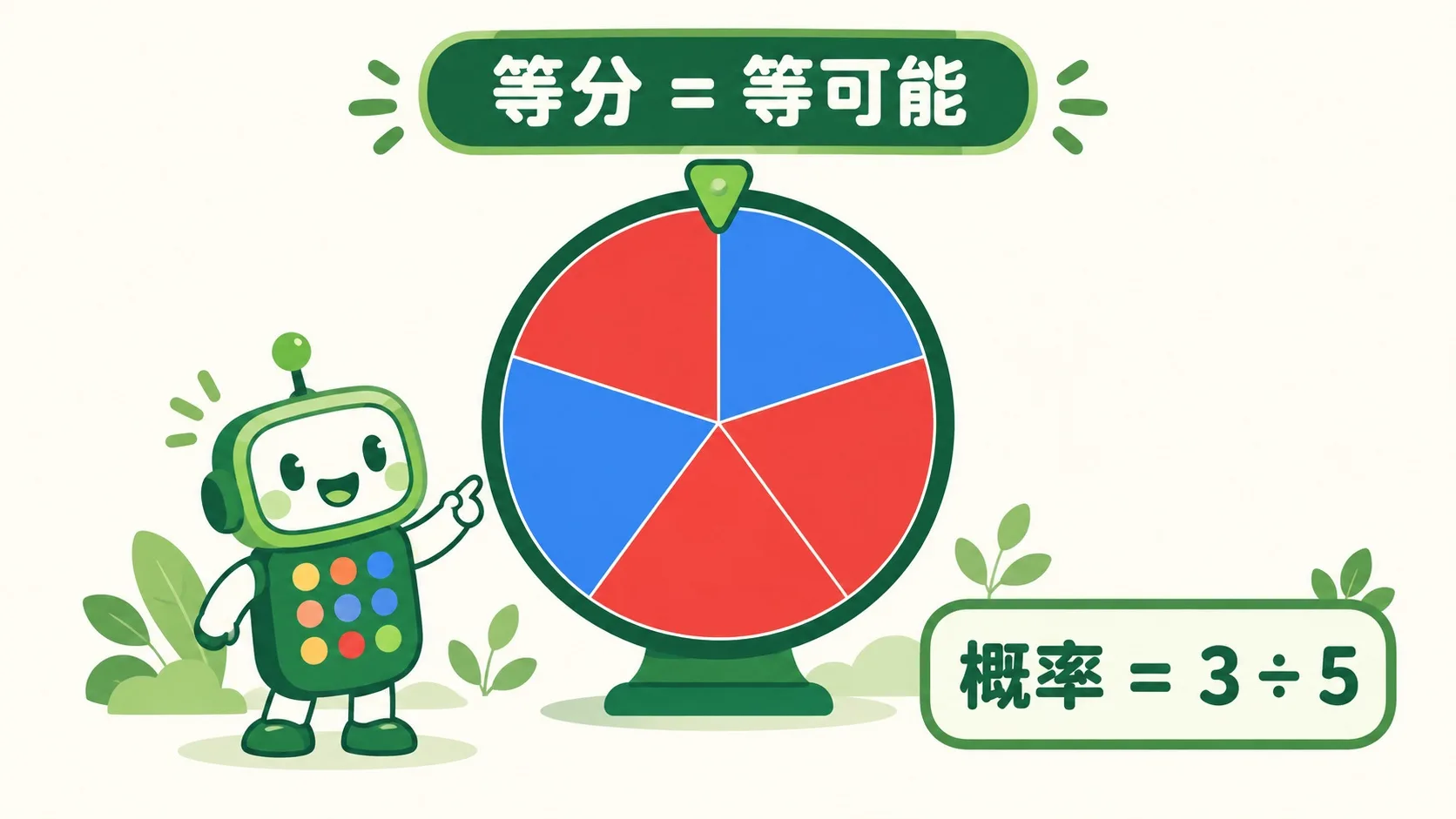
抽奖转盘平均分成 5 格(3 红 2 蓝),指针停在每格的机会一样,照样数:P(红) = 3 ÷ 5。可要是格子有大有小,或者球有轻有重,等可能就破了——那时数出来的比例会骗人。用这招前,先确认:每一份真的一样可能。A prize wheel split into 5 equal slices (3 red, 2 blue): the pointer is equally likely to stop on any slice, so count again: P(red) = 3 ÷ 5. But if the slices had different sizes, or some balls were heavier, equally likely breaks — and the counting would lie. Before using this trick, check: is every outcome really equally likely?
🎮 摸球实验:先猜,再摸 100 次🎮 The drawing lab: guess first, then draw 100 times
道理懂了,来验证:先选出正确答案,再让机器人真的摸 100 次,看频率怎么靠近概率。Time to test it: pick the right probability, then let the robot really draw 100 times and watch the frequency approach it.
一句话记住它:古典概型 = 等可能的前提下,概率 = 有利结果数 ÷ 全部结果数。Remember it in one line: classical probability — when outcomes are equally likely, P = wanted outcomes ÷ all outcomes.
等可能是前提:球一样大、格子一样宽,机会才一样“Equally likely” comes first: same-size balls, same-width slices, same chance概率是 0~1 之间的比例,不是“肯定发生”A probability is a ratio between 0 and 1 — not a guarantee实验次数越多,频率越贴近理论概率The more trials, the closer the experimental frequency gets to the theoretical probability
内容参考 OpenStax 等公开教材,多来源核对 · AI 生成、人工审核 · 发现错误欢迎指正,帮这片叶子长得更好。Based on OpenStax and other open textbooks, cross-checked across sources · AI-generated, human-reviewed · Spotted a mistake? Tell us — help this leaf grow.
 Back to tree