🎢 机械能守恒:过山车不用加油的秘密🎢 Conservation of Mechanical Energy: The Roller Coaster's Free Ride
上一片里,小火箭把能量压进了弯弯的弹簧(弹性势能)。这一片跟着它看一件更神的事:这些能量从来不会凭空消失——它们只是换了件衣服。Last leaf, the little rocket stored energy in a bent spring (elastic potential energy). Now follow it into something stranger: that energy never disappears — it only changes clothes.
第 1 步:高处的势能,低处的动能Step 1: Potential up high, kinetic down low
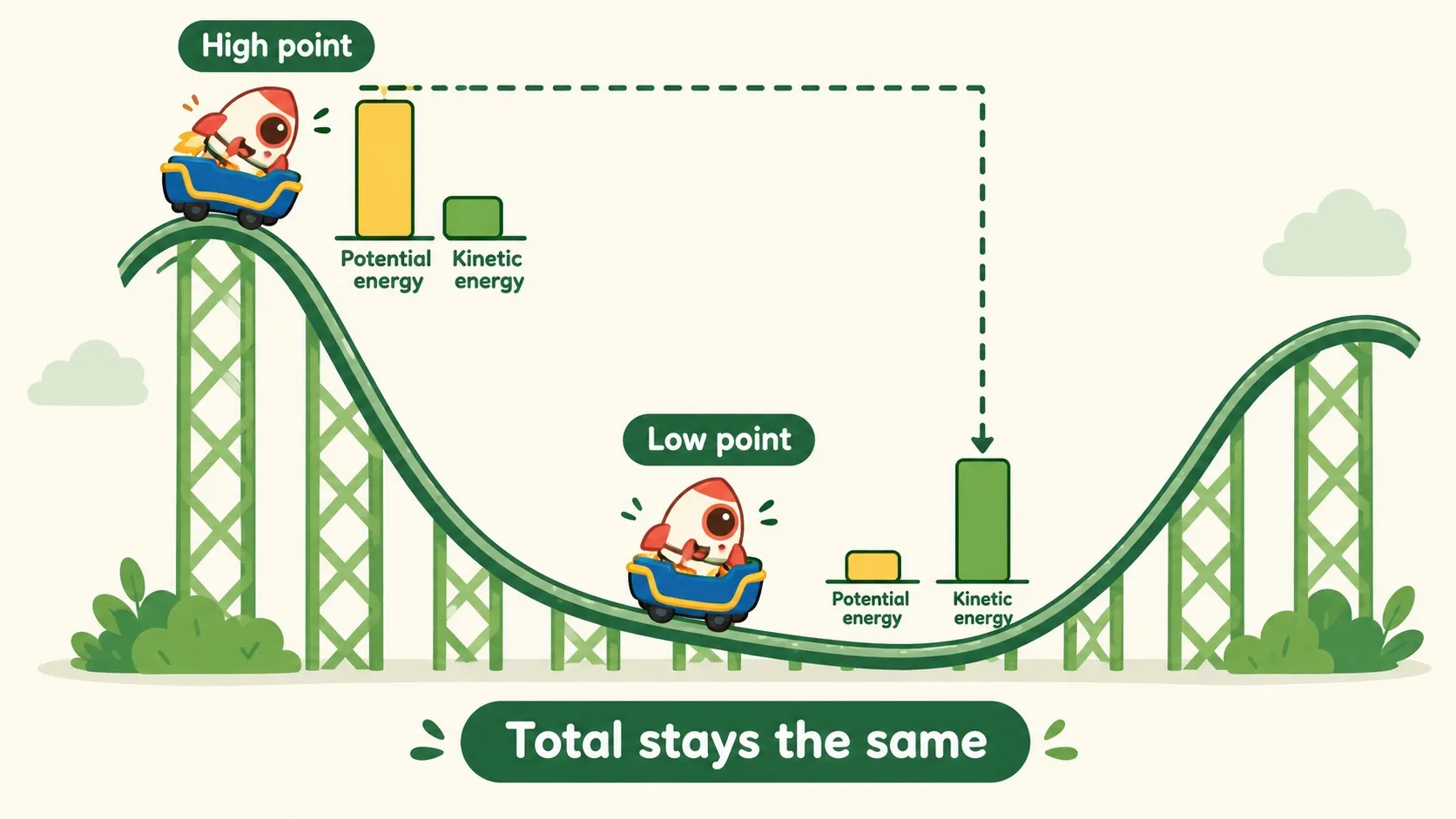
先看一辆从不上坡加油的过山车——它的能量到底从哪来?Start with a roller coaster that never refuels on the climb — where does its energy come from?
把小车拖到最高点:黄色势能条最长、绿色动能条最短;滑到最低点,两条正好反过来——可加起来的总长一动也没动。动能 + 势能 = 机械能;只有重力(或弹力)做功时,机械能守恒:快的时刻势能少,慢的时刻势能多,总量永远不变。Drag the cart to the top: the yellow potential-energy bar is longest and the green kinetic bar is shortest; at the bottom they swap — yet the two bars always add up to the same length. Kinetic + potential = mechanical energy. When only gravity (or a spring) does work, mechanical energy is conserved: fast moments carry little potential energy, slow moments carry plenty, and the total never changes.
可能量真的没有偷偷溜走一点吗?让摆锤自己回答。But does no energy secretly leak away? Let the pendulum answer.
第 2 步:摆锤总回到同样高Step 2: The pendulum returns to the same height
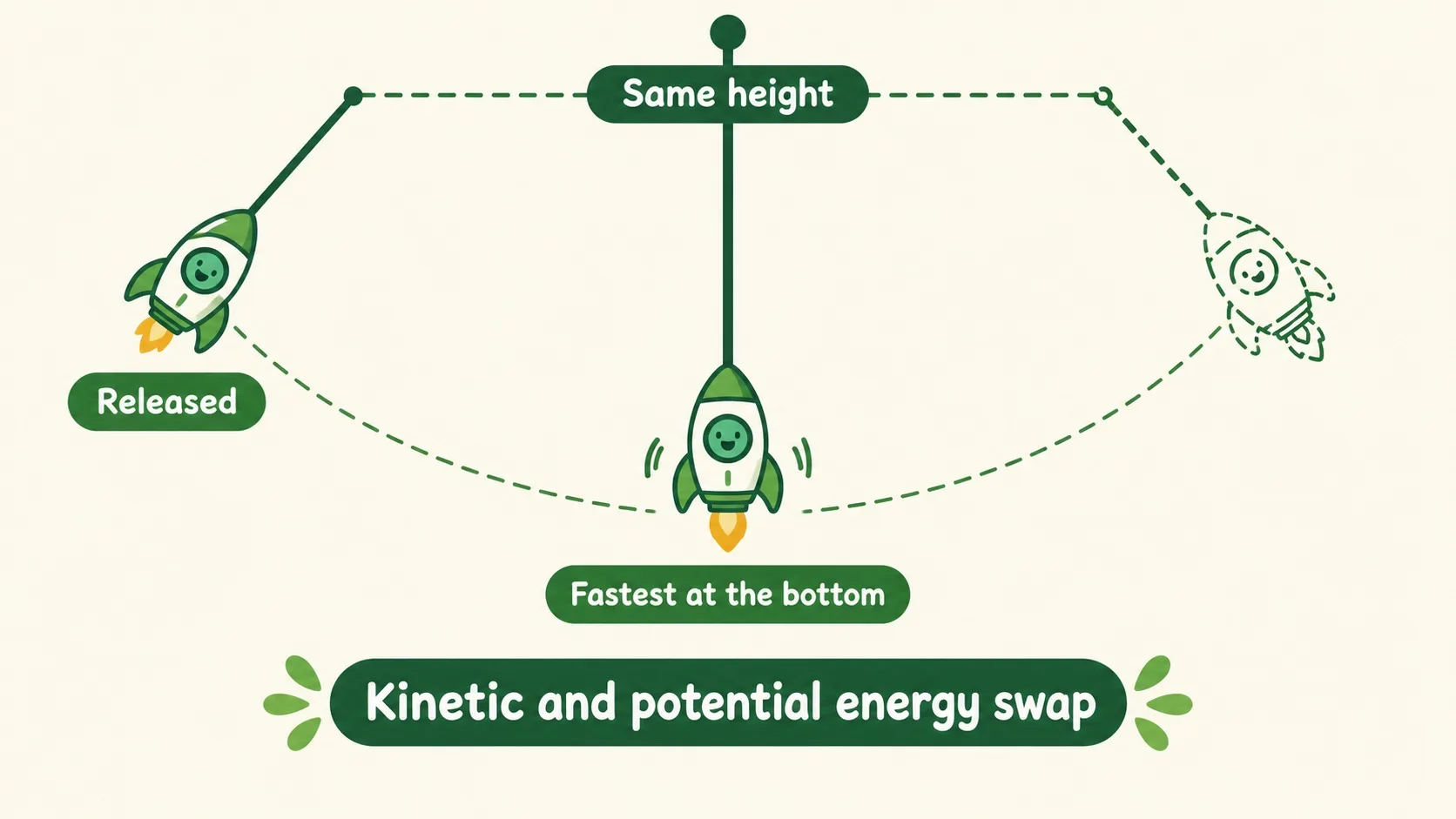
摆锤从左边放开,荡过最低点时最快,升到右边——又回到和左边一样的高度;下一次、再下一次,高度都不变。最低点是速度的巅峰、势能的谷底,这次“变身”一秒也不停。所谓守恒,不是“不发力”,而是动能和势能此消彼长,谁也不多谁也不少。Release the pendulum on the left; it swings fastest through the bottom, rises on the right — and climbs back to exactly the same height as the left. Next swing, and the next: the height never changes. The lowest point is speed's peak and potential energy's valley, and this transformation never pauses. “Conserved” doesn't mean “no action” — it means kinetic and potential energy trade places in perfect balance.
把这个规律搬到大自然里,会看到什么?Move this rule out into nature — what do we see?
第 3 步:瀑布:大自然的能量搬运工Step 3: Waterfalls: nature's energy movers
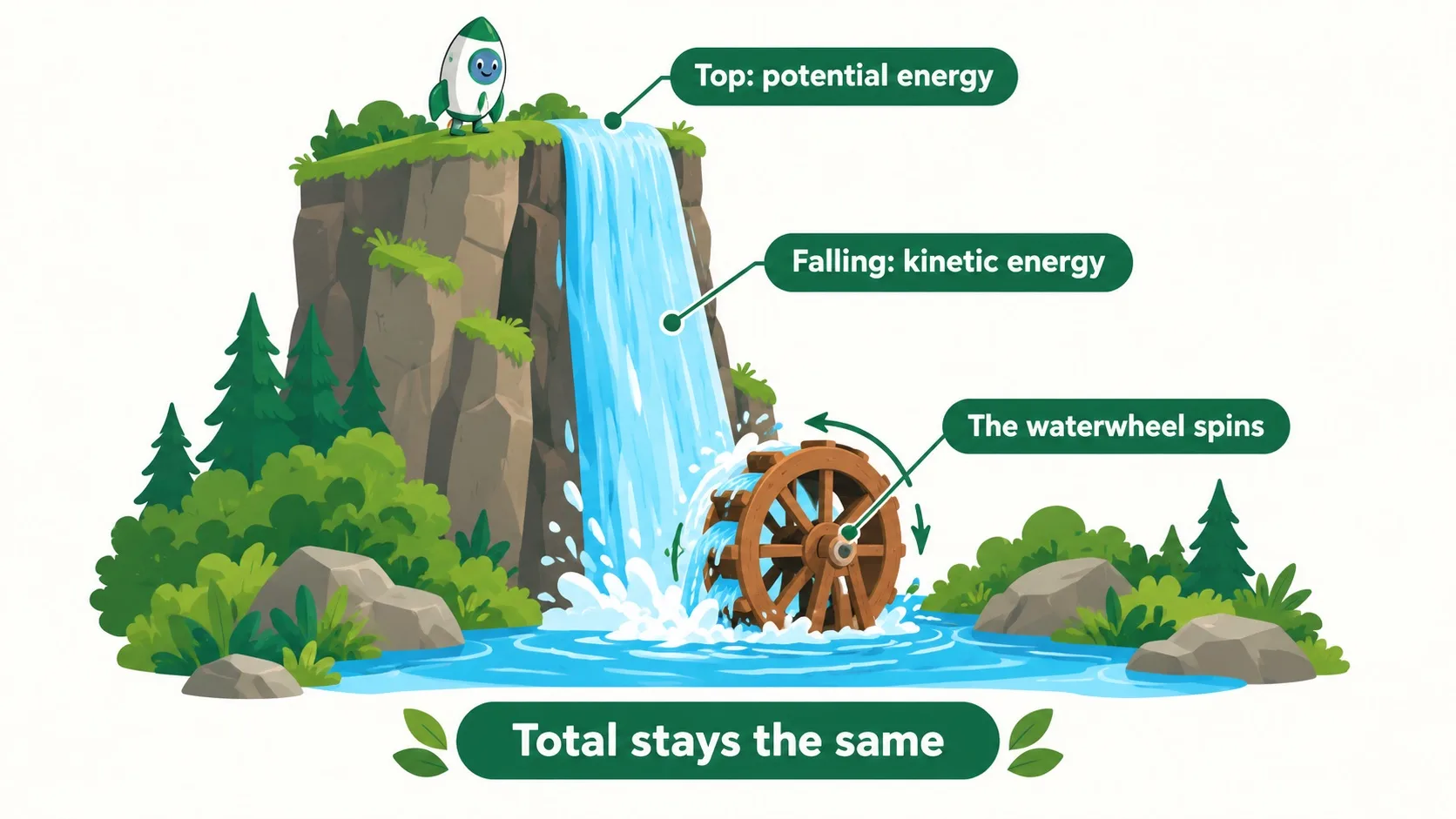
山顶的水存着大量重力势能,一路落下,势能不断变成动能,冲到底部推动水轮、点亮灯泡。水电站不“生产”能量,它只是把水存的势能变成我们用的电能。反过来,把水抽回高处,则是电能存回势能——能量在链条上来回跑,可以从一种变成另一种,但总量始终不变。Water at the top of a cliff holds a huge reserve of gravitational potential energy. As it falls, that energy keeps turning into kinetic energy, which spins the waterwheel and lights the lamps. A hydro station doesn't “produce” energy — it converts the water's stored potential energy into electricity we can use. Pump the water back up and electricity is stored as potential energy again: energy runs along the chain, changing form, but the total stays fixed.
🎮 你来当工程师(30 秒)🎮 Your turn: engineer duty (30 seconds)
道理讲完了。把小火箭的车拖到高处、松手,看两根能量条此消彼长;再完成 4 道速度预测。Theory done. Drag the rocket's cart up high and let go — watch the two energy bars trade places; then take on 4 speed predictions.
一句话记住它:只有重力(或弹力)做功时,动能 + 势能 = 机械能,总量不变;高度差决定最低点速度 v = √(2gh)。Remember it in one line: when only gravity (or a spring) does work, kinetic + potential = mechanical energy — a fixed total; the height drop alone fixes the bottom speed, v = √(2gh).
动能 + 势能 = 机械能;只有重力/弹力做功时,它守恒Kinetic + potential = mechanical energy; conserved when only gravity or a spring does work高处势能多、低处动能多;一个变多,另一个一定变少High up: more potential. Down low: more kinetic. One grows, the other must shrink最低点速度只看高度差:v = √(2gh),质量和轨道形状都不出现Bottom speed depends on height drop alone: v = √(2gh) — mass and track shape never show up
内容参考 OpenStax 等公开教材,多来源核对 · AI 生成、人工审核 · 发现错误欢迎指正,帮这片叶子长得更好。Based on OpenStax and other open textbooks, cross-checked across sources · AI-generated, human-reviewed · Spotted a mistake? Tell us — help this leaf grow.
 Back to tree