🗺️ 坐标系:给每个位置一个门牌号🗺️ Coordinate Systems: An Address for Every Spot
上一片量距离时,横差 3、竖差 4 是直接从点的坐标里减出来的。可这些坐标是谁发的位置?这一片就给方格城市装上完整的门牌号系统。Last leaf we subtracted 3 and 4 straight from the points' coordinates. But who assigns those coordinates in the first place? This leaf installs the full address system for Grid City.
第 1 步:先横后竖,门牌号 (x, y)Step 1: Across first, then up — the address (x, y)
城市这么大,一个位置怎么用两个数字说清楚?The city is big — how can two numbers pin down one spot?
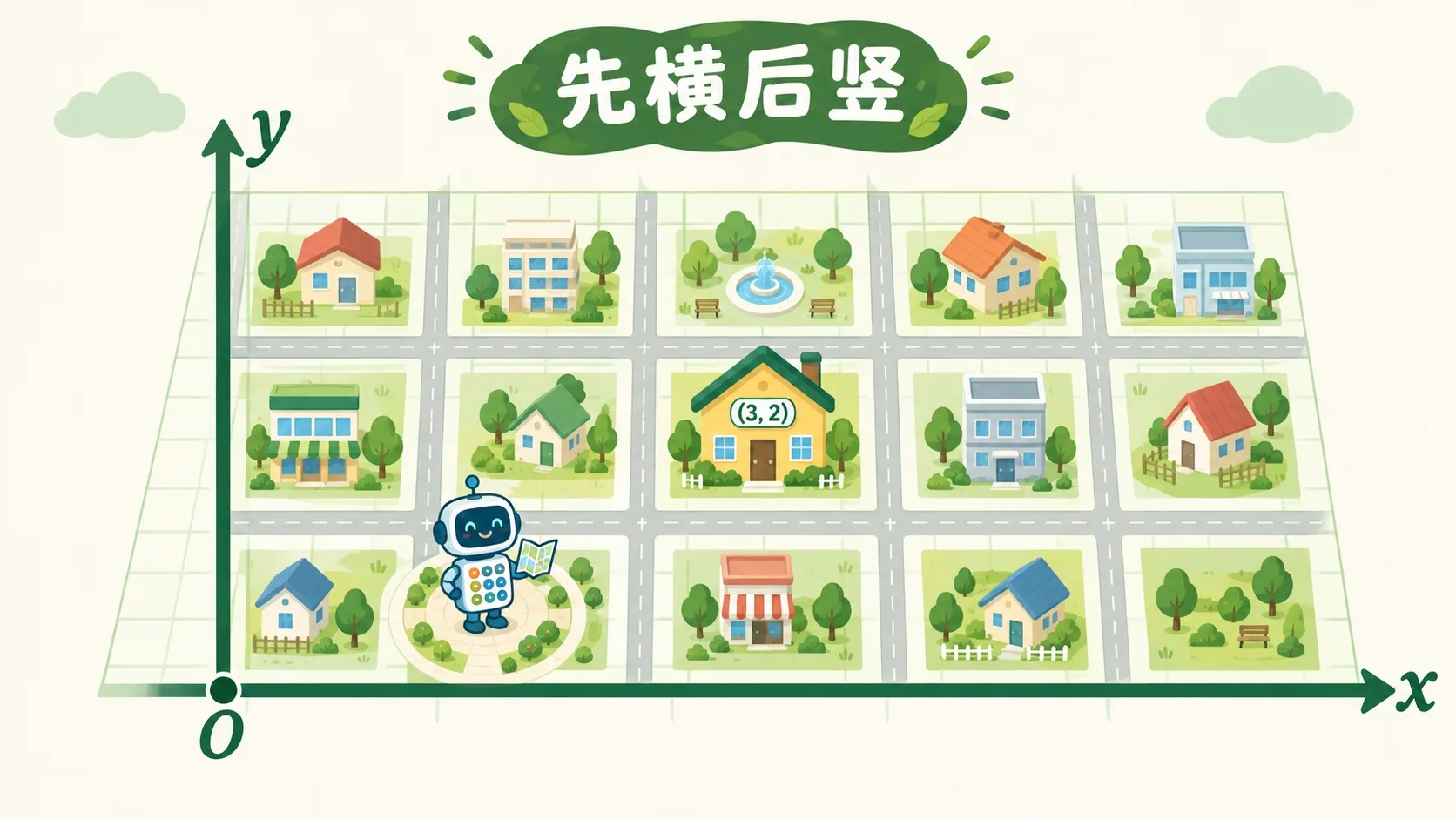
规则很简单:先数横着第几格,再数竖着第几格,两个数字一拼就是门牌号 (x, y)——永远先横后竖。横、竖两条主线分别叫 x 轴和 y 轴,交点叫原点 O。图里那栋小房子就是 (3, 2):横着 3 格,再竖着 2 格。反过来,报出 (x, y),机器人就一定能找到它。The rule is simple: first count squares across, then squares up; the two numbers form the address (x, y) — always across first, then up. The two main streets are the x-axis and the y-axis, and their crossing is the origin O. The little house in the picture is (3, 2): 3 across, then 2 up. And given (x, y), the robot can always find it again.
坐标里可以出现负数——负号的位置长什么样?Coordinates can go negative — what do minus positions look like?
第 2 步:四个象限,四个街区Step 2: Four quadrants, four neighbourhoods
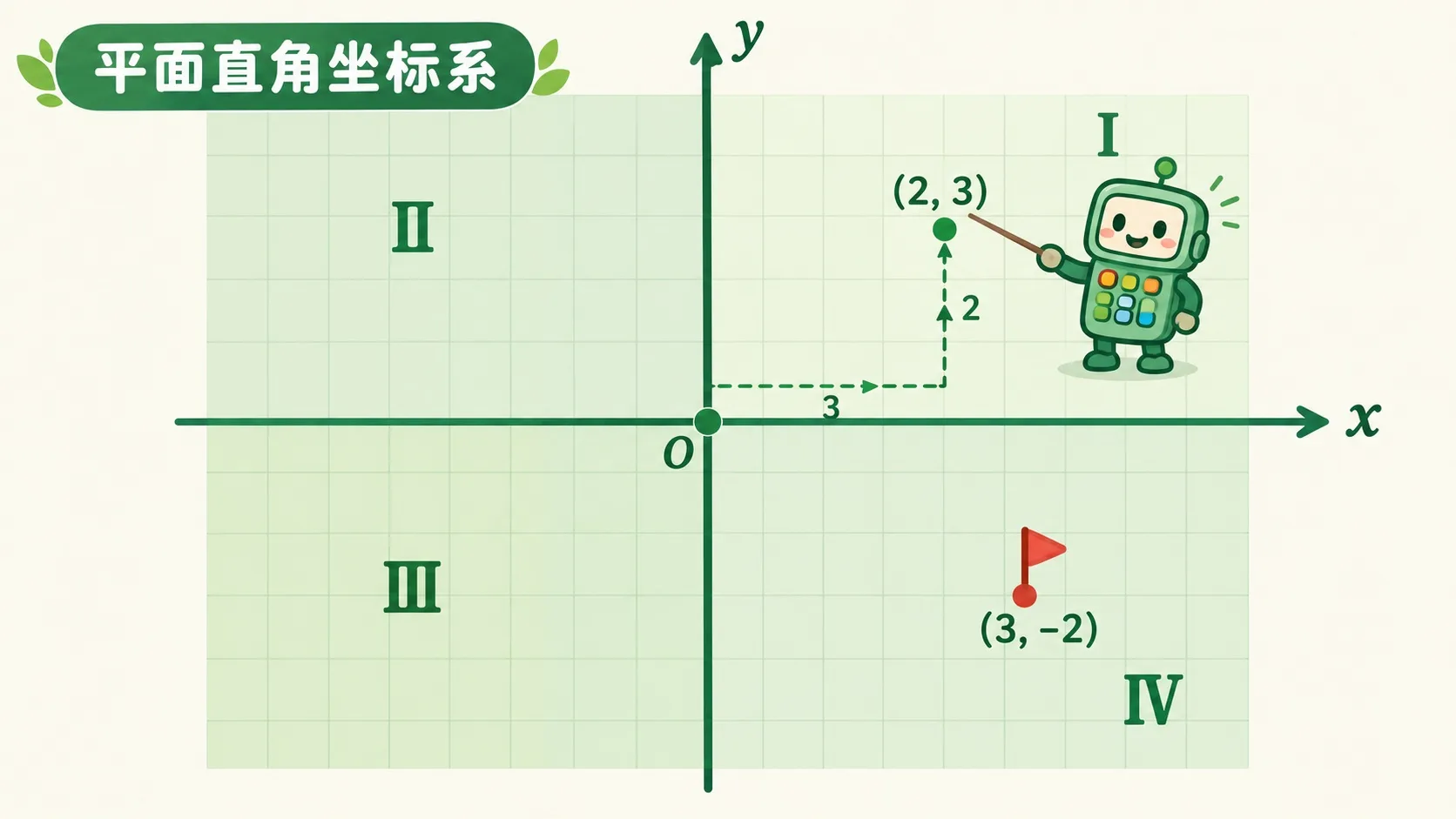
两条轴把平面分成四块,叫四个象限:右上 I、左上 II、左下 III、右下 IV。符号一眼记住:I 是 (+, +),II 是 (−, +),III 是 (−, −),IV 是 (+, −)。比如 (2, 3) 横竖都为正,在第一象限;而 (3, −2) 的纵坐标是负数,要向下走,落在第四象限。先横后竖,负号就代表反方向。The two axes slice the plane into four blocks called quadrants: I top-right, II top-left, III bottom-left, IV bottom-right. Their signs are easy: I is (+, +), II is (−, +), III is (−, −), IV is (+, −). For example (2, 3) is positive both ways, so it sits in Quadrant I; (3, −2) has a negative y, so the robot walks down into Quadrant IV. Across first, then up — and a minus sign means the opposite direction.
除了方格城市,哪儿还藏着坐标系?Besides Grid City, where else do coordinate systems hide?
第 3 步:生活中的坐标系Step 3: Coordinate systems in real life
棋盘就是一个坐标系:字母定横、数字定竖,「E4」就是一个门牌号。地球也是:经线定横、纬线定竖,经纬度把全球任何一个点定住——报出两个数字,搜救队就能找到你。还有电影院座位(第 7 排 5 座)、游戏地图、手机导航……有坐标系,才有「准确的位置」。A chessboard is a coordinate system: letters across, numbers up — "E4" is an address. So is the Earth: longitude lines across, latitude lines up, and the pair pins down any point on the planet — read out two numbers and a rescue team can find you. Cinema seats (row 7, seat 5), game maps, phone navigation… accurate positions all begin with coordinates.
🎮 你来送机器人(1 分钟)🎮 Your turn: deliver the robot (1 minute)
道理讲完了。拖动小算盘机器人,把它送到 4 个目标门牌号——四个象限都走一遍,全对就撒花。Theory done. Drag the little abacus robot to the 4 target addresses — visit all four quadrants, and clear them all to set off the confetti.
一句话记住它:坐标系 = 用「先横后竖」的两个数字,给平面上的每个点发一个门牌号 (x, y)。Remember it in one line: a coordinate system hands every point on the plane an address (x, y) — across first, then up.
先横后竖:(x, y),两条轴 x、y 与原点 OAcross first: (x, y), with an x-axis, a y-axis and origin O四个象限:I (+, +)、II (−, +)、III (−, −)、IV (+, −)Four quadrants: I (+, +), II (−, +), III (−, −), IV (+, −)生活中:棋盘「E4」、经纬度、座位号、导航定位In real life: chess "E4", latitude & longitude, seat numbers, GPS
内容参考 OpenStax 等公开教材,多来源核对 · AI 生成、人工审核 · 发现错误欢迎指正,帮这片叶子长得更好。Based on OpenStax and other open textbooks, cross-checked across sources · AI-generated, human-reviewed · Spotted a mistake? Tell us — help this leaf grow.
 Back to tree