🟦 定积分:曲线下的面积🟦 Definite Integrals: the area under the curve
上一片,机器人学会了“反着求导”,可答案后面总挂着一条 +C。这一片给积分钉上起点和终点:从 a 到 b,算出一个具体的数——比如水塔里到底流出了多少水。Last leaf, the robot learned to run derivatives backwards — but the answer always carried a “+C”. This leaf pins two endpoints on it, from a to b, so the integral returns one specific number — say, exactly how much water left the tank.
第 1 步:把曲线铺满小矩形Step 1: Tile the curve with little rectangles
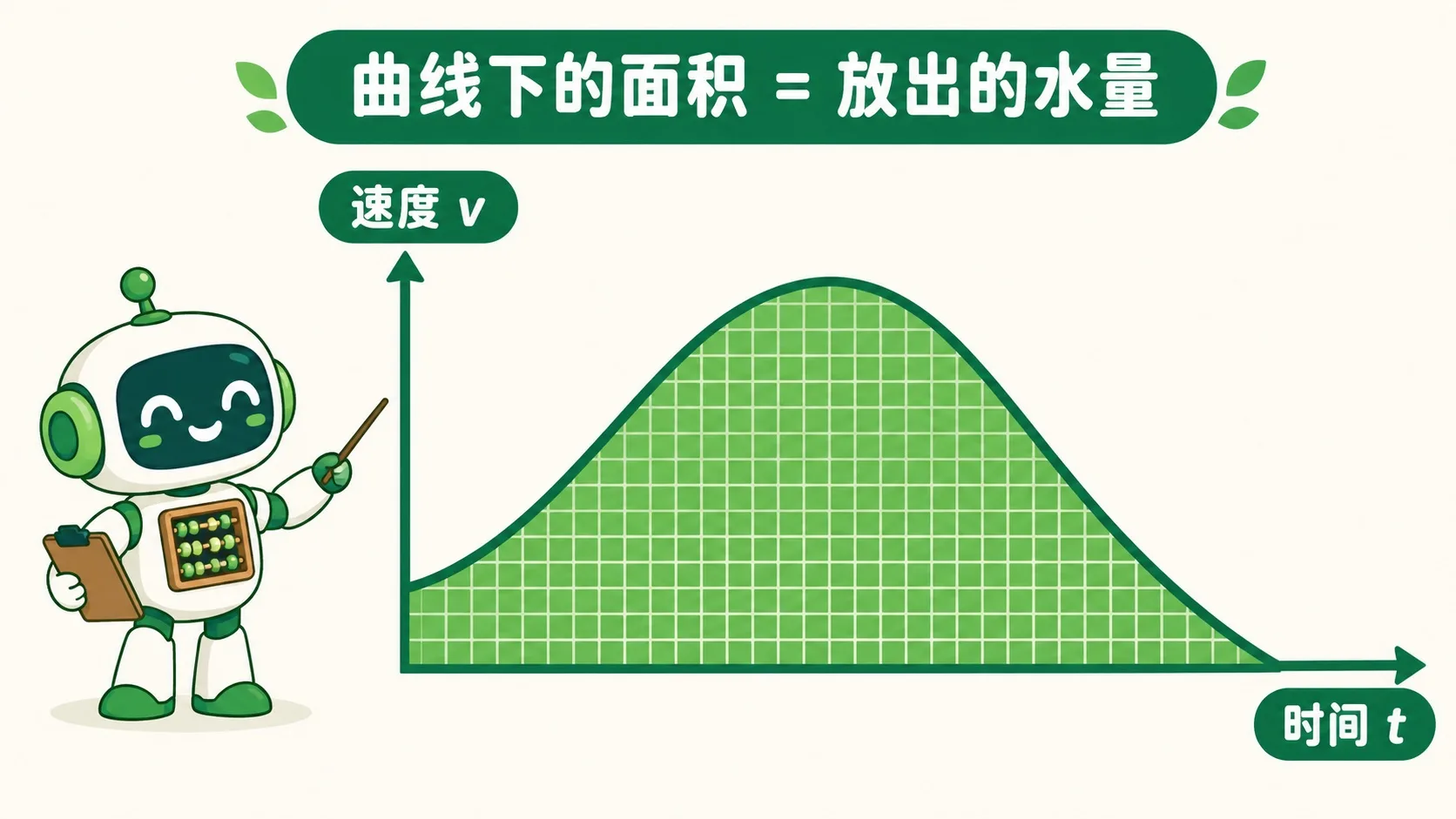
机器人要算水塔放出的总水量,可放水速度一直在变——“忽快忽慢”怎么加?The robot wants the total water released, but the release speed keeps changing — how do you add up “fast, then slow”?
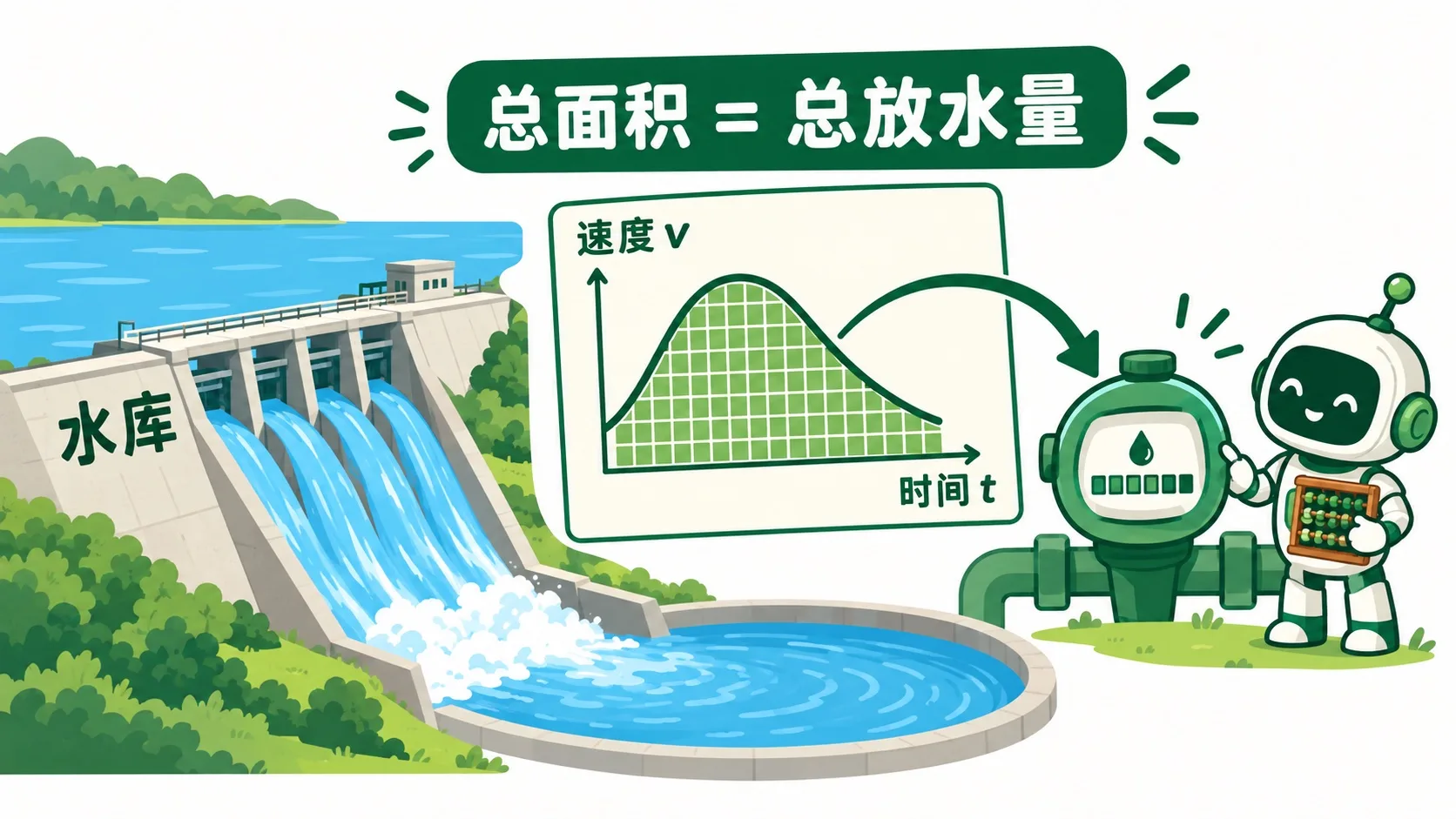
把放水速度 v 画成曲线:闸门开大时曲线高,关小时曲线低。但每一小段时间里,速度几乎不变——这一小段放出的水 ≈ 速度 × 时间,正好是一个细矩形的面积。把所有小矩形挨个加起来,就约等于曲线下的总面积 = 总放水量。Draw the release speed v as a curve: high when the gate is wide open, low when it is nearly shut. Yet within any tiny slice of time the speed is almost constant — so the water released in that slice ≈ speed × time, exactly the area of one thin rectangle. Add all the little rectangles and you get the total area under the curve = the total water released.
可矩形是“直”的,曲线是“弯”的——差出来的部分怎么办?But rectangles are straight and the curve bends — what about the mismatch?
第 2 步:切得越细,贴得越紧Step 2: Finer slices hug the curve
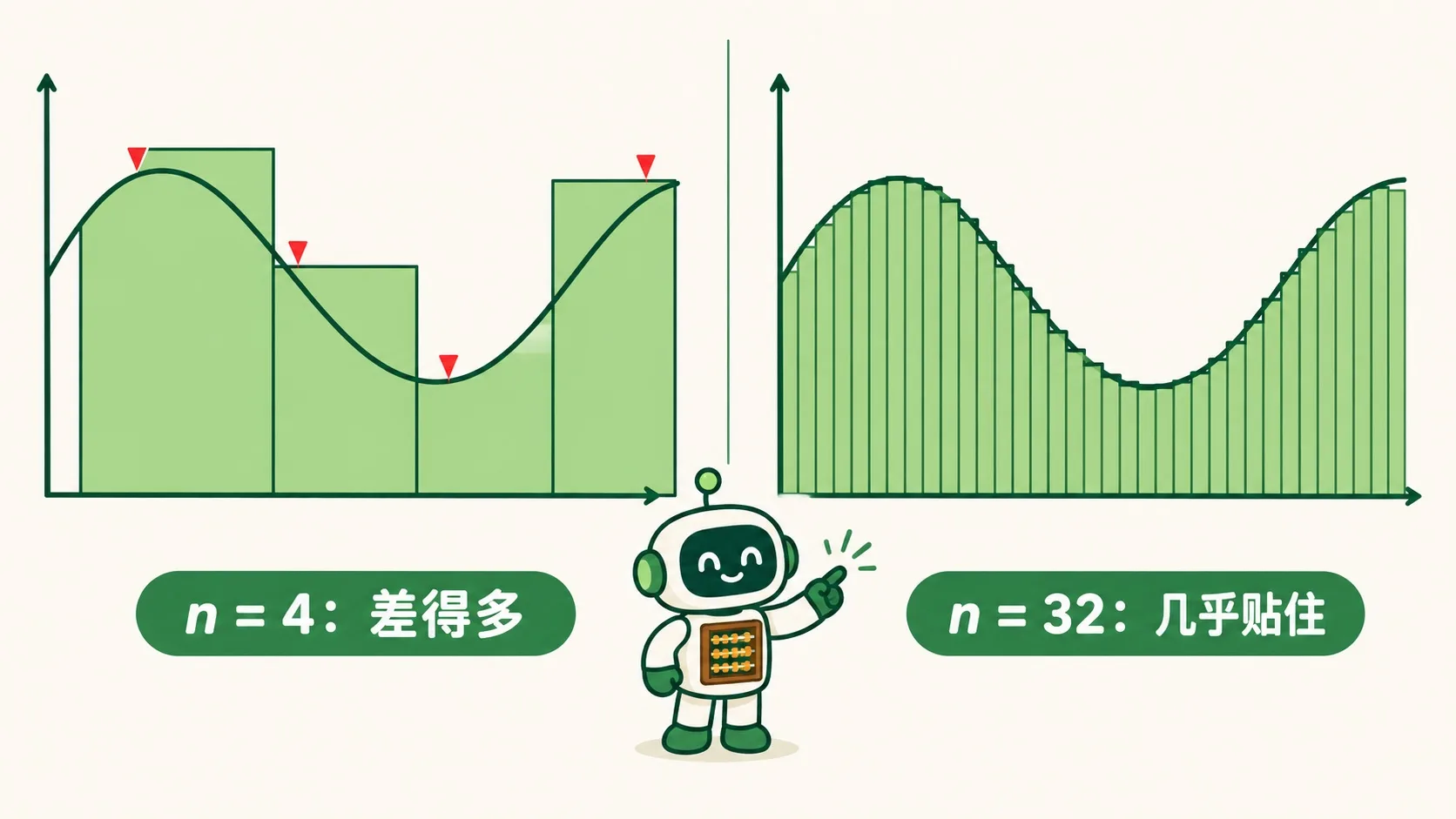
一场“铺砖”比赛:左边只切 4 条,矩形顶得七上八下,和曲线差得远;右边切 32 条,细细的条几乎把曲线描了出来。切得越细,每小段里的速度就越接近不变,误差越来越小——无限切下去,“矩形之和”就变成了“曲线下的面积”。这就是定积分(definite integral)的想法:∫ₐᵇ v(t) dt = 曲线下的面积。A tiling contest: cut only 4 slices and the stepped tops wobble far above and below the curve; cut 32 and the thin bars trace it almost perfectly. The finer the slices, the closer each speed is to constant, and the smaller the gap — sliced forever, “the sum of rectangles” becomes “the area under the curve”. That is the idea of the definite integral: ∫ₐᵇ v(t) dt = the area under the curve.
这个“面积”除了水,还能算什么?Besides water, what else is this “area” good for?
第 3 步:面积就是累积量Step 3: The area is an accumulated total
凡是“速度 × 时间”的累积量,都能这样算:汽车的路程 = 速度曲线下的面积;存钱罐里的钱 = 每天存入速度的面积;充电宝的电量 = 充电功率的面积。记号里:∫ 是拉长的 S(Sum 的首字母),意思是“把无数小条加起来”;a 和 b 是起点和终点;答案是一个具体的数,不带 +C。Anything that accumulates as “rate × time” works the same way: a car's distance = the area under its speed curve; coins in a piggy bank = the area under the daily saving rate; a power bank's charge = the area under its charging power. In the notation: ∫ is a stretched S (the first letter of Sum) meaning “add up infinitely many thin strips”; a and b are the start and end; and the answer is one specific number, with no +C.
🎮 你来切面积(30 秒)🎮 Your turn: slice the area (30 seconds)
拖动滑块,把曲线切成 n 条矩形,看“矩形之和”怎样一步步贴上“真实面积”——4 关的曲线一关比一关弯!Drag the slider to cut the curve into n rectangles and watch “the sum of rectangles” creep up on “the true area” — each of the 4 levels bends a little more!
一句话记住它:把变化切成很细的小段,每段当成不变,加起来就是累积量——这块“曲线下的面积”,就是定积分;它比不定积分多了一对端点 a、b,答案是一个具体的数。Remember it in one line: slice a changing quantity into tiny pieces, treat each as constant, and add them up — that “area under the curve” is the definite integral. It carries a pair of endpoints a and b, and its answer is one specific number.
曲线下的面积 = 累积量:路程、水量、电量都是它Area under the curve = an accumulated total: distance, water, charge切成 n 条小矩形再相加,n 越大误差越小(Riemann 和)Cut into n thin rectangles and add: the larger n, the smaller the gap (a Riemann sum)∫ₐᵇ 表示从 a 积到 b;∫ 是拉长的 S(Sum),答案是具体的数、不带 +C∫ₐᵇ means integrating from a to b; ∫ is a stretched Sum-S, and the answer is a definite number with no +C
内容参考 OpenStax 等公开教材,多来源核对 · AI 生成、人工审核 · 发现错误欢迎指正,帮这片叶子长得更好。Based on OpenStax and other open textbooks, cross-checked across sources · AI-generated, human-reviewed · Spotted a mistake? Tell us — help this leaf grow.
 Back to tree