➡️ 直接证明:从条件一路推到结论➡️ Direct Proof: Straight from the Conditions to the Conclusion
上一片里,推理链一旦偷偷断掉,就成了逻辑谬误。那么一条不断链的推理是什么样?从这片开始,小算盘机器人教你三种正式的证明方法。第一种最直白:直接证明。Last leaf, a reasoning chain that secretly breaks becomes a logical fallacy. So what does an unbroken chain look like? From this leaf on, the little abacus robot teaches three official proof techniques. The first is the most straightforward: direct proof.
第 1 步:一条直线,从条件推到底Step 1: one straight line from conditions to conclusion
先看证明最常见的形状——一条笔直的推导链。First, look at the most common shape of a proof — one straight chain of reasoning.
直接证明就是把「因为…所以…」排成一条直线:从已知条件出发,每一步都用一个定义、一条公式或一个已证的结论当理由,稳稳推到目标结论。链条的起点是前提,终点是结论,中间不许断、不许跳。图里 5 块骨牌连起来就是一句话:两个奇数相加,结果一定能写成 2 的倍数。A direct proof lines up the “because… therefore…” into one straight chain: start from the given conditions, and let every step use a definition, a formula, or an already proven fact as its reason, until you arrive at the target conclusion. The chain begins with the premises and ends with the conclusion — no gaps, no jumps. The 5 dominoes in the picture spell out one sentence: add two odd numbers, and the result can always be written as a multiple of 2.
换一种画面:证明像上楼梯,台阶就是理由。Here is another picture: a proof is like climbing stairs, and each step is a reason.
第 2 步:每一步都要踩在理由上Step 2: every step must stand on a reason
为什么叫「直接」?因为结论一直就在你眼前,你只是从前提开始,一级一级地走近它。每级台阶都必须有理由:这一步用的是定义?公式?还是题目给的已知?如果哪一级找不到理由,脚就踩空了——证明也就断在那里。写证明的时候,把理由写在每一步旁边,是最稳的习惯。Why “direct”? Because the conclusion stays in sight the whole time; you simply start from the premises and walk toward it rung by rung. Every step must stand on a reason: did this step use a definition? A formula? A given fact? If a step has no reason, your foot lands on air — and the proof breaks right there. When you write a proof, naming the reason next to each step is the safest habit.
现在把这条直线真正走一遍:奇数 + 奇数 = 偶数。Now let us actually walk that straight line: odd + odd = even.
第 3 步:亲手推一遍:奇数 + 奇数 = 偶数Step 3: walk it yourself: odd + odd = even
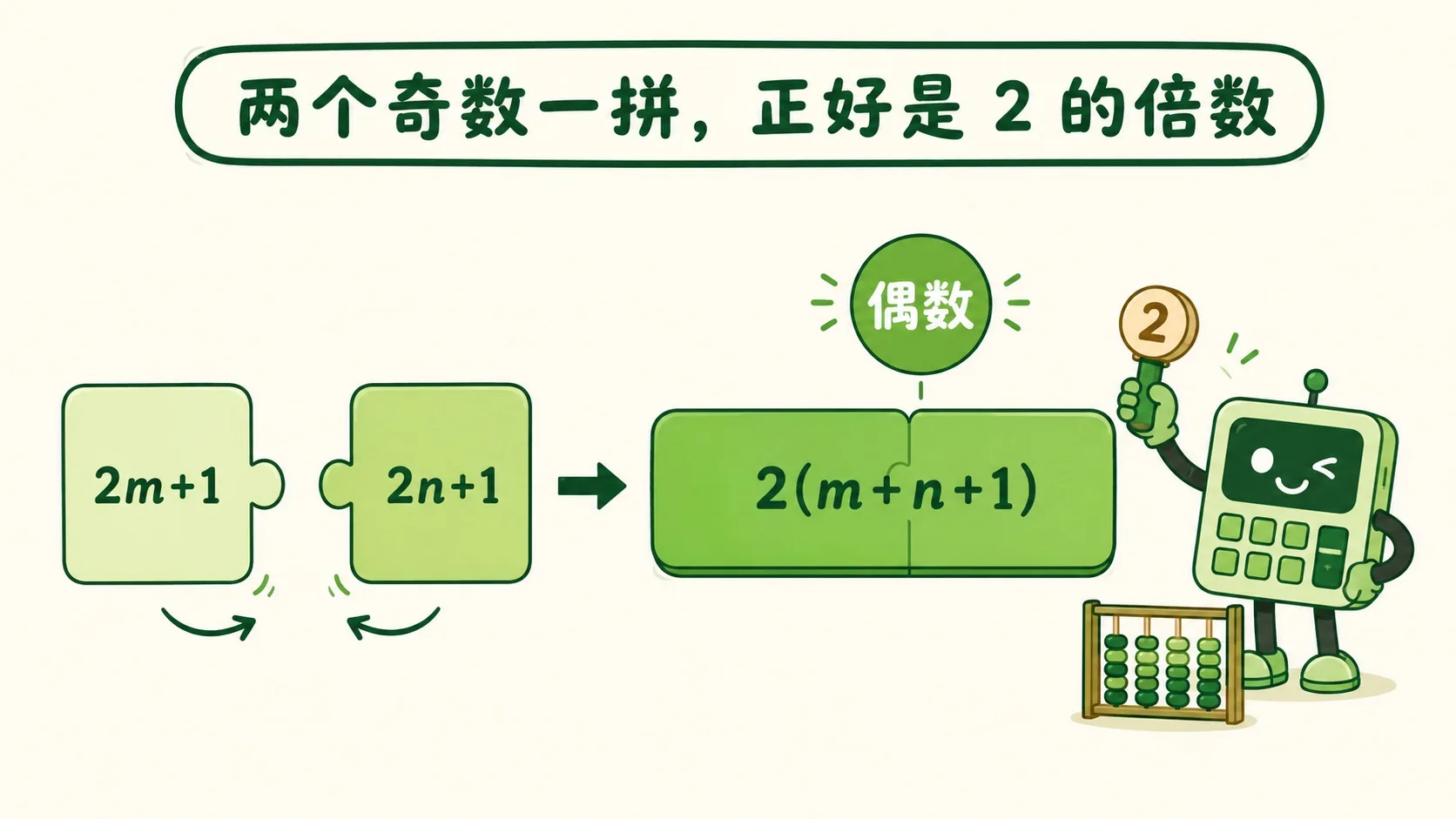
要证明:任意两个奇数之和是偶数。① 前提:设两个奇数为 2m+1 和 2n+1(m、n 是整数)——「奇数 = 2 的倍数加 1」正是它的定义。② 相加:(2m+1) + (2n+1) = 2m + 2n + 2。③ 提公因数:2m + 2n + 2 = 2(m + n + 1)。④ 结论:m + n + 1 是整数,所以和是 2 的倍数,也就是偶数。∎ 全程只用了加法交换律、合并同类项和乘法分配律——都是已经知道的规则。这就是直接证明:不需要任何花招。Claim: the sum of any two odd numbers is even. (1) Premises: let the two odds be 2m+1 and 2n+1 (m, n integers) — “odd = one more than a multiple of 2” is exactly the definition. (2) Add: (2m+1) + (2n+1) = 2m + 2n + 2. (3) Factor out 2: 2m + 2n + 2 = 2(m + n + 1). (4) Conclusion: m + n + 1 is an integer, so the sum is a multiple of 2 — that is, even. ∎ Every move used only the commutative law of addition, collecting like terms, and the distributive law — all already known. That is direct proof: no tricks needed.
🎮 你来当拼装师(1 分钟)🎮 Your turn: the proof puzzle (1 minute)
道理讲完了。下面有 4 条被打乱的证明链——把正确的步骤按顺序点进链条(小心混进来的干扰步骤),拼完 4 条通关。Theory done. Below are 4 shuffled proof chains — click the right steps into the chain in order (watch out for decoys), and complete all 4 to win.
一句话记住它:直接证明 = 从前提出发,每一步都有理由,一路排到结论。Remember it in one line: direct proof = start from the premises, give every step a reason, and walk straight to the conclusion.
先写前提:把「已知什么」摆清楚Write the premises first: state exactly what is given每一步给理由:定义、公式或已证结论Give every step a reason: a definition, a formula, or a proven fact结论自然到达:最后一步正好就是目标Let the conclusion arrive: the last step is exactly the goal
内容参考 OpenStax 等公开教材,多来源核对 · AI 生成、人工审核 · 发现错误欢迎指正,帮这片叶子长得更好。Based on OpenStax and other open textbooks, cross-checked across sources · AI-generated, human-reviewed · Spotted a mistake? Tell us — help this leaf grow.
 Back to tree