上一片里,每个原子核都在某个随机的时刻衰变——那科学家凭什么敢说“这批原子核 5730 年后剩一半”?答案就藏在这一片:半衰期。Last leaf, every nucleus decayed at some random moment — so how can scientists still say “half of these nuclei will be left in 5730 years”? The answer hides in this leaf: the half-life.
第 1 步:骰子实验:随机里藏着规律Step 1: The dice experiment: order inside randomness
先做个游戏:把每个原子核都想成一颗骰子,掷出 6 就“衰变”。Let's play: imagine every nucleus is a die — roll a 6 and it “decays”.
哪颗骰子会掷出 6?完全说不准——单个原子核什么时候衰变,同样无法预测。但骰子一多,规律就浮出来了:每轮大约 1/6 的骰子出 6,连掷 4 轮约剩一半((5/6)⁴ ≈ 0.48)。科学家正是抓住了这“大量个体的统计规律”,才敢给原子核的寿命打包票。Which die will show a 6? Impossible to say — just as no one can predict when one particular nucleus decays. But with plenty of dice, order appears: each round about 1 in 6 dice roll a 6, so after 4 rounds roughly half remain ((5/6)⁴ ≈ 0.48). That statistical law of large numbers is why scientists can make promises about a crowd of nuclei.
骰子终归只是比方——真实世界里的节拍长什么样?Dice are just an analogy — what does the real-world beat look like?
第 2 步:一座只会对半切的钟Step 2: A clock that only halves
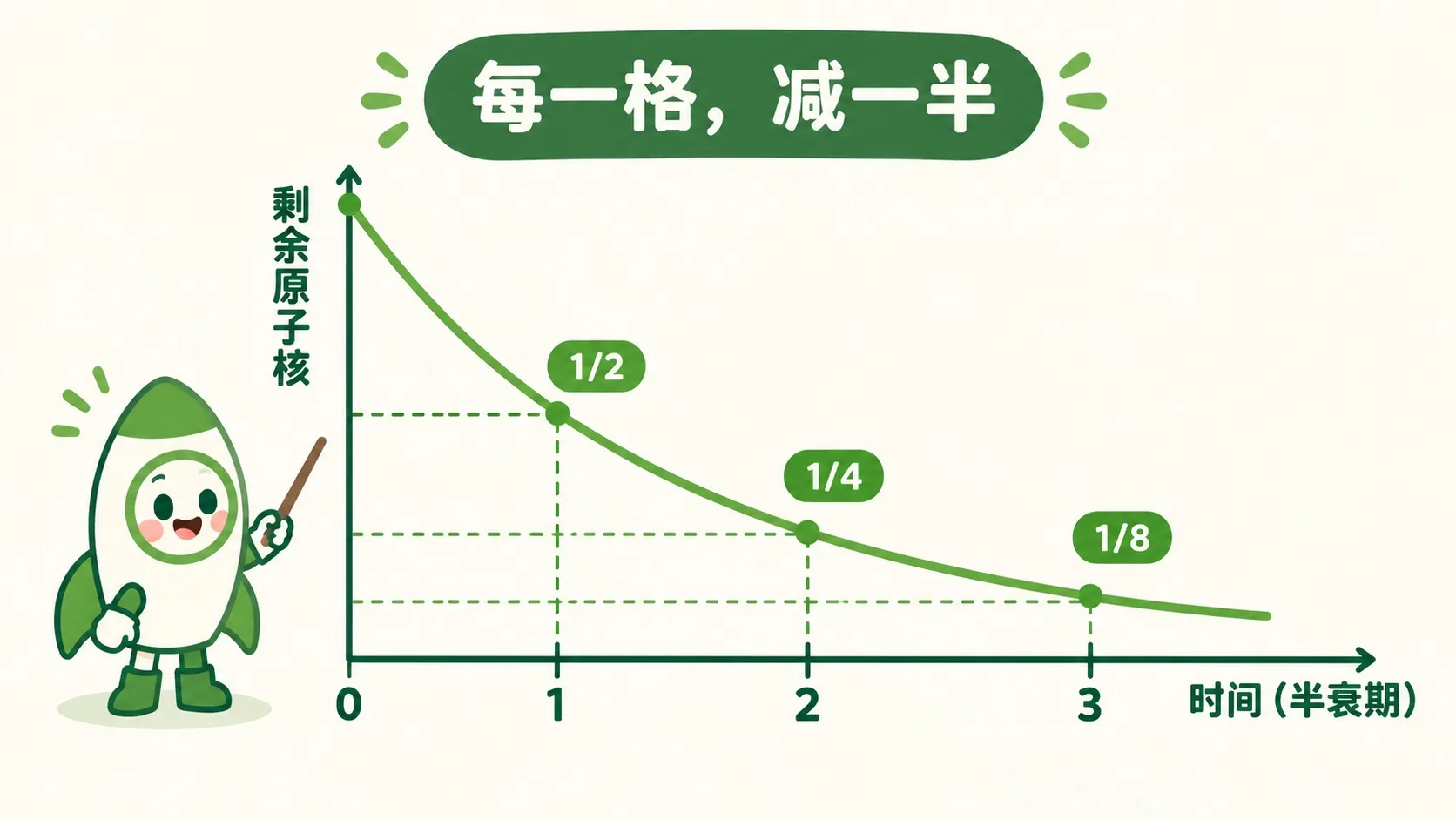
半衰期 = 一半原子核衰变所需的时间。每过一个半衰期,剩下的就减半:1 → 1/2 → 1/4 → 1/8……写成一个式子就是 N = N₀ × (1/2)ⁿ。更妙的是,这个节拍只由原子核自己决定:加热、加压、换成什么化合物,都改不了它——因为衰变发生在核内部,外面的折腾根本够不着。这正是它当“时钟”的底气。A half-life is the time for half of the nuclei to decay. Every half-life, what remains halves: 1 → 1/2 → 1/4 → 1/8…, written as N = N₀ × (1/2)ⁿ. Best of all, the beat belongs to the nucleus alone: heating, squeezing or changing its chemical bonds cannot shift it — decay happens deep inside the nucleus, out of reach. That is exactly why it works as a clock.
这口“只会减半的钟”,怎么变成测量年代的工具?So how does this halving clock become a dating tool?
第 3 步:碳-14 时间尺:5730 年一格Step 3: The carbon-14 ruler: one step = 5730 years
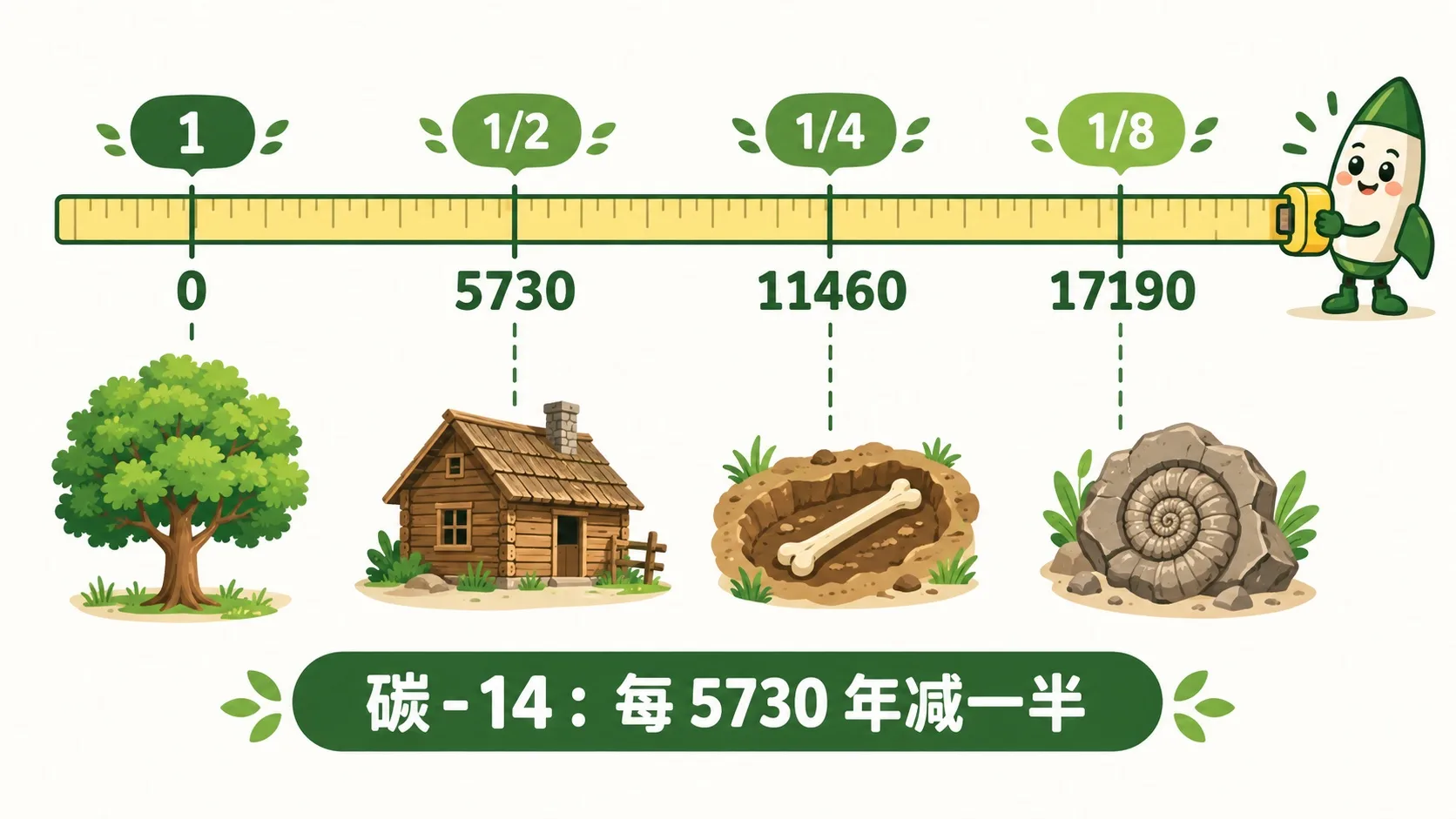
碳-14 的半衰期约 5730 年:文物里剩 1/2,它就约 5730 岁;剩 1/4,约 11460 岁;剩 1/8,约 17190 岁——几格就是几个 5730 年。反过来算也一样:想知道一片骨头有多老,只要量出碳-14 剩几分之几。不过碳-14 会越剩越少,约 5 万年后就少到测不准了,所以它擅长的是几万年内的考古现场。Carbon-14's half-life is about 5730 years: a relic with 1/2 left is about 5730 years old; 1/4 left, about 11460; 1/8 left, about 17190 — each step is another 5730 years. The reverse works too: to date a bone, just measure the fraction of carbon-14 remaining. But the signal shrinks every step, and after roughly 50,000 years there is too little left to measure — so this clock excels on digs within a few tens of thousands of years.
🎮 你来当衰变观察员(1 分钟)🎮 Your turn: watch the decay (1 minute)
道理讲完了。先拖滑块看减半曲线、掷骰子感受随机,再完成 4 个任务。Theory done. Drag the slider to see the halving curve, roll the dice to feel the randomness — then finish 4 tasks.
一句话记住它:半衰期 = 原子核数量减半的固定时间,每过一格剩一半:N = N₀ × (1/2)ⁿ;它不受温度、压强、化学状态影响。Remember it in one line: a half-life is the fixed time for a crowd of nuclei to halve: N = N₀ × (1/2)ⁿ — and nothing outside the nucleus, no heat, pressure or chemistry, can change it.
单个原子核何时衰变无法预测,大量原子核却有固定节奏——半衰期One nucleus is unpredictable; a crowd keeps a fixed beat — the half-life每过一个半衰期剩一半:1/2、1/4、1/8……与温度、化学状态无关Each half-life leaves half: 1/2, 1/4, 1/8… independent of temperature and chemistry碳-14 半衰期约 5730 年:剩 1/4 就是过了 2 个半衰期,约 11460 年Carbon-14 halves every ~5730 years: 1/4 left means 2 half-lives, about 11460 years
内容参考 OpenStax 等公开教材,多来源核对 · AI 生成、人工审核 · 发现错误欢迎指正,帮这片叶子长得更好。Based on OpenStax and other open textbooks, cross-checked across sources · AI-generated, human-reviewed · Spotted a mistake? Tell us — help this leaf grow.
 Back to tree