🔍 透镜成像:凸透镜的魔术🔍 Lens Imaging: the magic of a convex lens
上一片看到,光斜着穿过水面会拐弯。现在把水面弯成球形,就得到一块透镜——光拐弯的本事,就这样变成了放大、缩小、照相的魔术。Last leaf, light bent as it crossed water at an angle. Now curve that surface into a sphere and you get a lens — and the trick of bending light becomes the magic of enlarging, shrinking and photographing.
第 1 步:三根线,画出像Step 1: Three rays draw the image
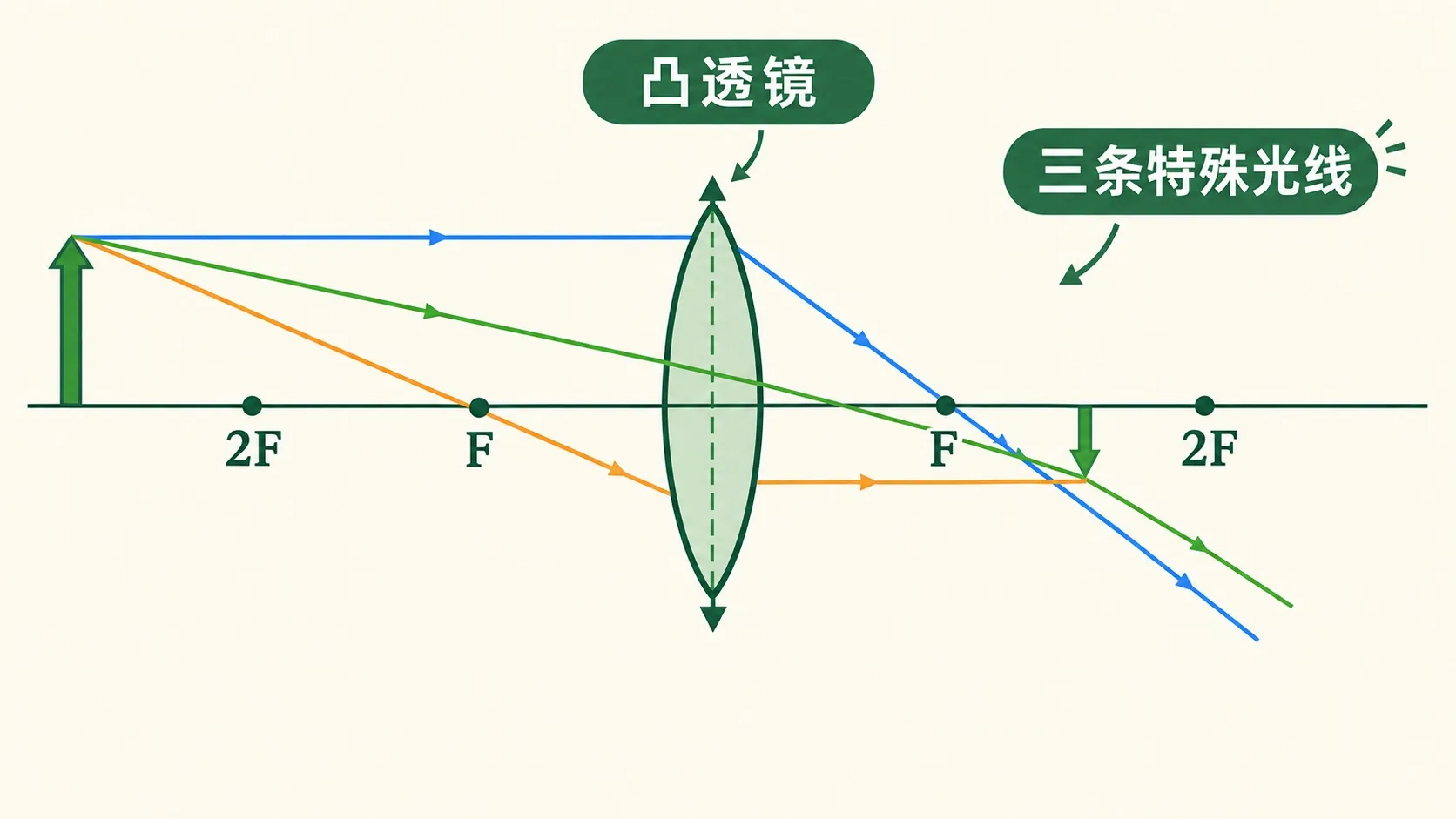
光穿过透镜会拐弯——怎么知道像在哪儿、有多大?Light bends through a lens — but how do we know where the image lands and how big it is?
只要抓住三条特殊光线:平行于主光轴的光线,出射后过焦点;过光心的光线,方向不变;过焦点的光线,出射后平行于主光轴。三条线的交点,就是像的位置——图中物体在 2 倍焦距以外,得到的是倒立、缩小的实像。Just catch three special rays: a ray parallel to the axis exits through the far focus; a ray through the lens centre goes straight on; a ray through the near focus exits parallel to the axis. Where the three meet is where the image forms — here the object sits beyond 2f, so the image is inverted, smaller and real.
同一个凸透镜,为什么有时照出小像,有时放出大像?Same lens — so why does it sometimes make a tiny image and sometimes a huge one?
第 2 步:物体站哪儿,像就长什么样Step 2: Where the object stands decides the image
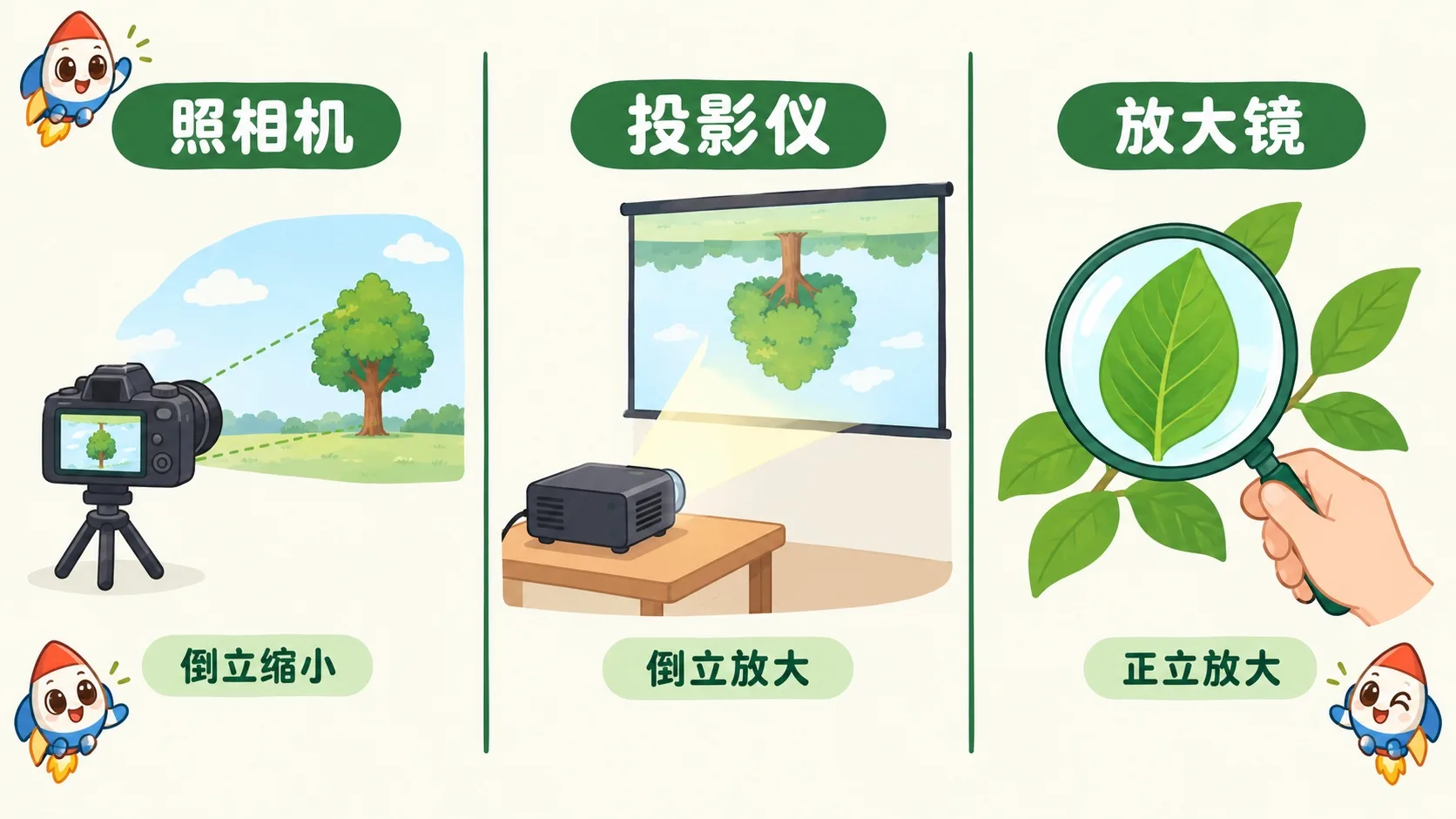
秘密藏在物距里。2 倍焦距以外:倒立、缩小的实像,照相机装下远方风景;1~2 倍焦距之间:倒立、放大的实像,投影仪把幻灯片投上幕布;焦距以内:正立、放大的虚像,放大镜让叶脉变粗。位置三段,成像三样。The secret is the object distance. Beyond 2f: inverted, smaller, real — a camera fits a whole landscape. Between f and 2f: inverted, larger, real — a projector throws a slide onto the screen. Inside f: upright, larger, virtual — a magnifier fattens leaf veins. Three ranges, three images.
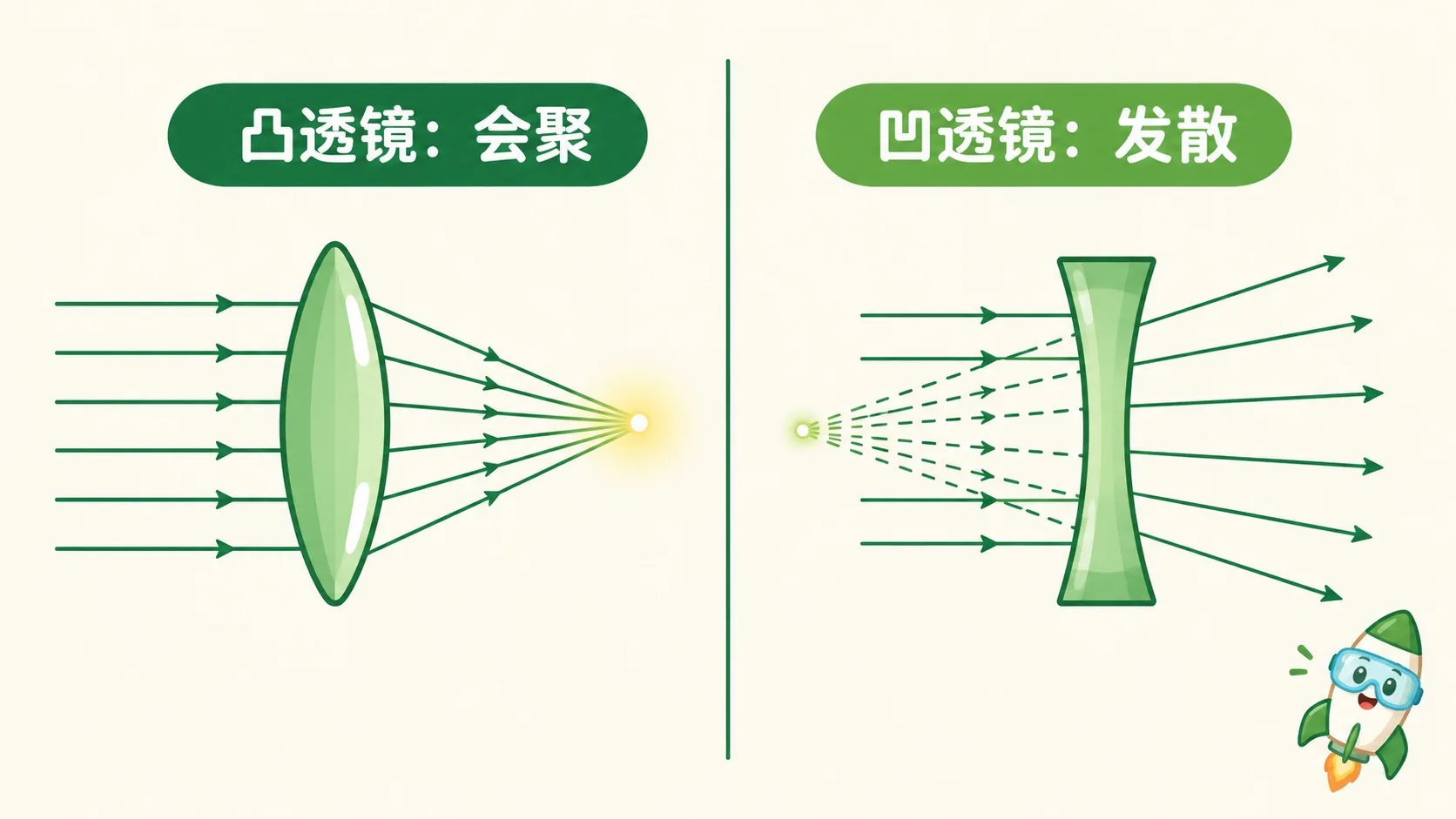
那凹透镜是干嘛的?它不会聚光,只会发散。And what about the concave lens? It never converges — it only spreads light.
第 3 步:两块透镜,两种脾气Step 3: Two lenses, two tempers
凸透镜中间厚、边缘薄,把平行光收拢到焦点,是照相机、投影仪、放大镜的主角;凹透镜中间薄、边缘厚,把平行光散开,自己没法当放大镜,却能“掰正”近视眼看东西——近视眼镜用的就是凹透镜。A convex lens is thick in the middle and gathers parallel rays into a focus — the star of cameras, projectors and magnifiers. A concave lens is thin in the middle and spreads rays apart; it can’t magnify on its own, but it bends light the right way for short-sighted eyes — that’s why glasses for short sight use concave lenses.
🎮 你来当配镜师(30 秒)🎮 Your turn: set the optical bench (30 seconds)
拖动滑块移动物体,看像的位置、大小、正倒怎么变;三档应用会跟着亮起,再过 4 关匹配。Drag the slider to move the object and watch the image shift, grow and flip; the right application lights up, then clear 4 matching challenges.
一句话记住它:凸透镜成像看物距:2f 以外缩小倒立(照相机)、f~2f 之间放大倒立(投影仪)、f 以内放大正立虚像(放大镜)。Remember it in one line: a convex lens images by object distance — beyond 2f: smaller & inverted (camera); between f and 2f: larger & inverted (projector); inside f: larger & upright virtual (magnifier).
凸透镜会聚光、凹透镜发散光;成实像用的是凸透镜Convex lenses converge, concave lenses diverge; real images come from convex ones三条特殊光线画光路:平行过焦点、过光心不变、过焦点后平行Three special rays trace any image: parallel→focus, through centre→straight, through focus→parallel照相机缩小倒立、投影仪放大倒立、放大镜放大正立虚像Camera: smaller inverted; projector: larger inverted; magnifier: larger upright virtual
内容参考 OpenStax 等公开教材,多来源核对 · AI 生成、人工审核 · 发现错误欢迎指正,帮这片叶子长得更好。Based on OpenStax and other open textbooks, cross-checked across sources · AI-generated, human-reviewed · Spotted a mistake? Tell us — help this leaf grow.
 Back to tree