🁢 数学归纳法(证明篇):两步证明无穷多情况🁢 Mathematical Induction (Proof Edition): Two Steps, Infinitely Many Cases
同一棵树上,数列篇用归纳法检验公式,把数列一项项推下去;这一片追问它背后的问题:为什么只验两步,就敢说「对所有 n 都成立」?顺便看看最容易踩的坑。On the same tree, the sequences leaf used induction to check a formula, pushing a sequence term by term. This proof edition asks the deeper question: why do just two checks settle “true for every n”? And where do people slip?
第 1 步:一步点火,一步传导Step 1: one lights the fire, one carries it
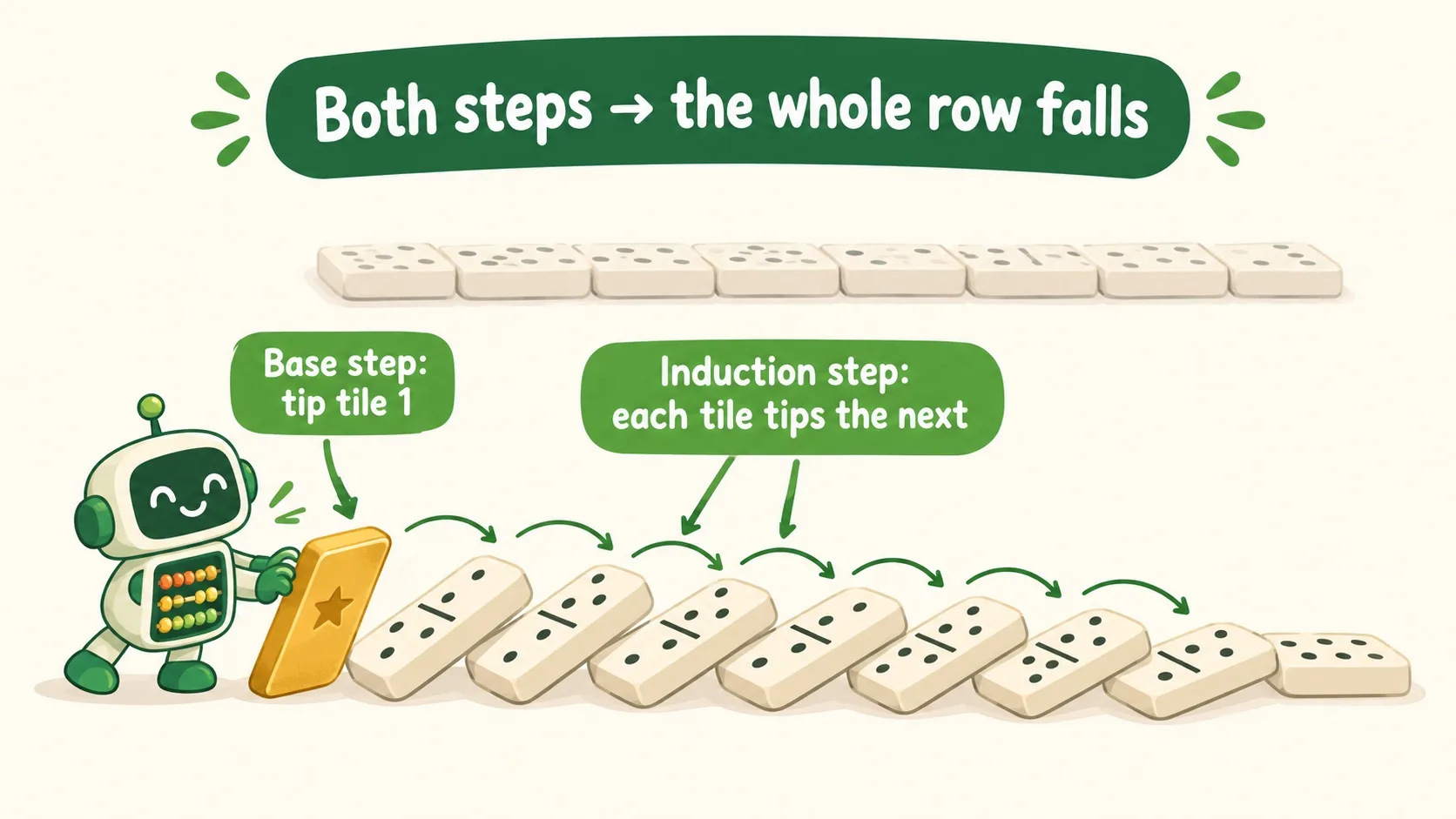
先看一排骨牌:它凭什么从第 1 块一路倒到最后?First watch a row of dominoes: what lets it fall from the 1st tile all the way to the last?
整排骨牌全倒,需要两个条件:①推倒第 1 块——这是基础步,验证 n=1 时命题成立;②随便哪一块倒下,都能推倒下一块——这是归纳步:假设 n=k 成立,推出 n=k+1 成立。基础步负责「点火」,归纳步负责「传导」。合起来,无论多少块都会倒——这就是两步搞定无穷多情况的秘密。A full domino fall needs exactly two things: (1) tip tile 1 — the base step, proving the statement for n = 1; (2) any falling tile tips the next — the induction step: assume it holds for n = k, deduce it for n = k+1. The base step lights the fire; the induction step carries it. Together they topple any number of tiles — that is how two steps handle infinitely many cases.
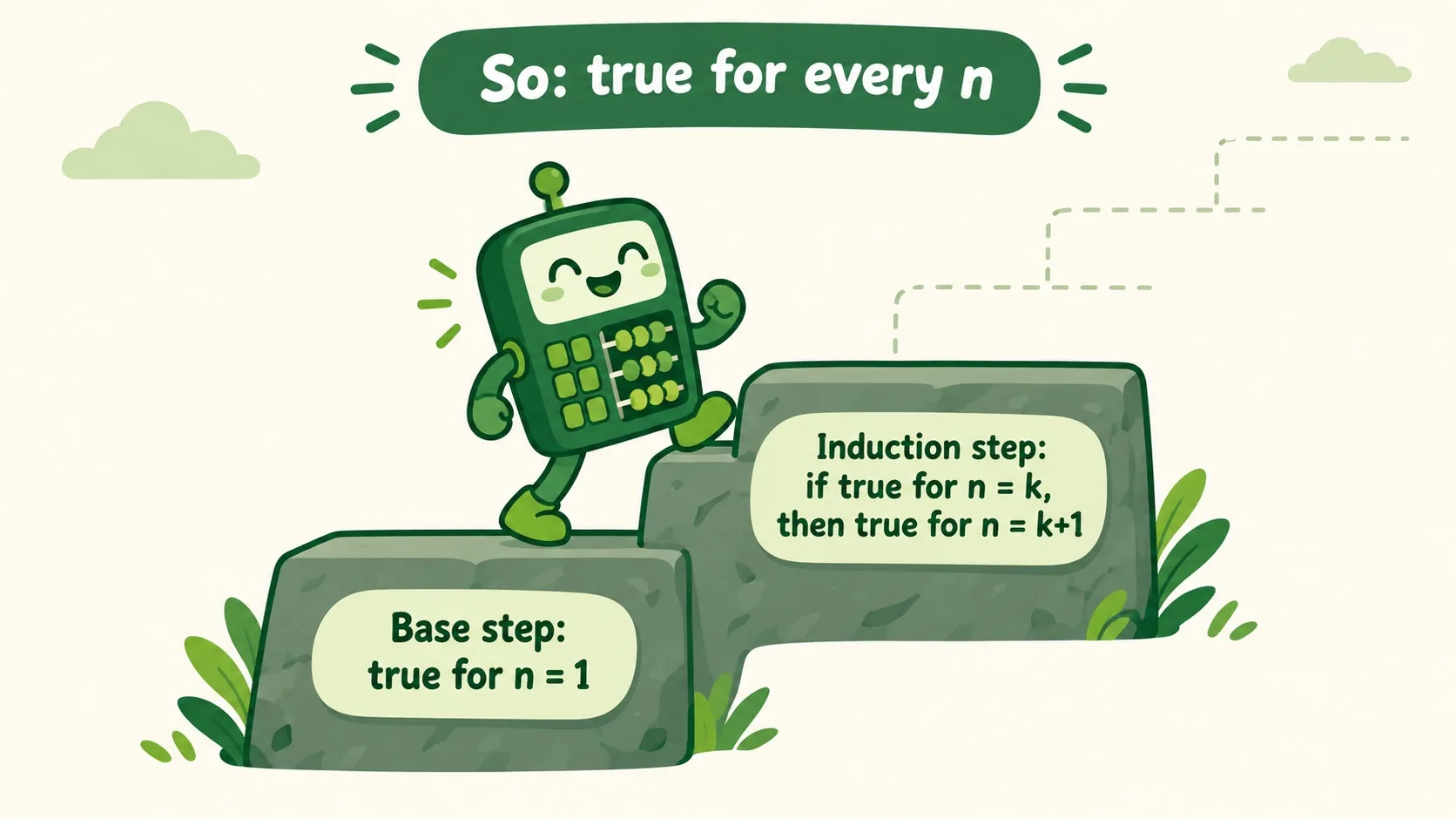
换一个更好懂的比喻:一架没有尽头的台阶。Here is an easier picture: a staircase with no end.
第 2 步:站上第一级,每一级都跨得动Step 2: stand on step one, and every step stays climbable
拿 1+2+…+n = n(n+1)/2 当例子:基础步验 n=1,左边 1,右边 1×2/2=1,成立;归纳步假设等式对 k 成立,两边一起加 k+1,右边整理后正好是把公式里的 k 换成 k+1。两步像台阶:站上第 1 级 + 每一级都能跨上下一级 ⟹ 任意高都能上。「对所有 n 成立」不是把 n 一个个试过去,而是证明「每一步都跨得动」。Take 1+2+…+n = n(n+1)/2: the base step checks n = 1 — left side 1, right side 1×2/2 = 1, true; the induction step assumes it holds for k, adds k+1 to both sides, and the right side tidies up to exactly the formula with k replaced by k+1. Two steps, like a staircase: stand on step 1 + every step climbs to the next ⟹ any height is reachable. “True for every n” is not testing n one by one — it is proving that every single step is climbable.
两步都写了,为什么还会证出荒唐结论?With both steps written, how can a proof still go absurdly wrong?
第 3 步:最常见的坑——忘了基础步Step 3: the classic trap — forgetting the base step
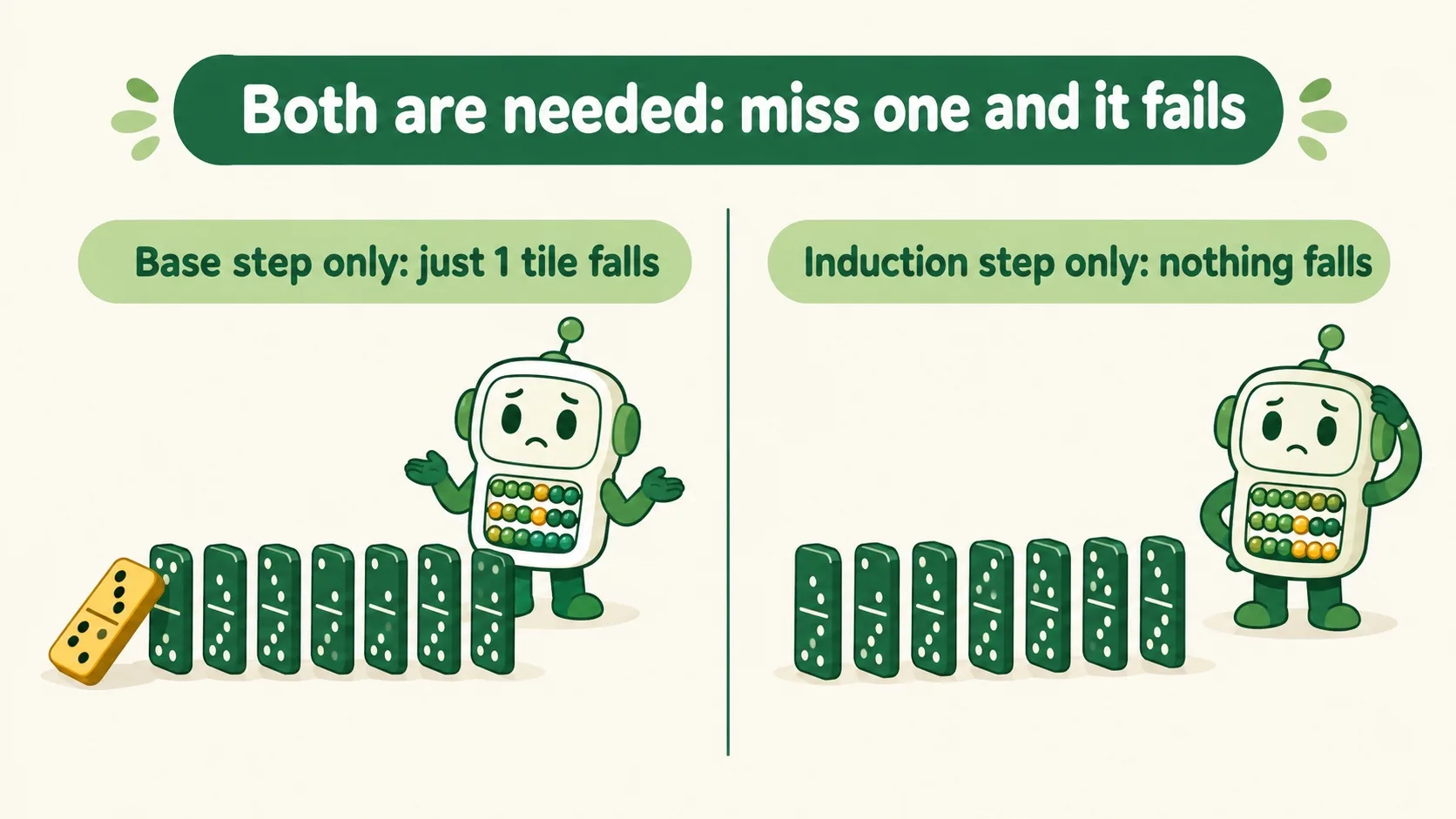
伪证现场:命题「n = n+1」。归纳步:假设 k = k+1,两边加 1 得 k+1 = k+2 ✓——这一步居然推得动!但基础步 n=1 时 1=2 不成立,整排骨牌纹丝不动。两个坑记住:①忘了基础步,归纳步再顺也是空转;②基础步起点不对——命题说「对所有正整数 n」,却只从 n=3 验起。检查口诀:先问「第 1 块倒了吗」,再问「每块都能推下一块吗」,最后问「起点对不对」。The fake-proof scene: claim “n = n+1”. Induction step: assume k = k+1, add 1 → k+1 = k+2 ✓ — it even pushes through! But the base step fails at n = 1 (1 = 2 is false), so the row never moves. Two traps to remember: (1) forget the base step and even a perfect induction step runs in place; (2) start at the wrong n — the claim says “every positive integer”, yet the check begins at n = 3. The checklist: did tile 1 fall? does every tile tip the next? is the starting point right?
🎮 你来当审查员(2 分钟)🎮 Your turn: the induction inspector (2 minutes)
上半场拨动两个开关,看看多米诺什么时候才全倒;下半场有 4 个「伪证现场」,逐个找出破绽。Flip two switches and see when the dominoes truly all fall; then inspect four fake proofs and find each flaw.
一句话记住它:数学归纳法 = 基础步(推倒第 1 块)+ 归纳步(每块能推倒下一块),两步齐备,无穷多情况一次证完。Remember it in one line: induction = base step (tip tile 1) + induction step (every tile tips the next); with both in place, infinitely many cases are settled in one go.
基础步:验证命题对第一个 n 成立(通常 n=1)Base step: check the statement at the first n (usually n = 1)归纳步:假设 n=k 成立,推出 n=k+1 成立Induction step: assume it holds for n = k, deduce it for n = k+1写完先自检:基础步有没有?起点的 n 对不对?Before finishing, check: is the base step there? is the starting n right?
内容参考 OpenStax 等公开教材,多来源核对 · AI 生成、人工审核 · 发现错误欢迎指正,帮这片叶子长得更好。Based on OpenStax and other open textbooks, cross-checked across sources · AI-generated, human-reviewed · Spotted a mistake? Tell us — help this leaf grow.
 Back to tree