🌊 机械波:振动在介质里接力传播🌊 Mechanical Waves: Vibration Passed On, Hand to Hand
上一片里,音叉振动把声音送了出去——可音叉自己没挪窝。振动是怎么“跑”到我们耳朵里的?靠的是一场接力:振动在介质里一站一站往前传。这就是机械波。Last leaf, the tuning fork's vibration sent sound out — yet the fork never left its spot. So how did the vibration reach our ears? By a relay race: each bit of the medium passes it on, station by station. That is a mechanical wave.
第 1 步:波向前跑,介质不搬家Step 1: The wave runs, the medium stays put
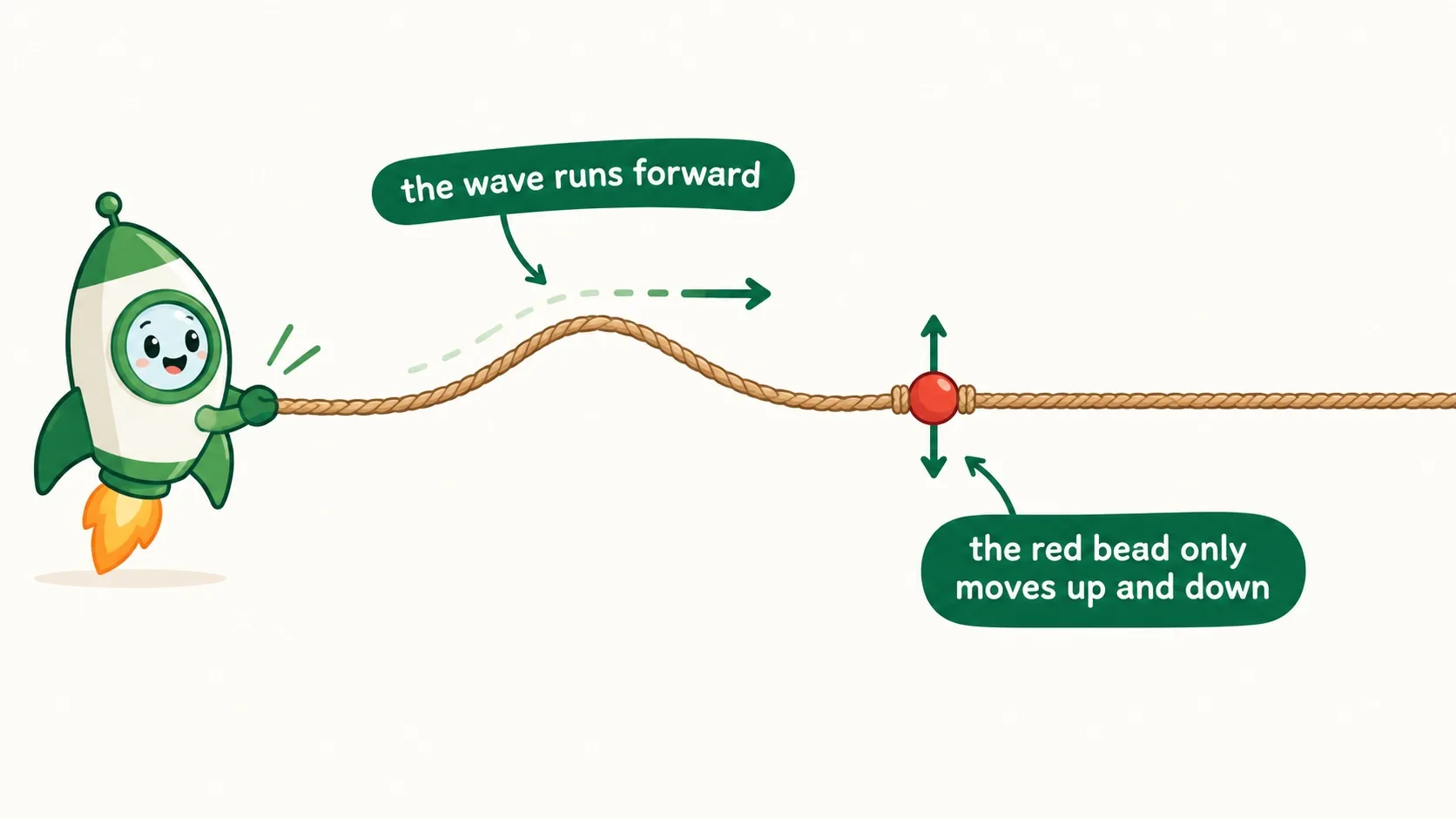
先看一根绳子:手一抖,鼓包往前跑——绳子自己跟着跑了吗?Start with a rope: flick one end and a bump runs forward — but does the rope itself run with it?
一只手抖动绳子左端,一个鼓包沿着绳子向右跑。盯住绳上系的红点:它只在自己位置上下动,从不向右挪。波带走的是“振动的方式”和能量;每一小段绳子都留在原地,只把振动接力给邻居。“波向前跑”说的是振动形式在跑,不是绳子在跑——这就是波传播的秘密。A hand flicks the left end of the rope and a bump runs rightwards along it. Watch the red bead tied to the rope: it only bobs up and down in its own spot, never travelling right. What the wave carries away is the pattern of vibration and its energy; every little piece of rope stays at its post, just passing the vibration to its neighbour. “The wave runs forward” means the pattern runs — not the rope. That is the secret of how waves travel.
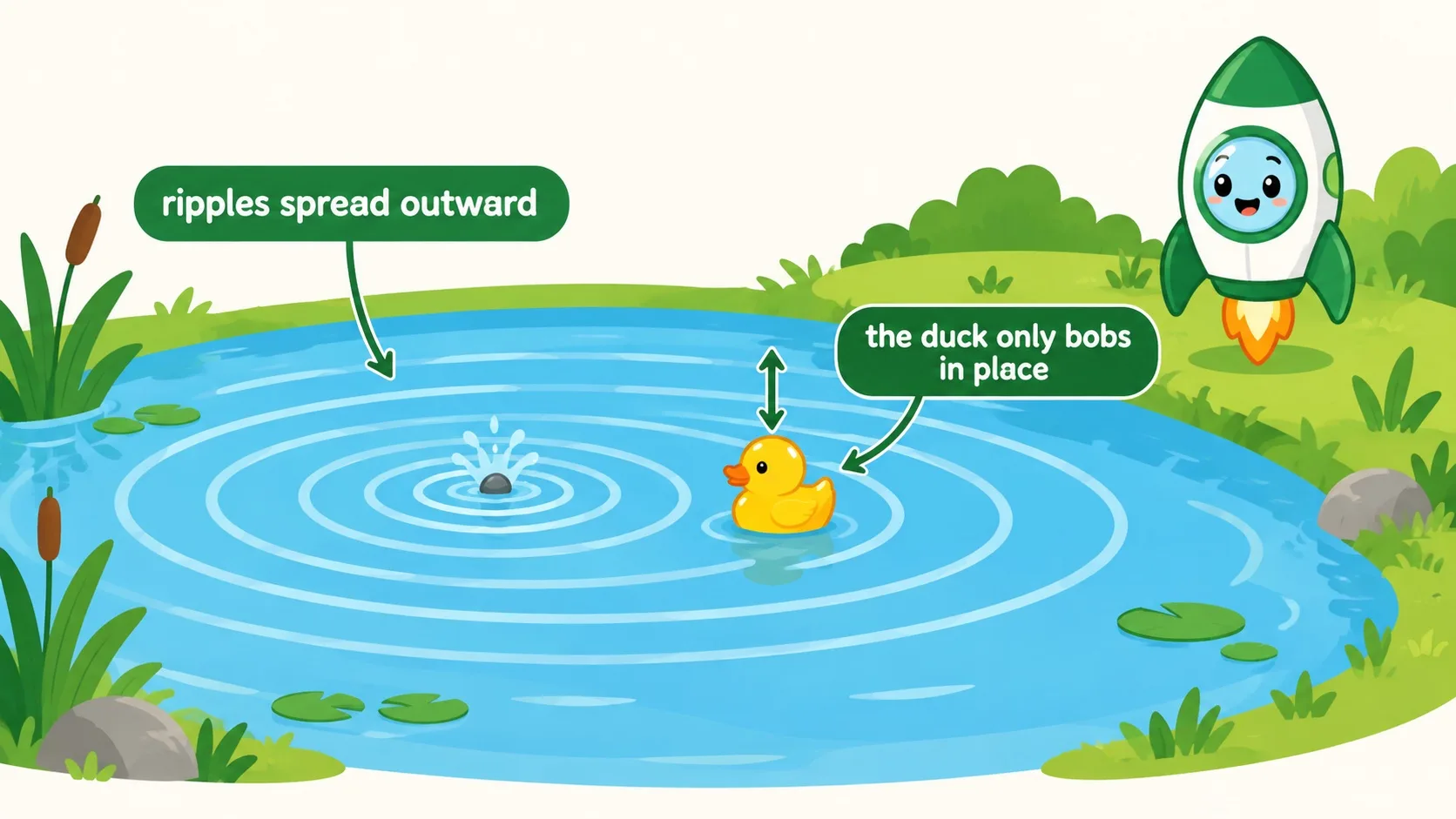
掉进池塘的石子,也是同样的剧本:波纹跑得远,水却留在原地。A pebble dropped into a pond tells the same story: the ripples travel far, the water stays home.
第 2 步:波纹扩散,小鸭留在原地Step 2: Ripples spread, the duck stays put
往池塘丢一颗石子,一圈圈波纹向四周扩散。漂在水上的小黄鸭只是随波上下起伏,并没有被推着跑到对岸。水波和绳波是一家人:振动方向(上下)与传播方向(向外)垂直。这种“上下抖、向外传”的波,叫横波——绳波、水波都是横波。Drop a pebble into a pond and rings of ripples spread outward. A yellow duck floating there only bobs up and down; the wave never pushes it to the far bank. Water waves and rope waves are family: the vibration goes up and down while the wave travels outward — the two directions are perpendicular. Waves that bob while travelling outward are called transverse waves — rope waves and water waves are both transverse.
那声音呢?空气分子可不玩“上下跳”,它玩的是另一种队形。And sound? Air molecules don't bob up and down — they play a different formation.
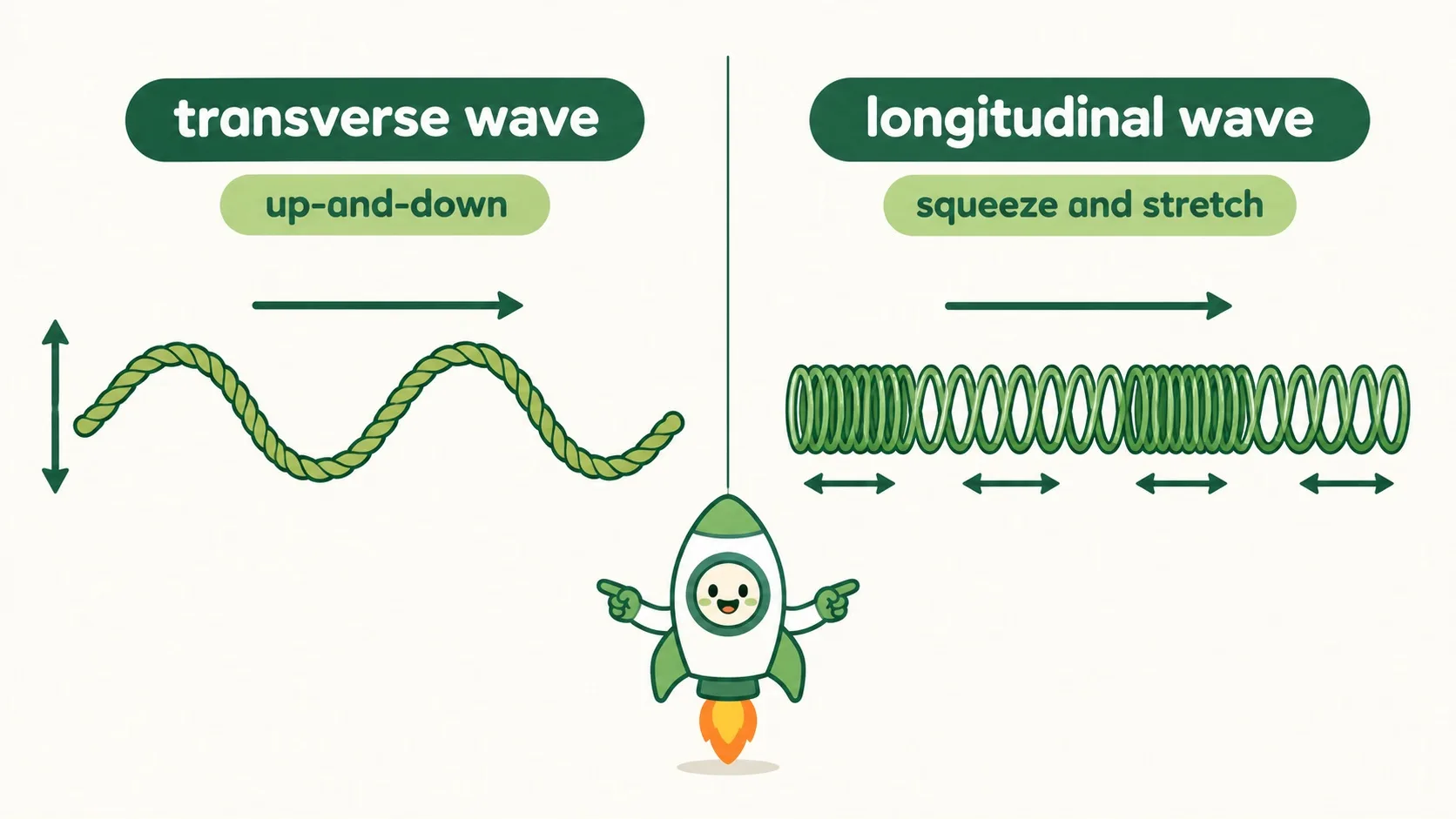
横波像抖动的绳子,波形是上下起伏的 S 形;纵波像推拉弹簧,分子沿着传播方向来回挤,一段密、一段疏。声音在空气里就是这样传播的——所以声波是纵波。不管哪种波,都离不开介质:闹钟放进真空罩,抽走空气,铃声就听不见了,因为真空里没有分子来接力。A transverse wave looks like a flicked rope — an up-and-down S shape. A longitudinal wave looks like a pushed spring — particles squeeze back and forth along the direction of travel, making dense and sparse bands. That is exactly how sound moves through air, so sound is a longitudinal wave. Either way, a wave needs its medium: put a ringing alarm clock in a vacuum jar and pump the air out — the ringing fades, because in a vacuum there are no particles to pass the message on.
🎮 你来当波形裁判(40 秒)🎮 Your turn: wave referee (40 seconds)
拖动绳子左端让波跑起来,盯住红点,再判断 4 个场景是横波还是纵波。Drag the rope's left end to send waves running, watch the red bead, then judge 4 scenes: transverse or longitudinal?
一句话记住它:波传的是振动形式和能量,介质不搬家;横波上下抖(绳波、水波),纵波疏密推(声波);机械波离不开介质。Remember it in one line: a wave carries the vibration pattern and energy, not the medium; transverse waves bob (rope, water), longitudinal waves squeeze (sound); mechanical waves need a medium.
波向前跑,介质只在原地振动(红点只上下动)The wave runs forward while the medium just vibrates in place (the red bead only bobs)横波:振动方向垂直于传播方向(绳波、水波)Transverse: vibration is perpendicular to the direction of travel (rope, water)纵波:振动方向平行于传播方向(声波);机械波需要介质,真空不传声Longitudinal: vibration is along the direction of travel (sound); mechanical waves need a medium — no sound in a vacuum
内容参考 OpenStax 等公开教材,多来源核对 · AI 生成、人工审核 · 发现错误欢迎指正,帮这片叶子长得更好。Based on OpenStax and other open textbooks, cross-checked across sources · AI-generated, human-reviewed · Spotted a mistake? Tell us — help this leaf grow.
 Back to tree