💥 核裂变:大原子核一分为二💥 Nuclear Fission: One Big Nucleus Splits in Two
上一片里,不稳定的原子核会自己慢慢衰变;这一片更热闹——一颗中子撞上去,大原子核当场裂成两半,还放出能量和更多中子。Last leaf, unstable nuclei decayed all by themselves. This leaf is livelier: one neutron strikes, and a big nucleus splits in two — releasing energy and even more neutrons.
第 1 步:一颗中子撞开铀核Step 1: One neutron cracks a uranium nucleus
先弄清楚谁撞谁——裂变需要一个“炮弹”和一个“靶子”。First, who hits whom — fission needs a “bullet” and a “target”.
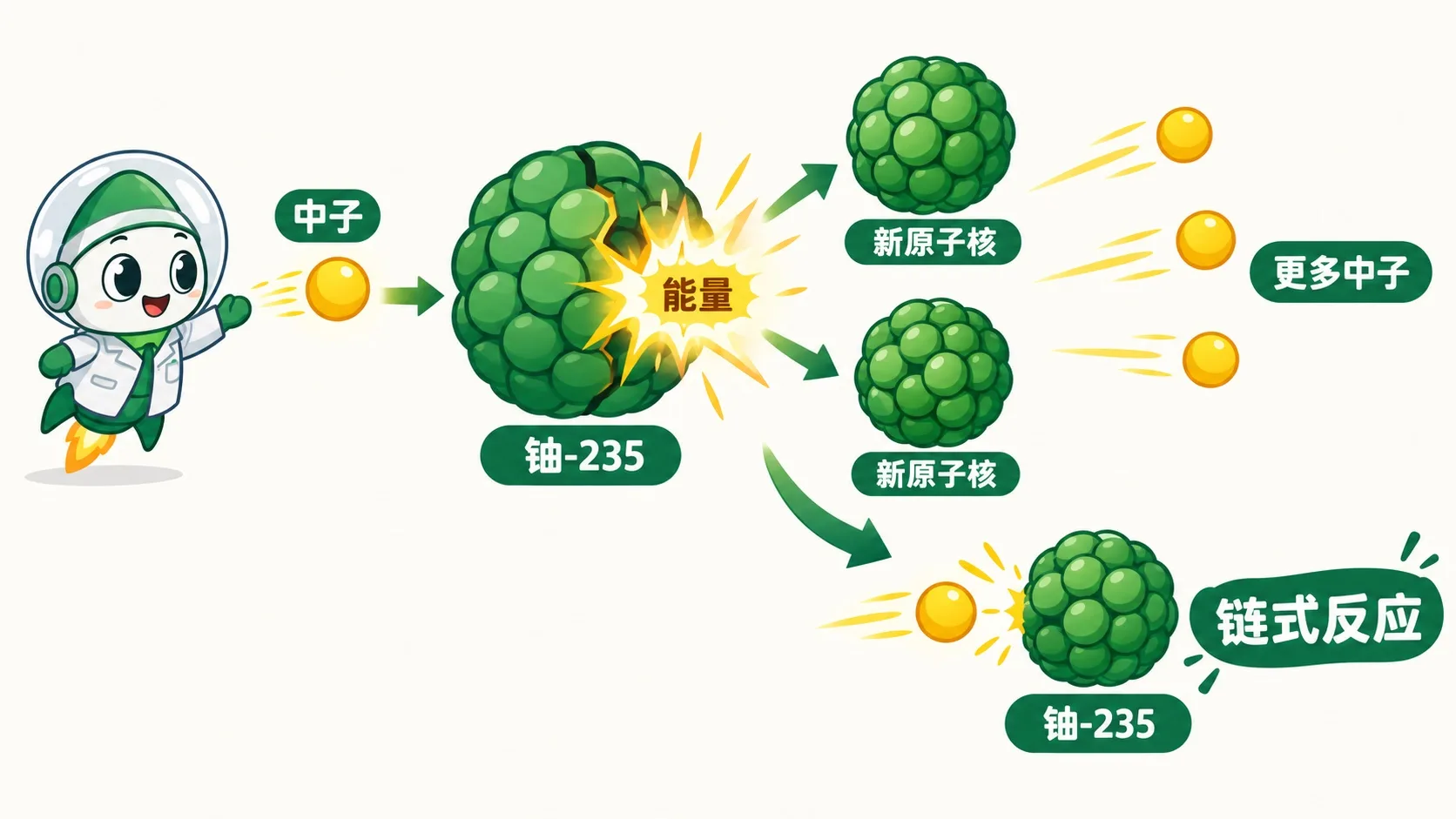
铀-235 是个“胖”原子核:92 个质子挤在一起,本来就不太安分。一颗慢慢飞来的中子撞上它,它立刻裂成两个中等大小的原子核,同时飞出 2~3 颗新中子和一大笔能量。慢中子更容易被铀-235 抓住,所以核电站会先用慢化剂把中子“减速”。Uranium-235 is a “fat” nucleus — 92 protons crammed together, already uneasy. A slow neutron strikes it, and it splits into two medium nuclei, flinging out 2–3 fresh neutrons and a burst of energy. Slow neutrons are easier for U-235 to catch, so power plants slow them down first with a moderator.
一颗中子变出两三颗——它们又去撞别人,会不会没完没了?One neutron becomes two or three — and they hit others. Doesn't this never end?
第 2 步:链式反应与刹车Step 2: The chain reaction and its brakes
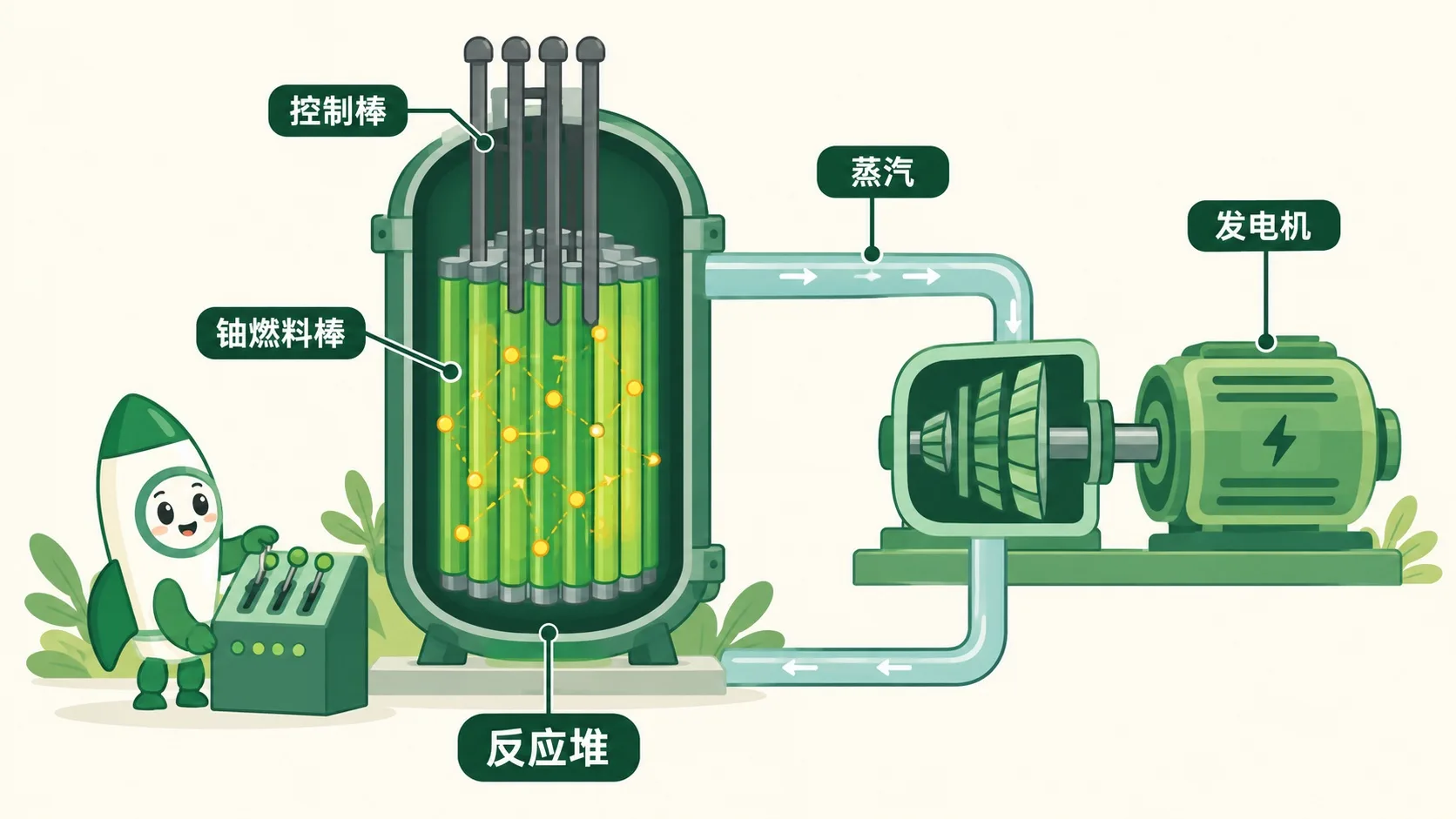
会!这叫链式反应,像雪崩一样一代传一代;要是每颗中子都引发新裂变,反应会指数暴涨——原子弹就是这种失控。核电站的答案是“刹车系统”:控制棒(镉、硼等)专门吸收中子,插得越深吸得越多、反应越弱;慢化剂把中子减速,让铀-235 更容易抓住它们;冷却剂把热量带走发电。让平均每颗中子正好只引发一次新裂变,功率就稳稳的。It would! This is a chain reaction, avalanching generation after generation. If every neutron triggers a new fission, the reaction explodes exponentially — that's the runaway in an atomic bomb. A power plant answers with brakes: control rods (cadmium, boron) absorb neutrons — the deeper they go, the weaker the reaction; a moderator slows neutrons so U-235 can catch them; a coolant carries heat away to make electricity. Keep the average at exactly one new fission per neutron, and power stays steady.
为什么全世界的核电站都盯着这块“石头”?Why do power plants everywhere fix their eyes on this one “rock”?
第 3 步:小小一块,能量惊人Step 3: A tiny lump, an enormous punch
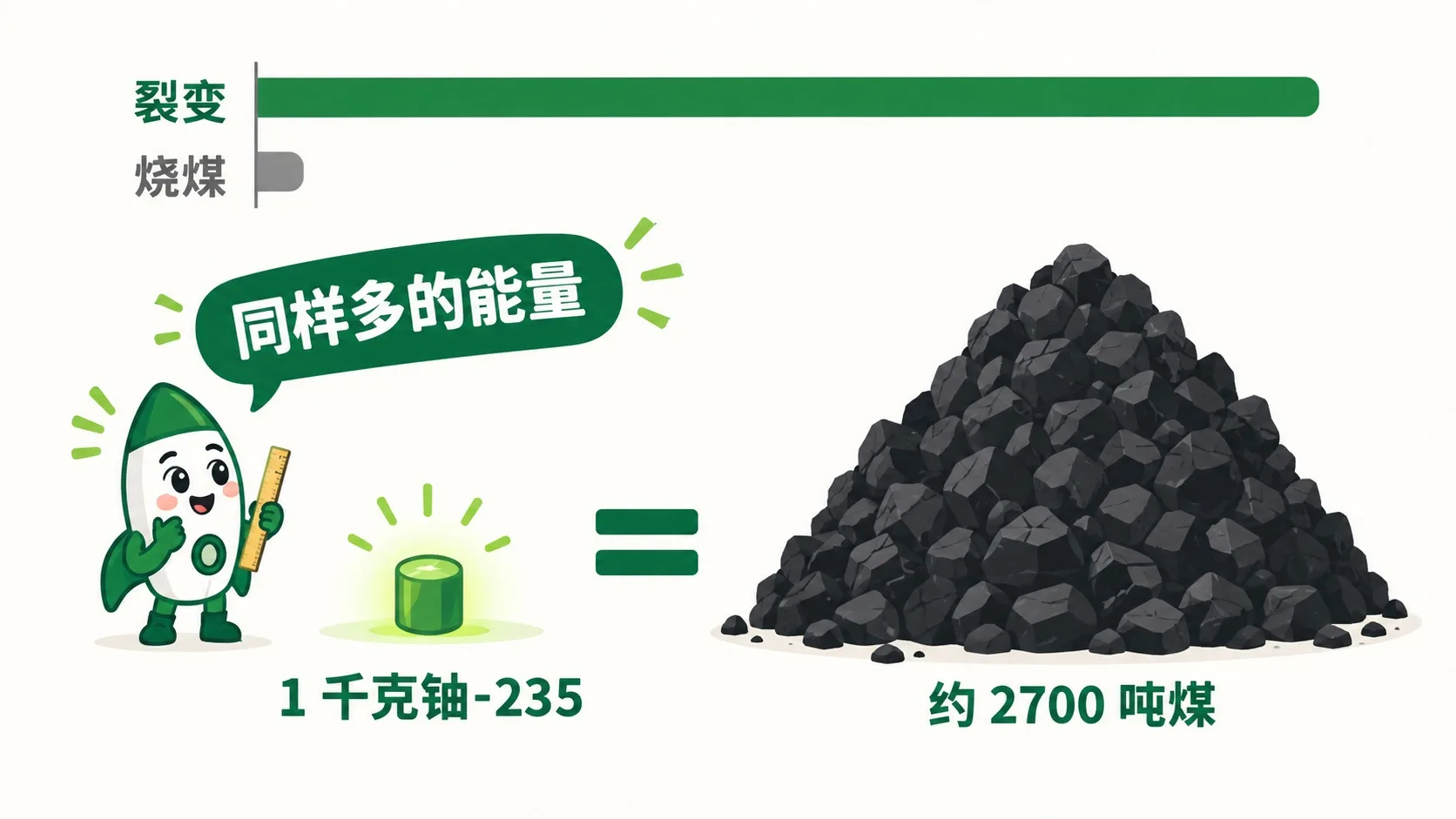
同样重量的燃料,裂变放出的能量是烧煤的几百万倍:1 千克铀-235 完全裂变,大约相当于烧掉 2700 吨煤。好处是几乎不排二氧化碳、燃料用量极小;难题是裂变产物放射性很强,且会持续很久——这就是核废料难题,必须装进特制容器、深埋地下,或者回收再利用。Per kilogram, fission releases millions of times more energy than burning coal: 1 kg of U-235 fully split ≈ burning about 2,700 tonnes of coal. The upside: almost no CO₂, and tiny amounts of fuel. The hard part: the fission products are intensely radioactive for a very long time — the nuclear waste problem, demanding special containers, deep storage, or recycling.
🎮 你来当反应堆操作员(1 分钟)🎮 Your turn: reactor operator (1 minute)
道理讲完了。拖动两个滑块,让链式反应维持“稳定输出”——4 关,从启动到高功率精准控制。Theory done. Drag the two sliders to hold the chain reaction at a steady output — 4 levels, from start-up to delicate high-power control.
一句话记住它:核裂变 = 中子撞开大原子核,一分为二,放出能量和 2~3 颗中子;控制棒吸收中子当刹车,让反应稳稳进行。Remember it in one line: fission = a neutron cracks a big nucleus into two, releasing energy and 2–3 neutrons; control rods absorb neutrons like brakes to keep it steady.
铀-235 被中子击中,裂成两个中等原子核,放出能量和更多中子A neutron splits U-235 into two medium nuclei, energy and more neutrons链式反应一代传一代;控制棒插得越深,吸收越多、反应越弱A chain reaction passes it on; deeper control rods absorb more and calm it down1 千克铀 ≈ 2700 吨煤的能量;核废料放射性强,必须安全存放1 kg of uranium ≈ 2,700 tonnes of coal; waste stays radioactive and must be stored safely
内容参考 OpenStax 等公开教材,多来源核对 · AI 生成、人工审核 · 发现错误欢迎指正,帮这片叶子长得更好。Based on OpenStax and other open textbooks, cross-checked across sources · AI-generated, human-reviewed · Spotted a mistake? Tell us — help this leaf grow.
 Back to tree