☀️ 核聚变:小原子核抱团取暖☀️ Nuclear Fusion: Light Nuclei Hug It Out
上一片把大原子核敲碎了,这一片反过来——让小原子核抱在一起。太阳就是靠这一招,发光发热了 46 亿年。Last leaf we cracked a big nucleus apart. This leaf flips it: make small nuclei hug together. That's how the Sun has shone for 4.6 billion years.
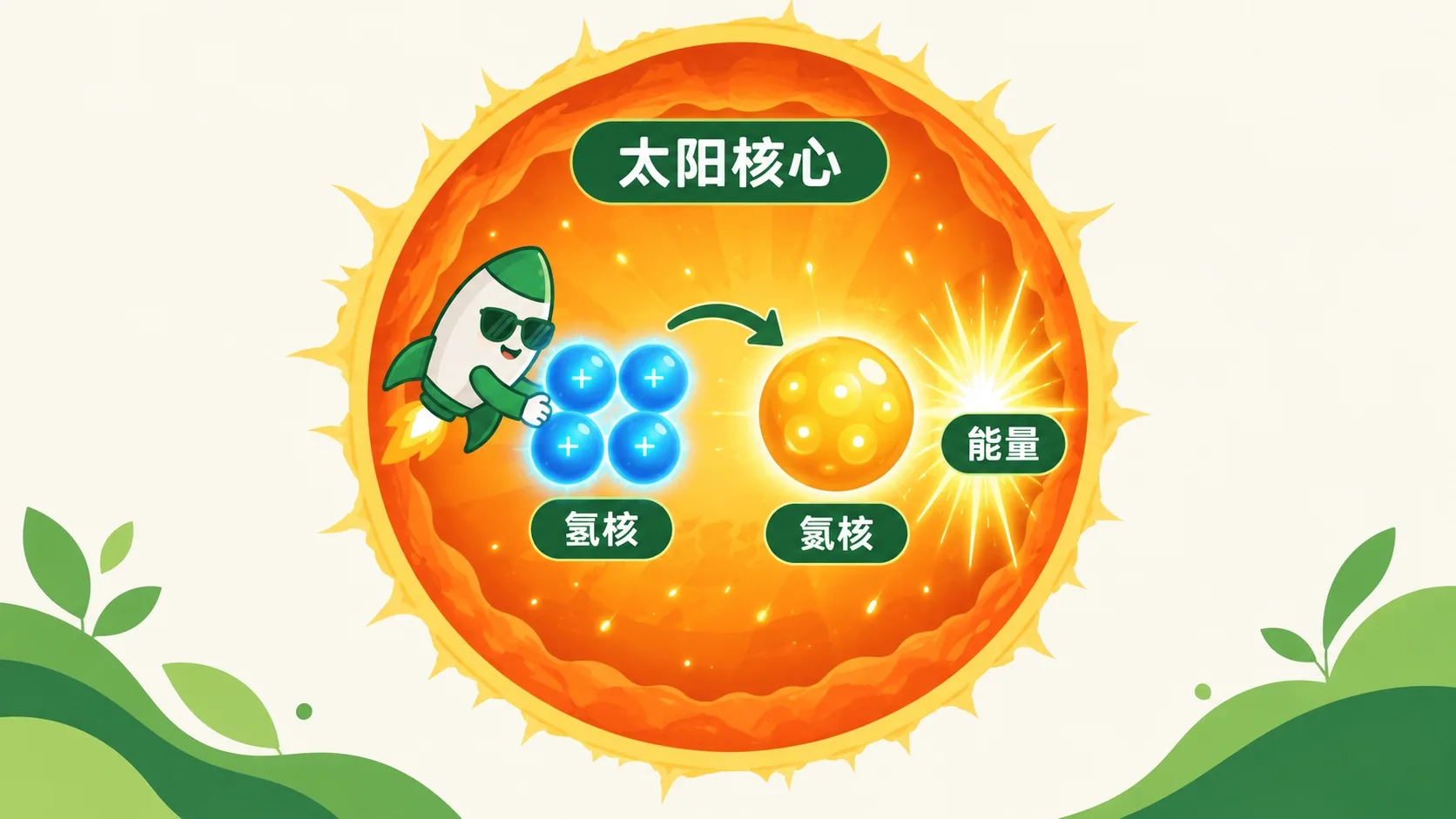
第 1 步:四个氢核,抱成一个氦核Step 1: Four hydrogen nuclei hug into one helium
小原子核为什么肯“抱团”?抱上之后又放出什么?Why would small nuclei ever hug — and what comes out when they do?
氢核(质子)都带正电,彼此死命排斥,想抱在一起非常难。但在太阳核心的超高温高压下,它们被挤得极近,核力这瓶“超级胶水”终于抓住它们:4 个氢核一步步合成 1 个氦核,同时释放出巨大的能量。太阳每秒把约 6 亿吨氢变成氦,这份能量穿过 1.5 亿千米,照到你我身上。Hydrogen nuclei (protons) all carry positive charge and shove each other away — hugging is hard. But in the Sun's core, extreme heat and pressure squeeze them close enough for the nuclear force — a “super glue” — to grab hold: 4 hydrogen nuclei merge step by step into 1 helium nucleus, releasing enormous energy. The Sun fuses about 600 million tonnes of hydrogen every second, and that energy crosses 150 million km to reach us.
太阳烧得这么轻松,我们照抄一个不行吗?The Sun makes it look easy — can't we just copy it?
第 2 步:地球上为什么难Step 2: Why it's so hard on Earth
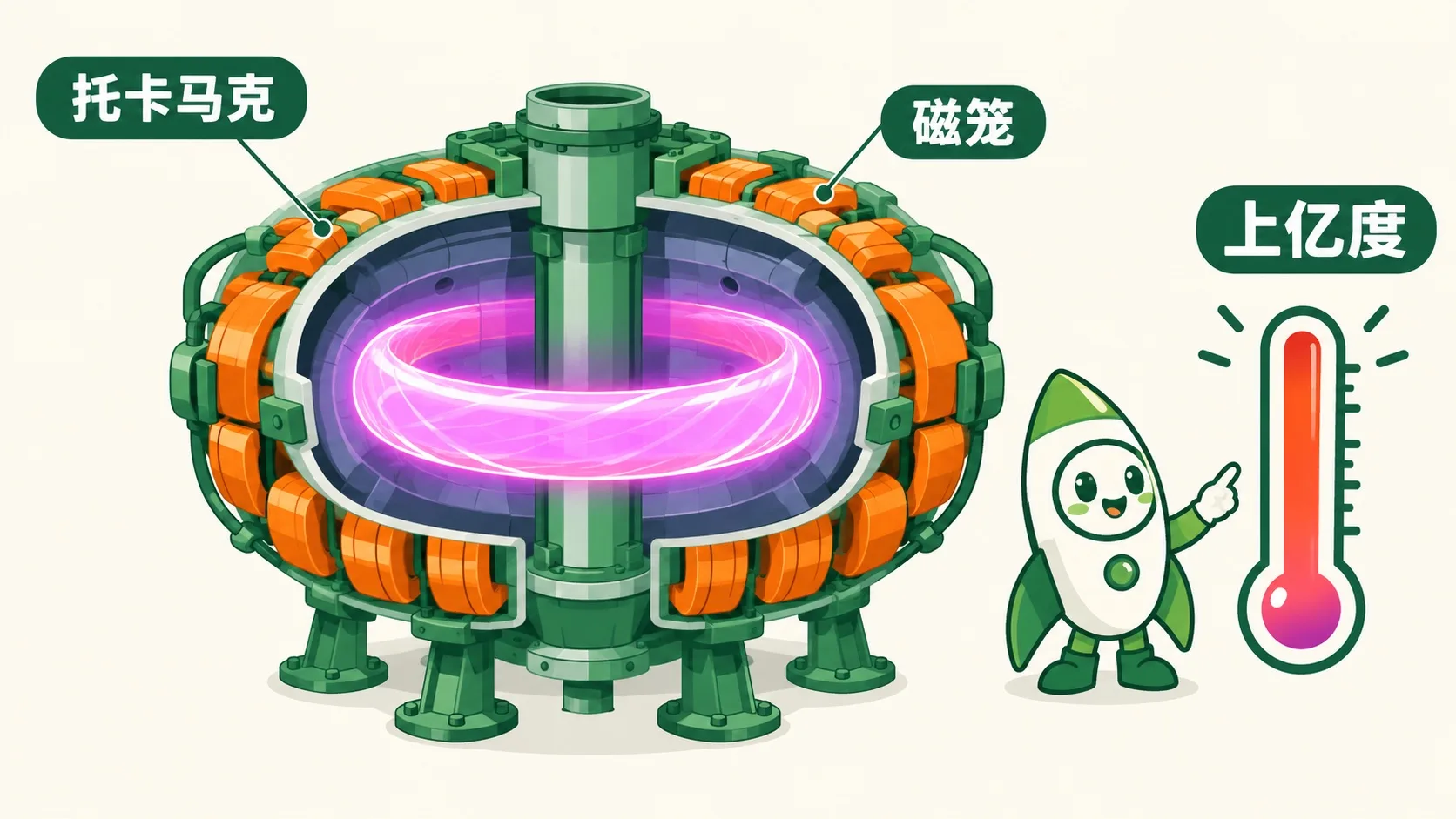
难就难在条件:聚变要上亿度的高温和极高的压强。太阳靠自身巨大的引力把核心压住;地球没有这么大的引力,只能换两招——把燃料加热到 1 亿度以上(比太阳核心还热 6 倍多),再用强磁场编成一个“磁笼”,把滚烫的等离子体悬空托住,不让它碰到容器壁。这种环形装置叫托卡马克,大家都叫它“人造太阳”。The catch is the conditions: fusion needs temperatures in the hundreds of millions of degrees and crushing pressure. The Sun's own gravity supplies that squeeze; Earth has no such gravity, so we use two tricks instead — heat the fuel past 100 million °C (over 6× hotter than the Sun's core), and weave a strong magnetic “cage” that holds the blazing plasma floating in mid-air, away from any wall. This ring-shaped machine is a tokamak — nicknamed an “artificial sun”.
聚变我们真的做到过吗?Have we ever actually achieved fusion?
第 3 步:两种聚变,天差地别Step 3: Two kinds of fusion, worlds apart
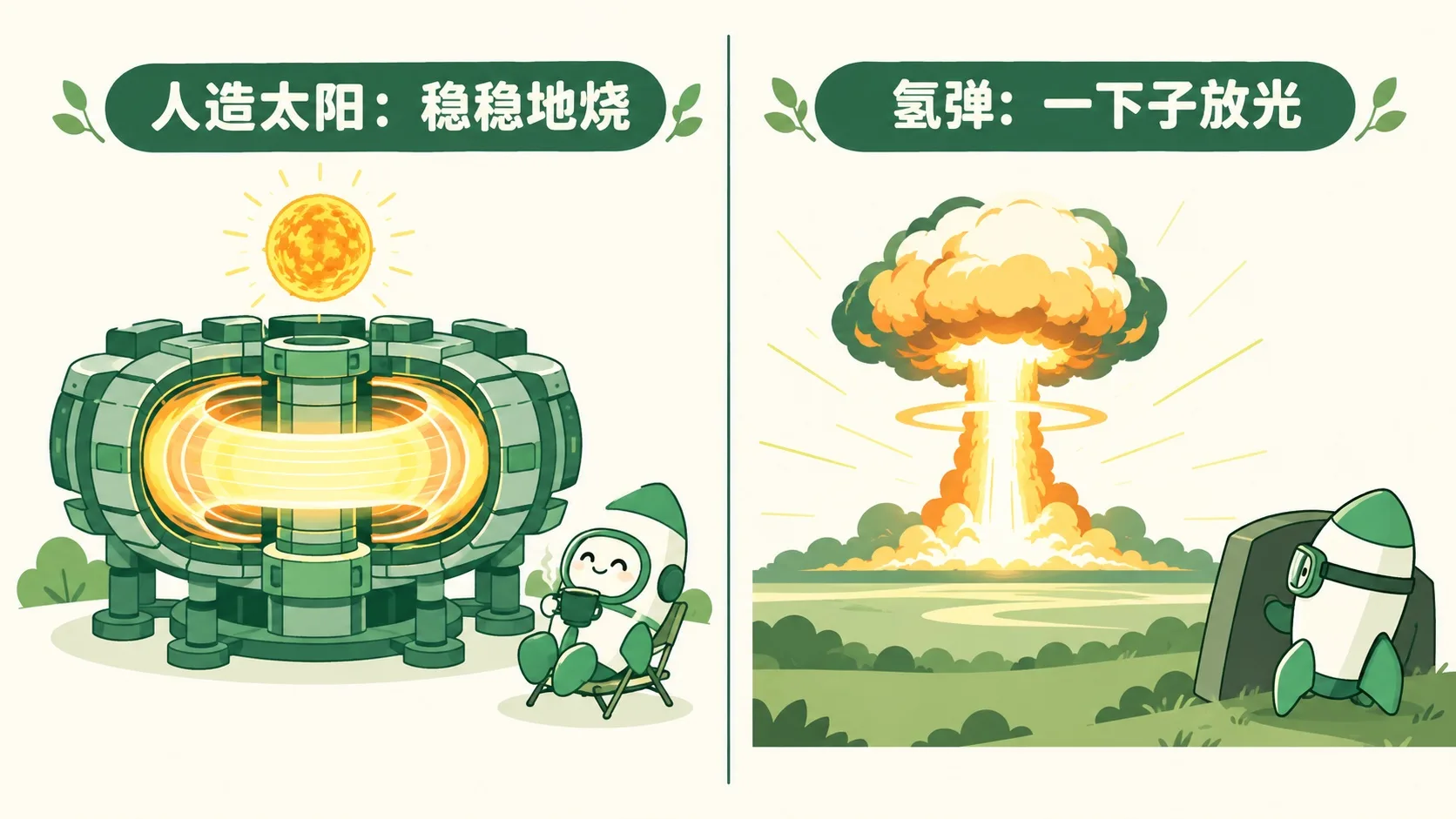
做到过,可惜是氢弹:用原子弹当“打火机”,瞬间点火,所有能量一下子放光——不可控,只能当武器。而“人造太阳”追求的是可控聚变:像烧锅炉一样稳稳地烧,把能量慢慢放出来发电。一旦成功,燃料几乎取之不尽(海水里就有),而且没有长寿命的强放射性废料——所以全世界都在抢这块“终极能源”。Yes — in the hydrogen bomb: an atomic bomb acts as the “lighter”, fusion ignites in an instant and dumps all its energy at once — uncontrollable, a weapon only. The “artificial sun” pursues controlled fusion instead: burning steadily like a boiler, releasing energy slowly to generate power. If it works, the fuel is nearly endless (it's in seawater) and there's no long-lived high-level radioactive waste — which is why the world is racing for this “ultimate energy”.
🎮 你来当点火工程师(1 分钟)🎮 Your turn: ignition engineer (1 minute)
道理讲完了。调温度和压强,看聚变能不能启动——4 个场景:太阳核心、托卡马克、氢弹、人造太阳。Theory done. Tune temperature and pressure to get fusion going — 4 scenes: the Sun's core, a tokamak, an H-bomb, and an artificial sun.
一句话记住它:核聚变 = 轻核(氢)在极高温、极高压下抱成氦核,放出更大的能量;太阳靠引力,人类靠温度和磁笼。Remember it in one line: fusion = light nuclei (hydrogen) hug into helium under extreme heat and pressure, releasing even more energy; the Sun uses gravity, we use heat and magnetic cages.
4 个氢核合成 1 个氦核,太阳的能源就是它4 hydrogen nuclei merge into 1 helium — this powers the Sun原子核都带正电、互相排斥,必须上亿度高温加高压才抱得住Nuclei repel each other, so fusion needs 100-million-degree heat plus pressure氢弹是失控的一次性聚变;托卡马克想把它变成稳稳的清洁能源The H-bomb is runaway one-shot fusion; tokamaks aim to make it steady and clean
内容参考 OpenStax 等公开教材,多来源核对 · AI 生成、人工审核 · 发现错误欢迎指正,帮这片叶子长得更好。Based on OpenStax and other open textbooks, cross-checked across sources · AI-generated, human-reviewed · Spotted a mistake? Tell us — help this leaf grow.
 Back to tree