🎚️ 幂函数:改变指数就改变世界🎚️ Power Functions: change the exponent, change the world
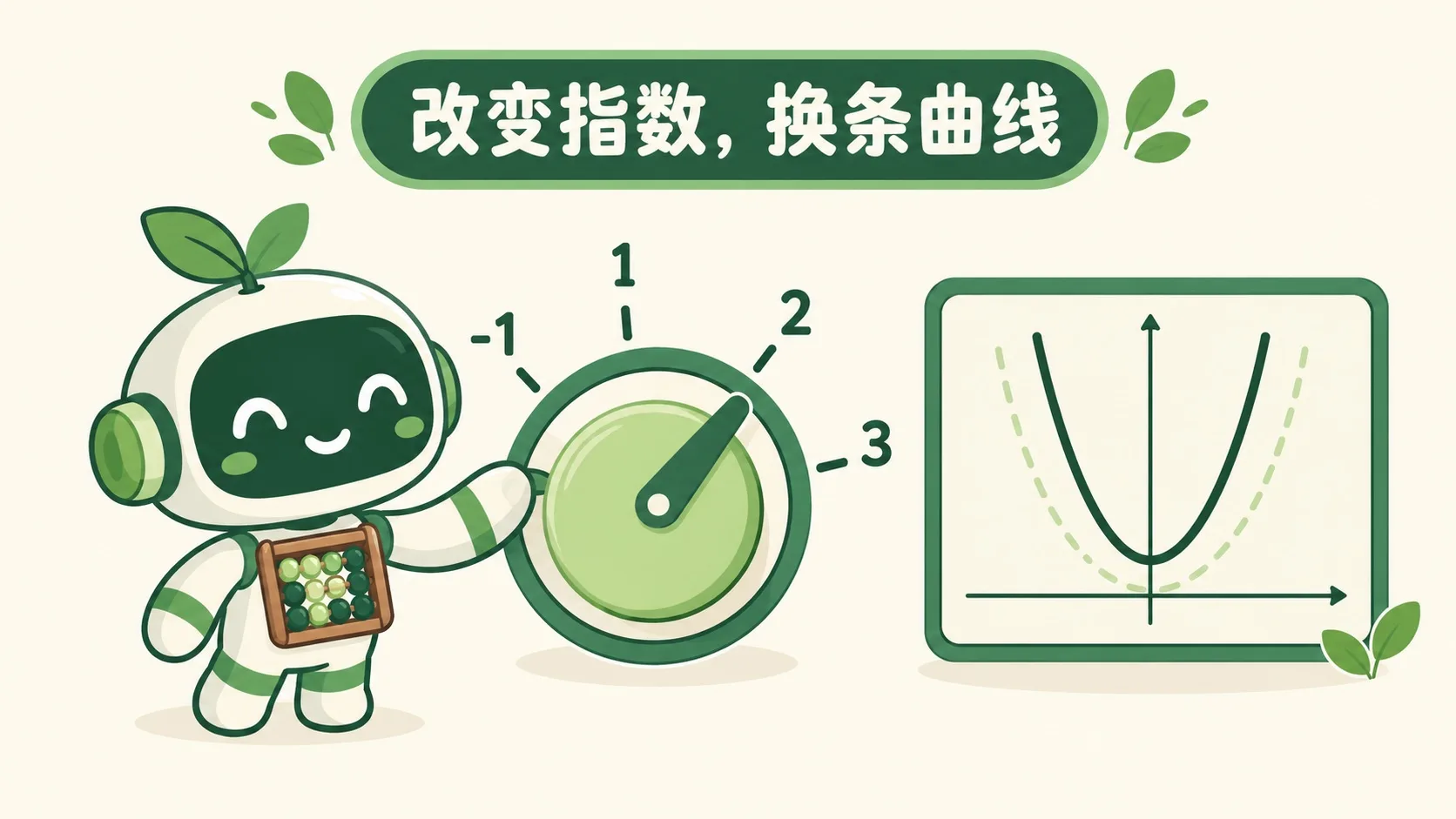
前两片里,指数要么固定、要么被倒着问。这一片把两样都摆上桌:y = xⁿ——底数是会变的 x,指数 n 是一个可以拧的旋钮。拧到不同档位,曲线就换一个家族。In the last two leaves the exponent was fixed, or asked backwards. This leaf puts both pieces on the table: y = xⁿ — the base is a changing x, and the exponent n is a knob you can turn. Each notch switches the curve to a different family.
第 1 步:一个指数,一种长相Step 1: One exponent, one family look
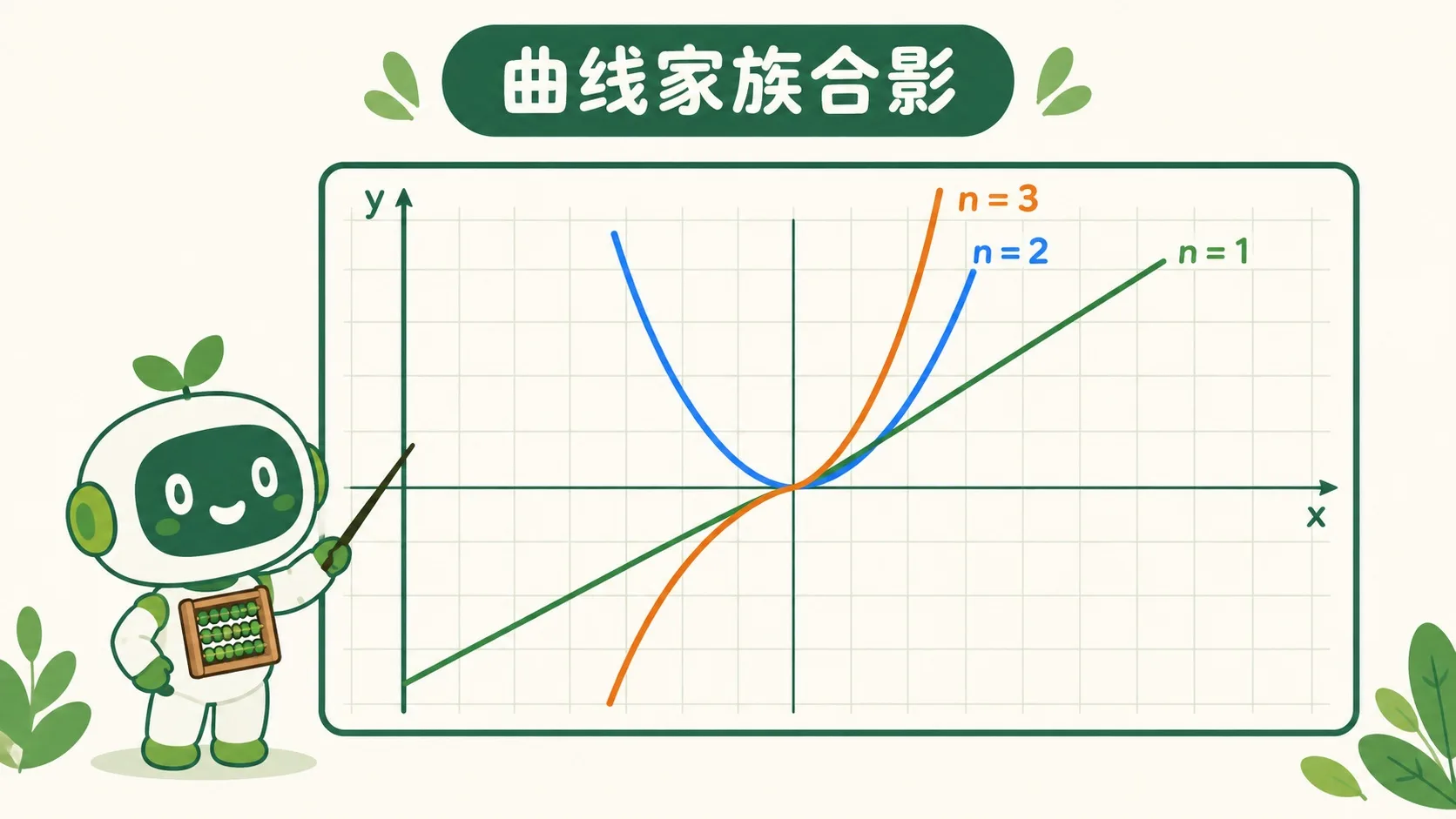
x 的 n 次方,画出来会是什么样?先看家族合影。What does x to the power n look like? First, the family portrait.
n = 1 时,y = x 是一条笔直的斜线;n = 2 时,y = x² 变成开口向上的碗(抛物线);n = 3 时,y = x³ 更陡,一三象限各冲出一头。如果 n 是负的,曲线会"翻"成倒数:n = -1 时 y = 1/x,两条分开的曲线各自滑向横轴,却永远碰不到它。指数是几,形状就归哪个家族。With n = 1, y = x is a straight sloping line; with n = 2, y = x² becomes an upward bowl (a parabola); with n = 3, y = x³ is steeper, shooting off in opposite corners. Make n negative and the curve flips into a reciprocal shape: for n = -1, y = 1/x gives two separate branches that slide toward the axis but never touch it. Change the exponent, change the family.
那同一个 x,放到不同的 n 下,谁大谁小?Now take the same x under different exponents — which is bigger?
第 2 步:同一家族里比个头Step 2: Comparing heights within the family
取 x = 2:n = 1 得 2,n = 2 得 4,n = 3 得 8——指数越大,长得越快。但这只在 x 大于 1 时成立:换成 x = 0.5,n 越大反而越小(0.5 的平方是 0.25)。而无论 n 是多少,x = 1 时结果永远都是 1——全家族在这一点集合打平。Take x = 2: n = 1 gives 2, n = 2 gives 4, n = 3 gives 8 — the bigger the exponent, the faster it grows. But that only holds for x above 1: at x = 0.5 a bigger n makes the result smaller (0.5 squared is 0.25). And whatever n is, at x = 1 every curve equals 1 — the whole family ties at that point.
这些曲线只是数学游戏,还是真的在描述世界?Are these curves just a math game, or do they describe the real world?
第 3 步:拧动旋钮,切换世界的规律Step 3: Turn the knob, switch the rule of the world
天花板面积按边长的平方长(x²),箱子体积按边长的立方长(x³);光照和引力按距离的平方反比减弱(x⁻²)。工程师调幂律、经济学看幂律——选对了 n,一条式子就能描出一种真实规律。幂函数就是那排刻度:世界长什么样,先看 n 拧到哪一档。A ceiling's area grows with the square of its side (x²); a box's volume with the cube (x³); light and gravity weaken with the inverse square of distance (x⁻²). Engineers tune power laws; economists spot them. Pick the right n and one formula outlines a real rule. The power function is that dial row: to see how the world behaves, first check which notch n sits on.
🎮 你来转旋钮:找到那条曲线🎮 Your turn: turn the knob and find the curve
拖动旋钮,看曲线家族一档一档地换模样;接 4 张任务卡,把每张卡要的形状转出来。Drag the knob to watch the family switch looks, then take 4 task cards and dial up the shape each one asks for.
一句话记住它:幂函数 y = xⁿ:底数在变,指数是旋钮。n 是几,曲线就换一个家族、换一种规律。Remember it in one line: a power function y = xⁿ has a changing base and a knob for an exponent. Each n switches the curve to a new family — and a new rule.
n = 1 直线、n = 2 抛物线、n = 3 更陡的 S 形;负指数变成两支倒数曲线n = 1 line, n = 2 parabola, n = 3 steeper S-curve; negative n makes two reciprocal branchesx > 1 时指数越大长得越快;0 < x < 1 时反过来;x = 1 时全家都等于 1For x > 1 bigger n grows faster; for 0 < x < 1 it's the reverse; at x = 1 the whole family equals 1面积用 x²、体积用 x³、平方反比用 x⁻²——真实世界的幂律就靠它描述Area uses x², volume x³, inverse-square laws x⁻² — power laws describe the real world
内容参考 OpenStax 等公开教材,多来源核对 · AI 生成、人工审核 · 发现错误欢迎指正,帮这片叶子长得更好。Based on OpenStax and other open textbooks, cross-checked across sources · AI-generated, human-reviewed · Spotted a mistake? Tell us — help this leaf grow.
 Back to tree