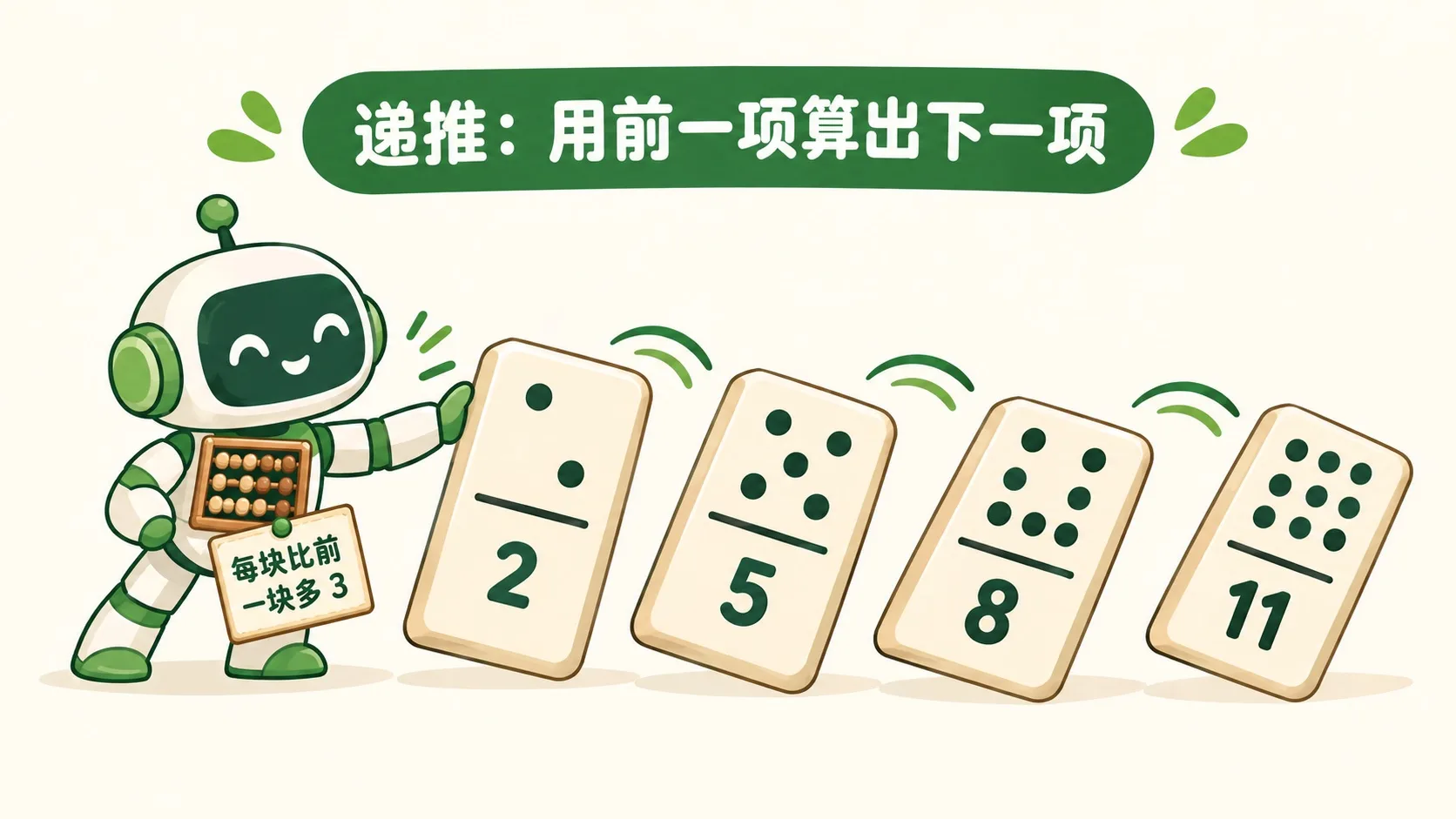
🔗 递推数列:用前一项算出下一项🔗 Recurrence Relations: Each Term from the One Before
上一片把一列数“加”了起来。这一片反过来问:这些数本身,是怎么一个接一个冒出来的?答案常常不是通式,而是一条“关系”。Last leaf, we added a list of numbers up. This leaf flips the question: how do the numbers themselves appear, one after another? Often the answer is not a closed formula, but a relation.
第 1 步:不写通式,写“下一步”Step 1: No formula — just the next step
先看最省事的写法:不写“第 n 项等于多少”,只写“下一项怎么来”。Start with the laziest description: don’t say what term n is — just say how the next one is made.
一排骨牌,每块比前一块多 3 个点:2、5、8、11…… 这张“规则卡”就是递推关系 aₙ = aₙ₋₁ + 3(读作:第 n 项 = 前一项 + 3)。它不直接告诉你第 100 项,但只要你给出第 1 项,后面每一项都能把前一项“推倒”算出来。写关系往往比写通式容易——很多规律天生就是“一步接一步”。A row of dominoes, each with 3 more pips than the one before: 2, 5, 8, 11… That rule card is the recurrence aₙ = aₙ₋₁ + 3 (read: term n = the term before + 3). It won’t hand you term 100 directly; but give it term 1, and every next term topples out of the one before. A relation is often easier than a formula — many patterns are born “one step at a time”.
最有名的一条递推,来自 800 年前的一个兔子问题。The most famous recurrence of all comes from a rabbit puzzle 800 years old.
第 2 步:明星例子——斐波那契Step 2: the star — Fibonacci
假设每对兔子长大后每月生一对新兔子。写下开头两项 1、1,规则只有一句:每项 = 前两项之和。数列就自己长下去:1、1、2、3、5、8、13……这就是斐波那契数列。向日葵的种子、松果的鳞片、菠萝的纹路里,都藏着它。一句小规则,长出一整片风景——这就是递推的威力。Suppose each pair of rabbits, once grown, has one new pair every month. Write down 1 and 1, with a single rule: each term is the sum of the two before. The sequence grows itself: 1, 1, 2, 3, 5, 8, 13… That is the Fibonacci sequence — hidden in sunflower seeds, pinecone scales and pineapple spirals. One small rule, a whole landscape grown from it.
没有通式,会不会“算不动”?计算机最擅长干这个。Without a closed formula, will it be too slow to compute? Computers are built for exactly this.
第 3 步:一步接一步,能算到很远Step 3: step by step, all the way out
递推的代价是:要算第 n 项,得先把前面每一项都走一遍——像雪球滚下坡,每一段路都在给下一段加料。好消息是,这种“重复同一件小事”正是计算机的强项,一秒钟能推几百万块骨牌。房贷的每月还款、天气预报的逐日推算、视频网站猜你下一个想看的——都是这样一步步推出来的。The price of recurrence: to reach term n, you must walk through every term before it — like a snowball rolling downhill, each stretch feeds the next. The good news: repeating one tiny step is what computers do best — millions of dominoes per second. Monthly loan payments, day-by-day weather forecasts, the next video a site recommends — all toppled out step by step.
🎮 你来摇数列机(1 分钟)🎮 Your turn: the sequence machine (1 minute)
道理讲完了。每轮给一条递推规则,点着骨牌一块块倒;倒到第 7 块之前——猜猜第 8 块是几?Theory done. Each round gives a recurrence rule; topple the dominoes one by one — and before the 7th tile falls, guess what the 8th one is.
一句话记住它:递推数列 = 一个起点 + 一条“下一项怎么来”的规则,数列自己长出来。Remember it in one line: a recurrence is a starting point plus a rule for “how the next term is made” — the sequence grows itself.
递推写的是关系 aₙ = aₙ₋₁ + 3,不是通式A recurrence states a relation aₙ = aₙ₋₁ + 3, not a closed formula斐波那契:每项 = 前两项之和(1、1、2、3、5、8……)Fibonacci: each term = the sum of the two before (1, 1, 2, 3, 5, 8…)要算得从头走,但计算机一秒能推几百万块骨牌Computing means walking from the start — but computers topple millions of steps a second
内容参考 OpenStax 等公开教材,多来源核对 · AI 生成、人工审核 · 发现错误欢迎指正,帮这片叶子长得更好。Based on OpenStax and other open textbooks, cross-checked across sources · AI-generated, human-reviewed · Spotted a mistake? Tell us — help this leaf grow.
 Back to tree