🛝 残差连接:给信号修一条滑梯🛝 Residual Connection: a Slide for the Signal
上一片里,池化像一台浓缩机:图变小了,重点不丢。可网络越叠越深,又冒出一个新麻烦——信号传着传着就淡了。这一片给信号修一条滑梯。Last leaf, pooling worked like a concentrator: a smaller map, the point kept. But the deeper a network stacks, the more one new trouble shows up — signals fade as they travel. This leaf builds the signal a slide.
第 1 步:深网络的老毛病Step 1: The deep network's old trouble
先看看没有滑梯时,信号在深网络里遭遇了什么。First, watch what happens to a signal inside a deep network with no slide.
还记得糖盐小机器人吗?它要改进,得把「错在哪」从出口传回最前面几层。可消息每过一层都打个折,层数一多,传到前面几乎没声了。前面的层收不到消息,学不动——这就是深网络的老毛病:不是不想深,是深了传不动。Remember the sugar–salt robot? To improve, it must send “what went wrong” from the exit back to the earliest layers. But the message gets a discount at every layer — stack enough and the front barely hears a whisper. The early layers can't learn: that's the old trouble of deep networks — depth stalls not because we don't want it, but because the signal can't travel.
那这根滑梯到底怎么修?So how do we build that slide?
第 2 步:加一根直通线Step 2: Add one straight line
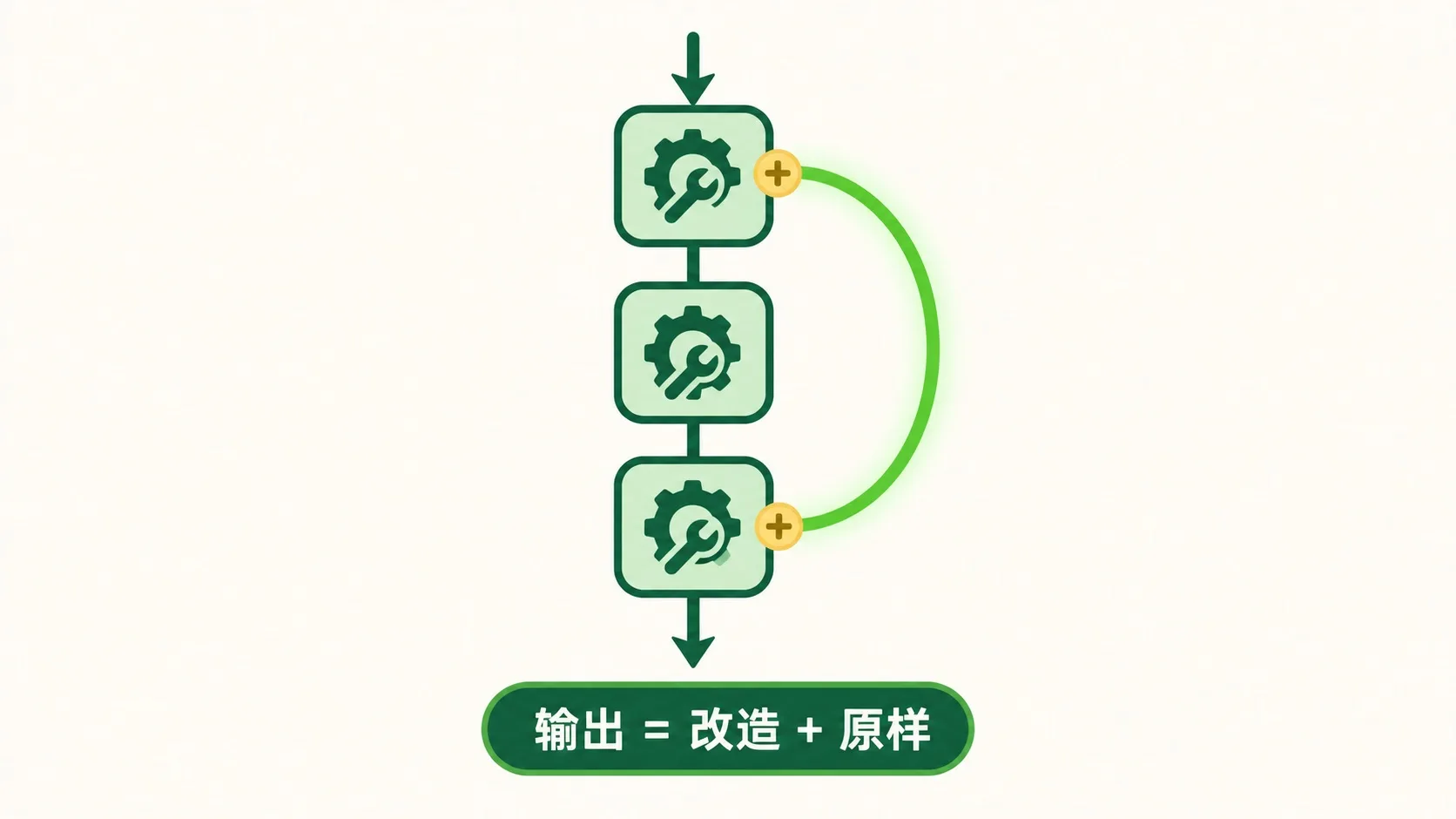
修法意外地简单:让这一层的输出 = 改造 + 原样。原样,就是这层收到的输入——一根直通线隔着几层把它送过去,这根线叫捷径(shortcut)。网络要学的只剩「改造的那一点点」,这一点点就叫残差(residual)。负担一下子小了很多。The fix is surprisingly simple: output = the change + the original. The original is what the layer received — one straight line carries it across the layers in between, and that line is the shortcut. All that's left to learn is the little bit of change — and that little bit is the residual. The learning load drops at once.
负担轻了,网络就敢叠多深?With a lighter load — how deep dare a network go?
第 3 步:叠几百层也不怕Step 3: Hundreds of layers, still learning
2015 年,ResNet(残差网络)靠捷径把网络叠到 152 层,还试过一千多层;在那之前,56 层的网络反而不如 20 层好用。有了捷径,深度这才真正起飞——今天的几乎每个大网络里,都藏着几根这样的直通线。In 2015, ResNet rode shortcuts to 152 layers — and trials went past a thousand. Before that, a 56-layer net actually did worse than a 20-layer one. With shortcuts, depth finally took off: today almost every big network hides a few lines like this.
🎮 你来搭滑梯(30 秒)🎮 Your turn: build the slide (30 seconds)
讲完了。点「走一层」看信号怎么变弱;到岔口时把两种走法都试一遍,看看差别。Theory done. Click “Go one layer” and watch the signal fade — at the fork, try both routes and compare.
一句话记住它:残差连接 = 给信号修一条捷径:输出 = 改造 + 原样,信号隔着几层也直达,网络才敢往深里叠。Remember it in one line: a residual connection is a shortcut for the signal: output = the change + the original — skip layers, keep the signal, and depth can finally grow.
深网络的老毛病:信号逐层打折,传到前面几乎没了,浅层学不动The old trouble: the signal is discounted layer by layer and fades before it arrives残差连接:输出 = 改造 + 原样,一根捷径让信号隔层直通The residual connection: output = the change + the original, carried across layers by a shortcut效果:ResNet 用它叠出 152 层甚至上千层,「深度」真正起飞The payoff: ResNet used it to reach 152 layers and beyond — depth finally took off
内容参考 OpenStax 等公开教材,多来源核对 · AI 生成、人工审核 · 发现错误欢迎指正,帮这片叶子长得更好。Based on OpenStax and other open textbooks, cross-checked across sources · AI-generated, human-reviewed · Spotted a mistake? Tell us — help this leaf grow.
 Back to tree