🧩 推理规则:像拼积木一样拼出结论🧩 Rules of Inference: Snap Blocks into Conclusions
上一片里,真值表像一台“真假检测仪”,能查出一句话是真还是假。可句子有无数句,总不能一句句查。这一片换个思路:拿已知为真的句子当积木,按规则拼出新句子——拼对了,新句子必然为真。Last leaf, truth tables worked like a true-or-false scanner for any single sentence. But sentences are endless — you can't scan them all. This leaf flips the idea: take sentences already known to be true as building blocks, and snap them together by rule. Fit them right, and the new sentence is guaranteed true.
第 1 步:两条真前提,拼出一条真结论Step 1: Two true premises, one true conclusion
先看推理史上最有名的一次“拼积木”。Start with the most famous block-snap in the history of reasoning.
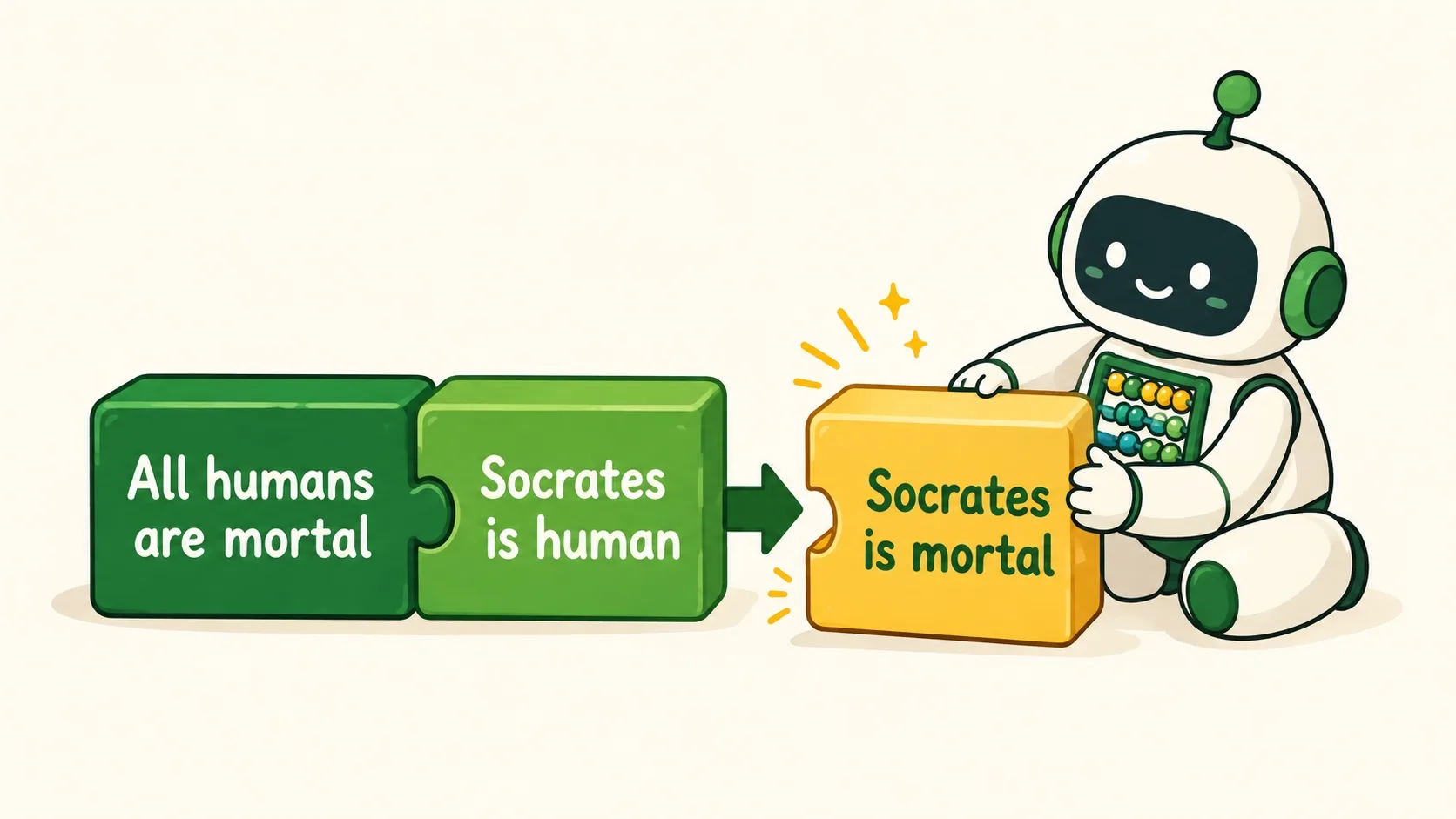
「人都会死」和「苏格拉底是人」两块积木先咬合,小算盘机器人再把第三块「苏格拉底会死」咔哒拼上。前两块是真的,第三块就一定真——这种“大前提 + 小前提 → 结论”的拼法叫三段论(Syllogism),两千多年前亚里士多德就写下了它。它不需要你认识苏格拉底,只要积木对、卡扣对,结论必然成立。The blocks “All humans are mortal” and “Socrates is human” lock together, and the little abacus robot clicks a third one into place: “Socrates is mortal”. If the first two are true, the third must be — this major-premise + minor-premise → conclusion pattern is a syllogism, written down by Aristotle over two thousand years ago. You don't need to know Socrates: fit the blocks and the buckle correctly, and the conclusion simply follows.
那是不是随便拼都行?当然不是——“如果……就……”的积木,只有两种合法拼法。So anything goes? No — the “if…then…” block has exactly two legal ways to snap.
第 2 步:踩得实的台阶与踩空的台阶Step 2: Stairs you can climb, stairs that give way
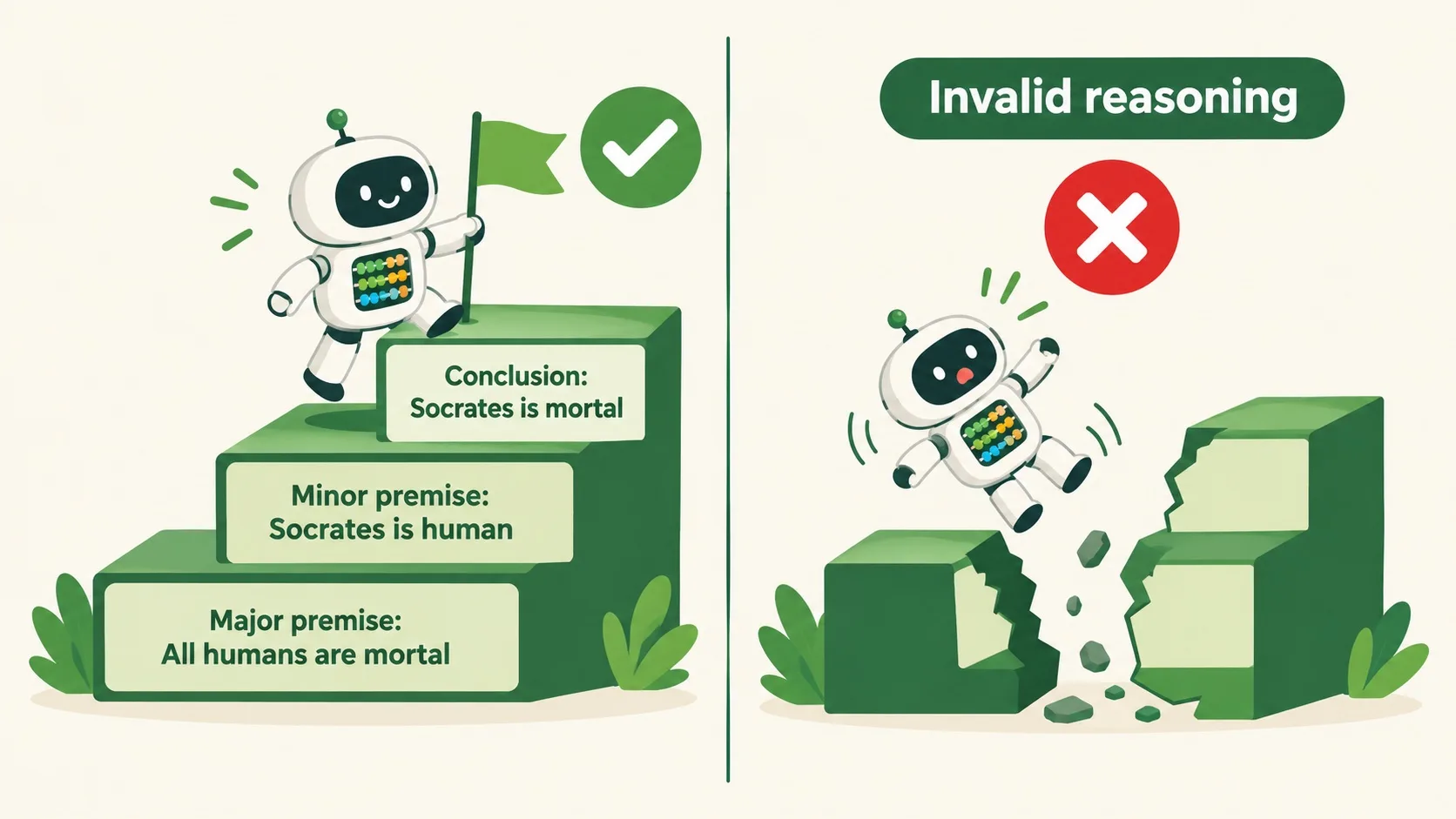
左边:大前提、小前提、结论三级台阶一级级踩实,机器人稳稳走上顶——这是有效的(valid)推理。右边:台阶中间断了,看着像路,一踩就摔——这是无效的(invalid)推理。换一组积木也一样:「如果下雨,地就湿」+「下雨了」→「地湿了」(肯定前件,前件成立结论就成立);「如果下雨,地就湿」+「地没湿」→「没下雨」(否定后件,后件不成立前件也不成立)。而反过来从「地湿了」推「下雨了」,或从「没下雨」推「地没湿」,都踩在断阶上——形式不对,结论就不保险。Left: major premise, minor premise, conclusion — three steps, each solid, and the robot climbs to the top. That's valid reasoning. Right: a staircase with a gap — it looks like a path, but the first step drops you. Swap in another set of blocks and nothing changes: “If it rains, the ground gets wet” + “It is raining” → “The ground gets wet” (modus ponens — the if-part holds, so the then-part holds); “If it rains, the ground gets wet” + “The ground is not wet” → “It is not raining” (modus tollens — the then-part fails, so the if-part fails). But running it backwards — “the ground is wet” therefore “it rained”, or “no rain” therefore “dry ground” — lands on the broken step: wrong form, no guarantee.
这套拼积木的功夫,也是计算机的看家本领。This block-snapping craft is also a computer's home turf.
第 3 步:计算机里的推理机器Step 3: The reasoning machine inside computers
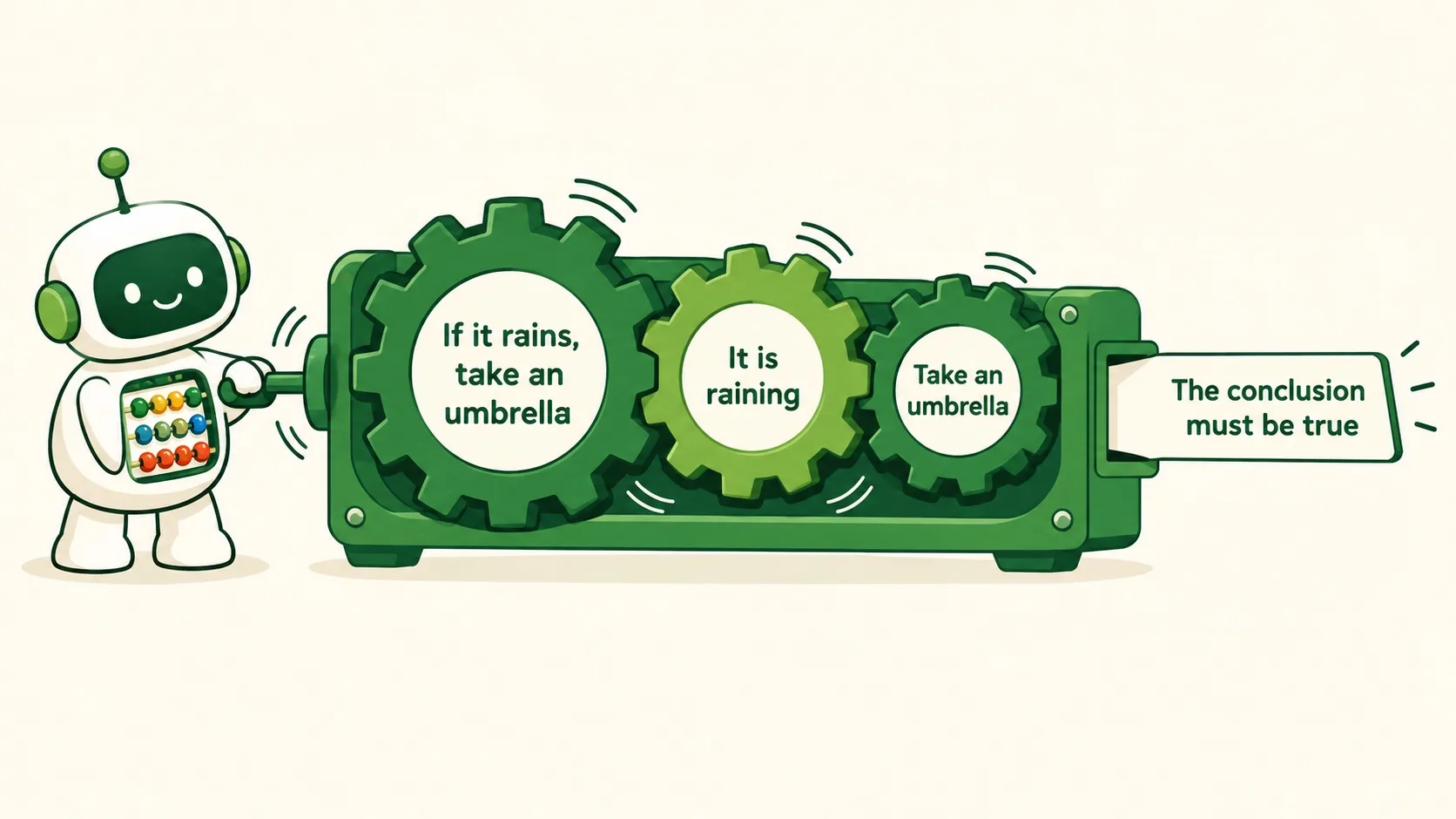
证明助手、逻辑编程语言、AI 解题系统,内核都是一台“推理机器”:前提像齿轮,一个咬一个,每转一格都保证为真,最后吐出一张写着「结论必然为真」的卡片。程序员的活儿,就是把前提喂对、把规则装好。数学里的证明、芯片电路的检查、智能助手一步步讲道理,靠的都是这条齿轮链。Proof assistants, logic-programming languages, AI solvers — at the core they are all “reasoning machines”: premises are gears that mesh one into the next, every turn guaranteed true, until a card slides out reading “The conclusion must be true”. The programmer's job is to feed in the right premises and install the right rules. Mathematical proofs, chip-circuit checks, assistants that reason step by step — all driven by this gear chain.
🎮 你来搭推理链(4 关)🎮 Your turn: snap the chain (4 rounds)
换你上手:每关有两块前提积木,从三块结论里挑出唯一能拼上的那块。拼对了,结论必然为真。Your turn: each round gives two premise blocks — pick the one conclusion block that truly snaps on. Fit it right, and the conclusion must be true.
一句话记住它:推理规则 = 拿已知为真的句子当积木,按有效形式拼出必然为真的新句子;形式对了,结论一定对。Remember it in one line: rules of inference let you snap true sentences together into a new sentence that must be true — right form, guaranteed conclusion.
三段论:大前提+小前提→结论(人都会死+苏格拉底是人→苏格拉底会死)Syllogism: major + minor premise → conclusion (All humans are mortal + Socrates is human → Socrates is mortal)两条最常用:肯定前件(P→Q,P 真则 Q 真);否定后件(P→Q,Q 假则 P 假)Two workhorses: modus ponens (P→Q, P true ⇒ Q true); modus tollens (P→Q, Q false ⇒ P false)反着套会踩空:肯定后件、否定前件都不成立;有效无效只看形式Backwards snaps fall through: affirming the consequent and denying the antecedent fail; validity depends on form alone
内容参考 OpenStax 等公开教材,多来源核对 · AI 生成、人工审核 · 发现错误欢迎指正,帮这片叶子长得更好。Based on OpenStax and other open textbooks, cross-checked across sources · AI-generated, human-reviewed · Spotted a mistake? Tell us — help this leaf grow.
 Back to tree