💈 罗素悖论:理发师给不给自己刮胡子?💈 Russell's Paradox: Who Shaves the Barber?
上一片说谎者悖论里,一句话绕回自己,就制造了说不清真假的死结。这一片,🧮 小算盘机器人走进一个村子:同样的怪圈,这次藏进了「集合」里,差点掀翻整座数学大厦。Last leaf, the liar paradox showed a sentence tying itself in a knot. This leaf, our little abacus robot visits a village where the same knot hides inside “sets” — and nearly toppled the whole building of mathematics.
第 1 步:理发师的规矩Step 1: The barber's rule
规矩只有一句,却把理发师本人圈了进去。One short rule — and it traps the barber himself.
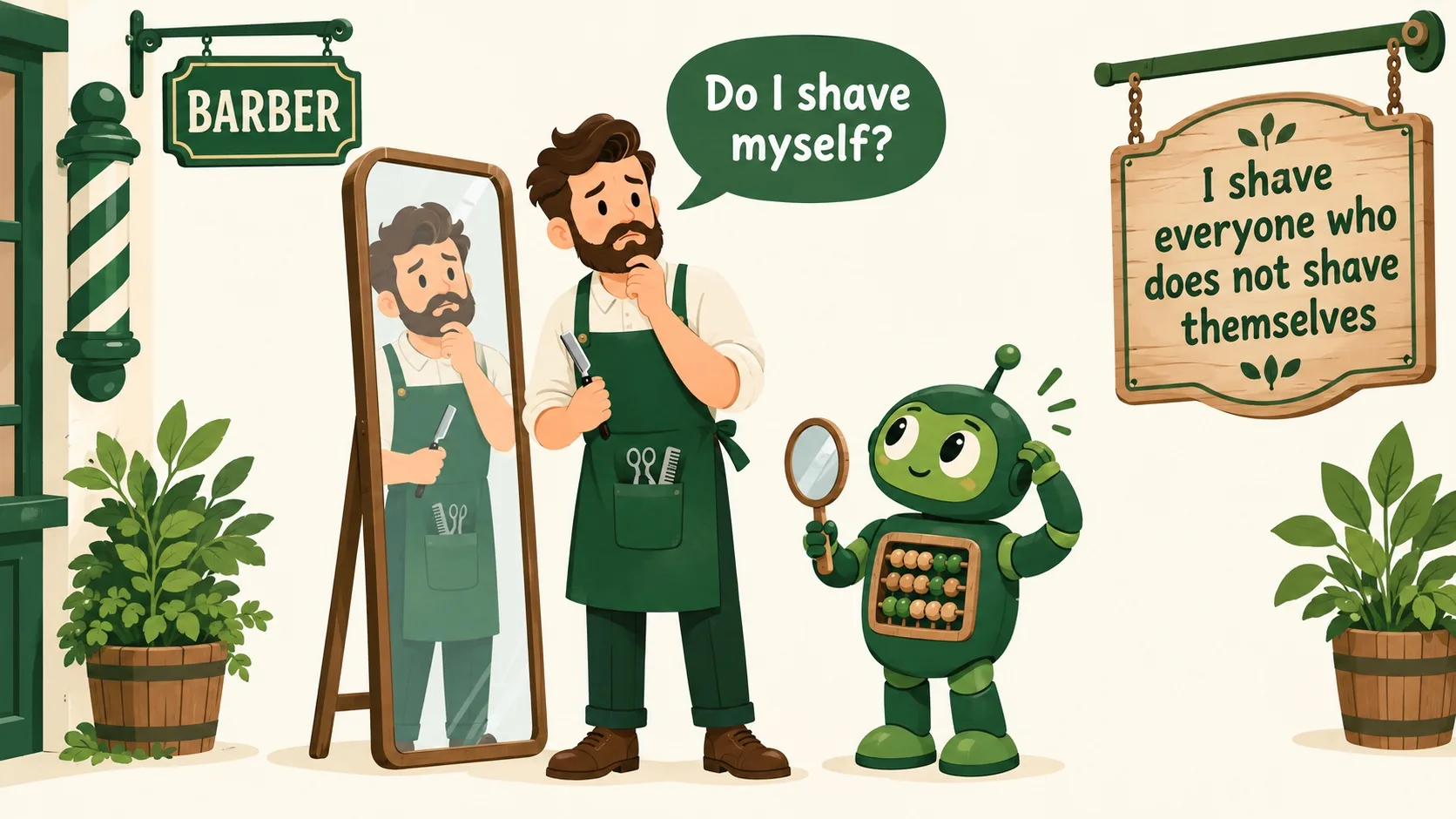
村里理发师挂出招牌:「给不自己刮胡子的人刮胡子。」听着没毛病。可他自己呢?给自己刮——他就成了「自己刮胡子的人」,按规矩不该给他刮;不给自己刮——他又成了「不自己刮胡子的人」,按规矩必须给他刮。两条路都堵死,这就是悖论(paradox)。A village barber hangs a sign: “I shave everyone who does not shave themselves.” Sounds fine. But what about the barber? If he shaves himself, he is someone who shaves himself — the rule says no. If he does not, he is someone who does not shave himself — the rule says yes. Both roads are blocked. That is a paradox.
看起来只是个脑筋急转弯?把它翻译成数学语言,事情就闹大了。Just a brain teaser? Translate it into the language of math and things get serious.
第 2 步:集合也在照镜子Step 2: Sets look in the mirror too
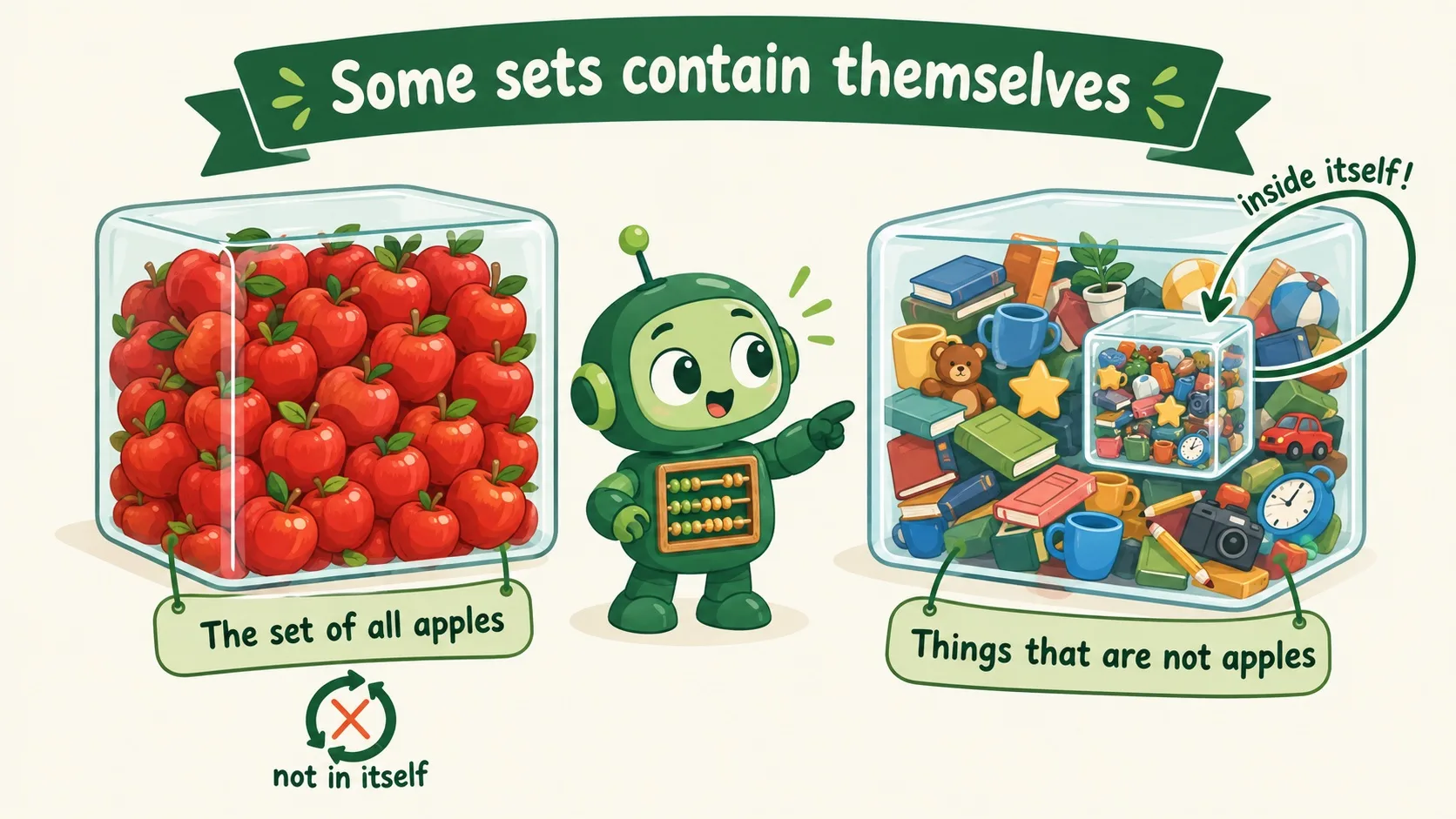
集合,就是把一堆东西打包。多数集合不包含自己:苹果集合不是苹果。可有的集合会包含自己:把所有「不是苹果的东西」打成一包,这包自己也不是苹果,于是它装进了自己。罗素追问:把所有「不包含自己的集合」打成一包——这包包含自己吗?装进去,它就成了「包含自己」,不该在里面;不装,它就是「不包含自己」,按定义又该进去。和理发师一模一样。A set is just a bundle of things. Most sets do not contain themselves: the set of apples is not an apple. But some do: bundle everything that is not an apple — the bundle itself is not an apple, so it lands inside itself. Then Russell asked: bundle all sets that do not contain themselves. Does this bundle contain itself? If yes, it contains itself — so it should not belong. If no, it does not contain itself — so by definition it belongs. Exactly the barber.
这不是玩笑——它真的把当时的数学地基震裂了。This was no joke — it really cracked the foundations of mathematics.
第 3 步:房子裂了,数学家来修Step 3: The house cracks, mathematicians repair
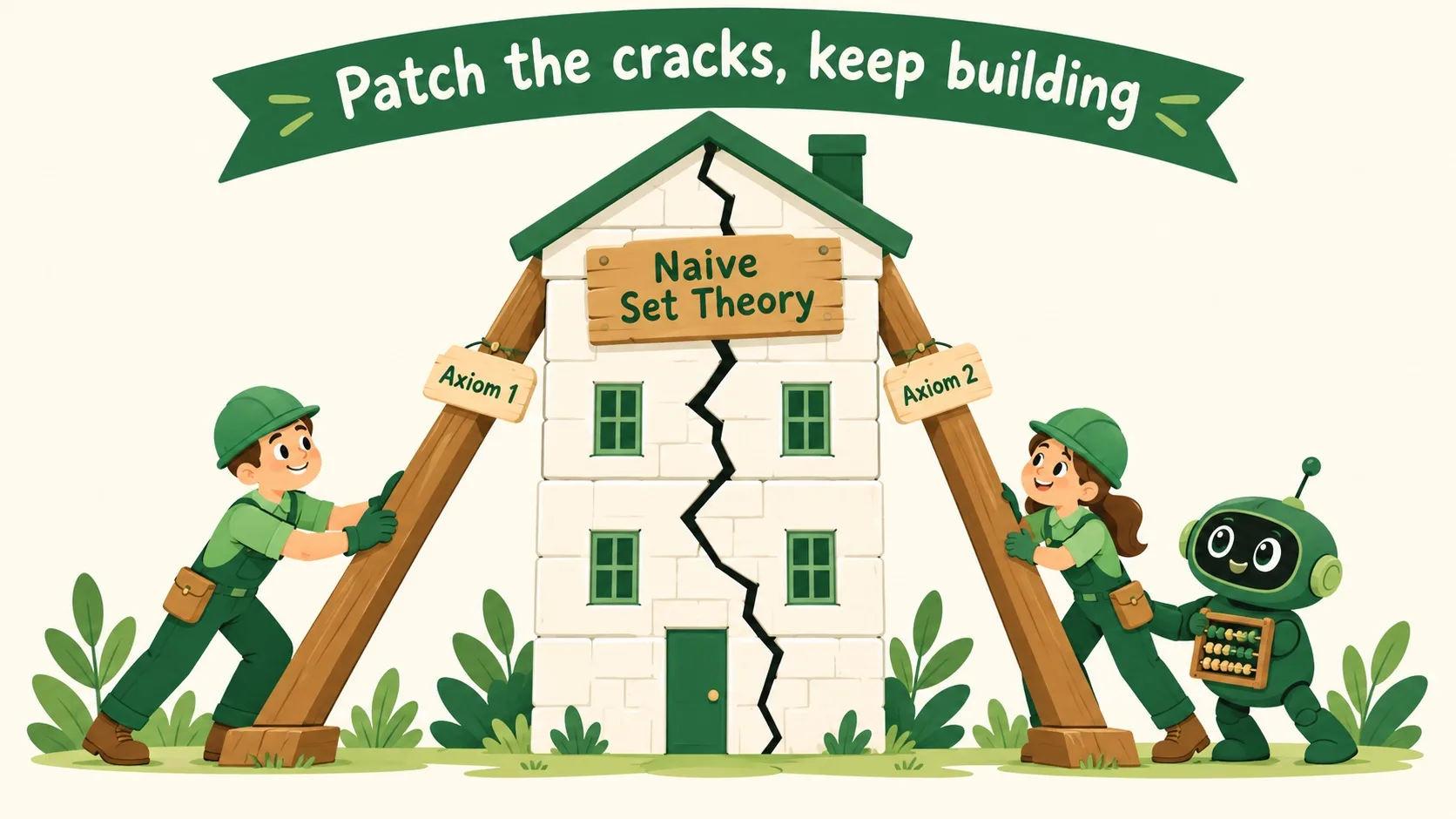
1901 年,罗素发现了这个矛盾,写信告诉弗雷格,弗雷格回信说「算术的地基摇晃了」。裂缝在哪?康托尔的朴素集合论(naive set theory)允许「随便一句描述都能打包成集合」,于是「所有集合的集合」这种打包闯了祸。修补办法:给打包立规矩——公理化集合论(如 ZF)只允许公理批准的方式打包,怪圈被挡在门外。今天数学,仍建在这套新地基上。In 1901, Russell found the contradiction and wrote to Frege, who replied that the ground of arithmetic was shaking. Where was the crack? Cantor's naive set theory allowed “any description can be bundled into a set” — so bundling “the set of all sets” broke everything. The fix: rules for bundling. Axiomatic set theory (such as ZF) only allows bundles approved by axioms, keeping the knot outside. Mathematics still stands on that new foundation today.
🎮 分类挑战:这张卡放哪个盒子?🎮 Sorting challenge: which box does this card belong in?
先别急着记结论。4 张卡片,两张分得轻松,另外两张你放哪边都会「炸」——去亲手体验一下。Don't rush to memorise the conclusion. Four cards: two sort easily; the other two explode whichever box you choose — go feel it for yourself.
一句话记住它:罗素悖论 =「所有不包含自己的集合」这个包,包不包含自己?一自我归类,两边矛盾;它逼数学家给集合论立下公理。Remember it in one line: Russell's paradox = the bundle of all sets that do not contain themselves: does it contain itself? Self-classify, and both answers clash — it forced mathematicians to rebuild set theory on axioms.
理发师:给自己刮、不给自己刮,两条路都堵死The barber: shaving or not shaving himself — both roads are blocked核心动作是「自我归类」:规则一用到自己身上,就绕成死结The key move is self-classification: apply the rule to itself and it knots后果:朴素集合论裂缝,数学转向公理化(如 ZF)The fallout: naive set theory cracked; math moved to axioms such as ZF
内容参考 OpenStax 等公开教材,多来源核对 · AI 生成、人工审核 · 发现错误欢迎指正,帮这片叶子长得更好。Based on OpenStax and other open textbooks, cross-checked across sources · AI-generated, human-reviewed · Spotted a mistake? Tell us — help this leaf grow.
 Back to tree