🧊 存储设备:断电不丢的冰箱🧊 Storage Devices: the fridge that never forgets
上一片的灶台(内存)一断电就清空。那照片、作业、游戏平时住哪?住在冰箱里——存储设备:又大又不怕断电,就是拿东西慢一点。Last leaf, the countertop (memory) went blank at power-off. So where do your photos, homework and games live? In the fridge — the storage device: big and power-proof, just slower to reach into.
第 1 步:存储 = 断电不丢的冰箱Step 1: Storage = the fridge that keeps things
先看看冰箱和灶台怎么配合。First, see how the fridge and the counter work together.
存储设备把数据长期存着,拔了电也不丢。开机或打开程序时,电脑从冰箱取出要用的,搬上灶台给 CPU。你按“保存”,就是把灶台上的菜放回冰箱。冰箱很大:1 TB = 1000 GB,能装约 25 万张照片。A storage device keeps data long-term, even unplugged. When you boot or open an app, the computer takes what it needs out of the fridge and up to the counter for the CPU. Pressing “Save” puts the dish back in the fridge. And the fridge is huge: 1 TB = 1000 GB, about 250,000 photos.
冰箱也分两种:一种要转要找,一种伸手就拿。Fridges come in two kinds: one spins and searches, one just reaches in.
第 2 步:机械硬盘 vs 固态硬盘Step 2: Hard disk vs solid-state drive
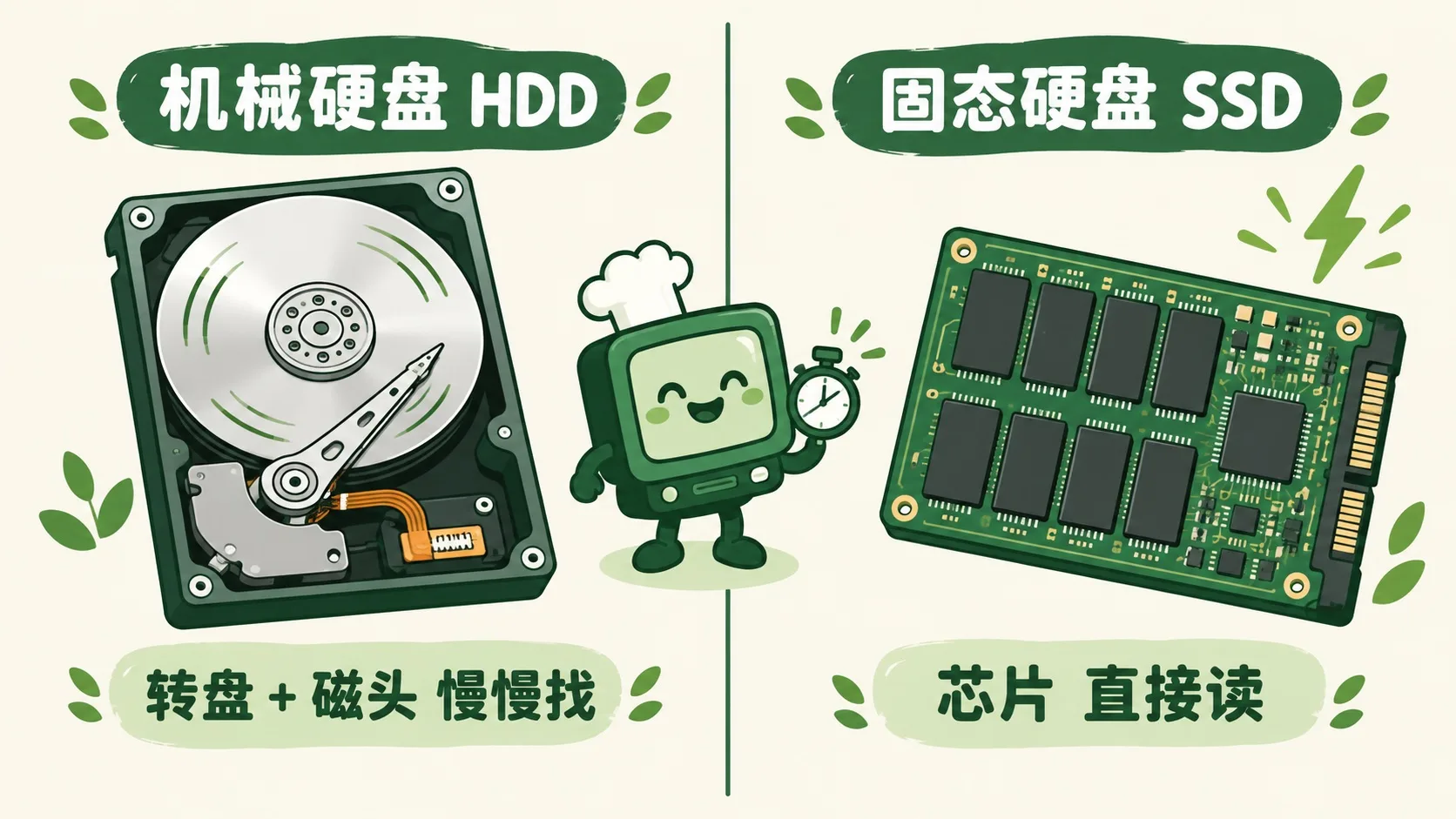
机械硬盘(HDD)里的磁盘高速旋转,磁头先挪到那一圈,再等数据转过来,读一次约 10 毫秒。固态硬盘(SSD)用闪存芯片,没有零件在动,读一次约 0.1 毫秒,快约 100 倍。U 盘、手机存储也都是闪存。A hard disk (HDD) has platters spinning fast: the head slides to the right ring, then waits for the data to spin by — about 10 ms per read. A solid-state drive (SSD) uses flash chips with no moving parts — about 0.1 ms, roughly 100× faster. USB sticks and phone storage are flash too.
SSD 这么快,为什么不全用它?甚至全用内存?If SSDs are so fast, why not use only them — or only memory?
第 3 步:存储金字塔——快的小,大的慢Step 3: The storage pyramid — fast is small, big is slow
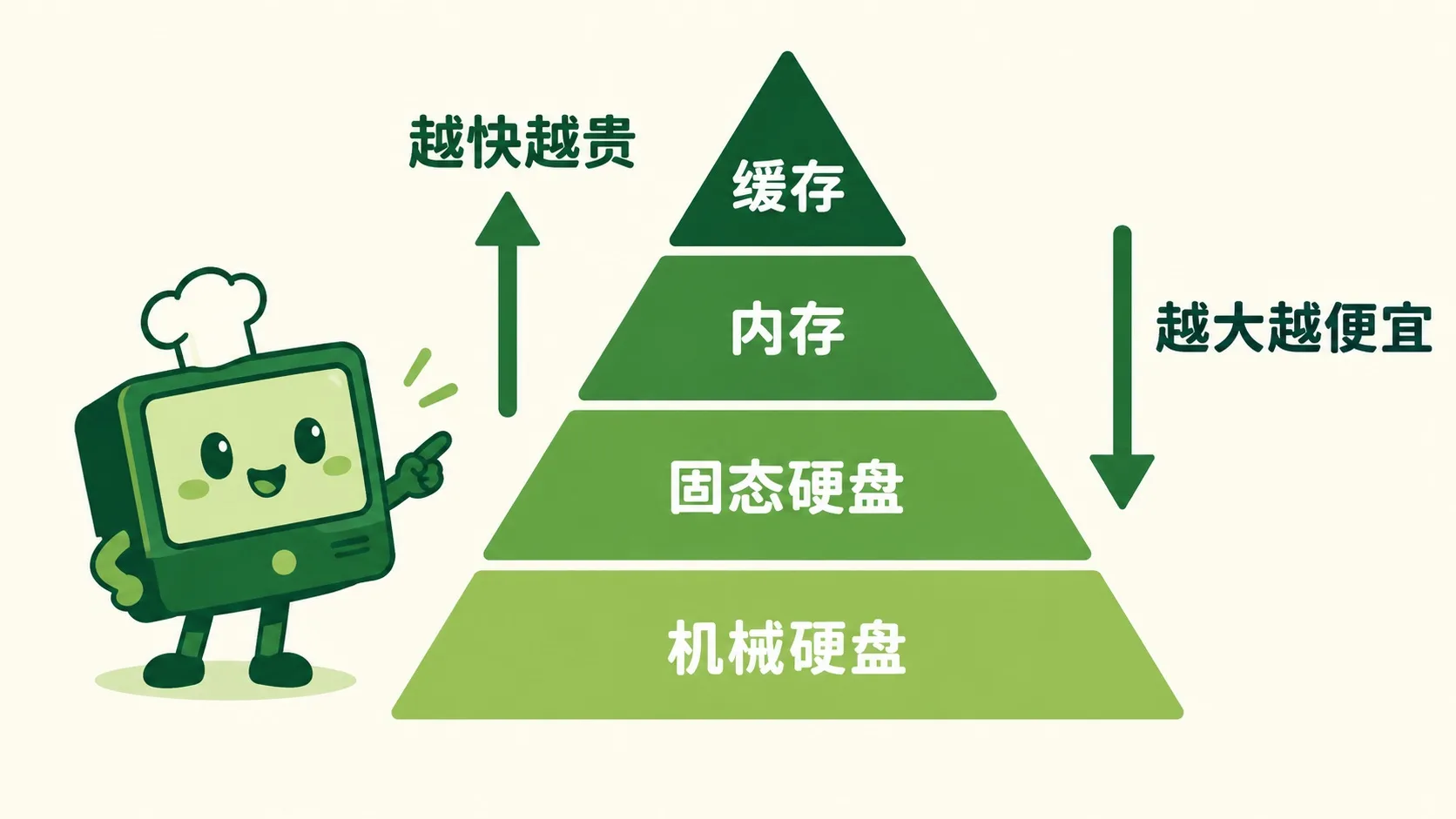
越快的越贵,所以做得越小。电脑把它们叠成金字塔:CPU 里的缓存最快最小,往下是内存、固态硬盘,最底层机械硬盘最大最便宜。常用的往上放,不常用的往下放,又快又省钱。云盘呢?就是别人家的大冰箱,靠网络去取。The faster it is, the pricier — so the smaller it gets. Computers stack them in a pyramid: the CPU's cache on top (fastest, tiniest), then memory, then SSD, and the hard disk at the bottom (biggest, cheapest). Busy data moves up, idle data sits low — fast and affordable. Cloud storage? Someone else's giant fridge, reached over the network.
🎮 硬盘赛跑 + 断电考验(30 秒)🎮 Your turn: drive race + power-cut test (30 seconds)
道理讲完了。先让 HDD 和 SSD 各读 5 张照片比快慢;再判断 4 样东西断电后还在不在。Theory done. First race an HDD against an SSD, 5 photos each; then judge whether 4 things survive a power cut.
一句话记住它:存储设备是断电不丢的冰箱:大、便宜、比内存慢;机械硬盘要转要找,固态硬盘芯片直读,快约 100 倍。Remember it in one line: a storage device is the fridge that survives power-off — big, cheap, slower than memory; a hard disk spins and seeks, an SSD reads chips directly, about 100× faster.
作用:长期存照片、作业、程序,拔电也不丢Role: keeps photos, homework and apps long-term, even unplugged两种:HDD 转盘加磁头约 10 毫秒,SSD 闪存约 0.1 毫秒Two kinds: HDD platter + head ~10 ms; SSD flash ~0.1 ms金字塔:缓存→内存→SSD→HDD,越往下越大越便宜越慢Pyramid: cache → memory → SSD → HDD — lower is bigger, cheaper, slower
内容参考 OpenStax 等公开教材,多来源核对 · AI 生成、人工审核 · 发现错误欢迎指正,帮这片叶子长得更好。Based on OpenStax and other open textbooks, cross-checked across sources · AI-generated, human-reviewed · Spotted a mistake? Tell us — help this leaf grow.
 Back to tree