📦 体积与表面积:装满 vs 包壳📦 Volume & Surface Area: Fill vs Wrap
上一片在菜园里分清了“围一圈”和“铺一层”。这一片机器人走进后院的打包间,把眼光从平面抬到立体:一个量盒子“里面装多少”,一个量“外面包多大”。Last leaf sorted out “around” and “inside” in the garden. Now the robot steps into the packing room and lifts its eyes from flat to solid: one idea is how much a box holds inside, the other how much it takes to wrap outside.
第 1 步:装满 vs 包壳Step 1: Fill vs wrap
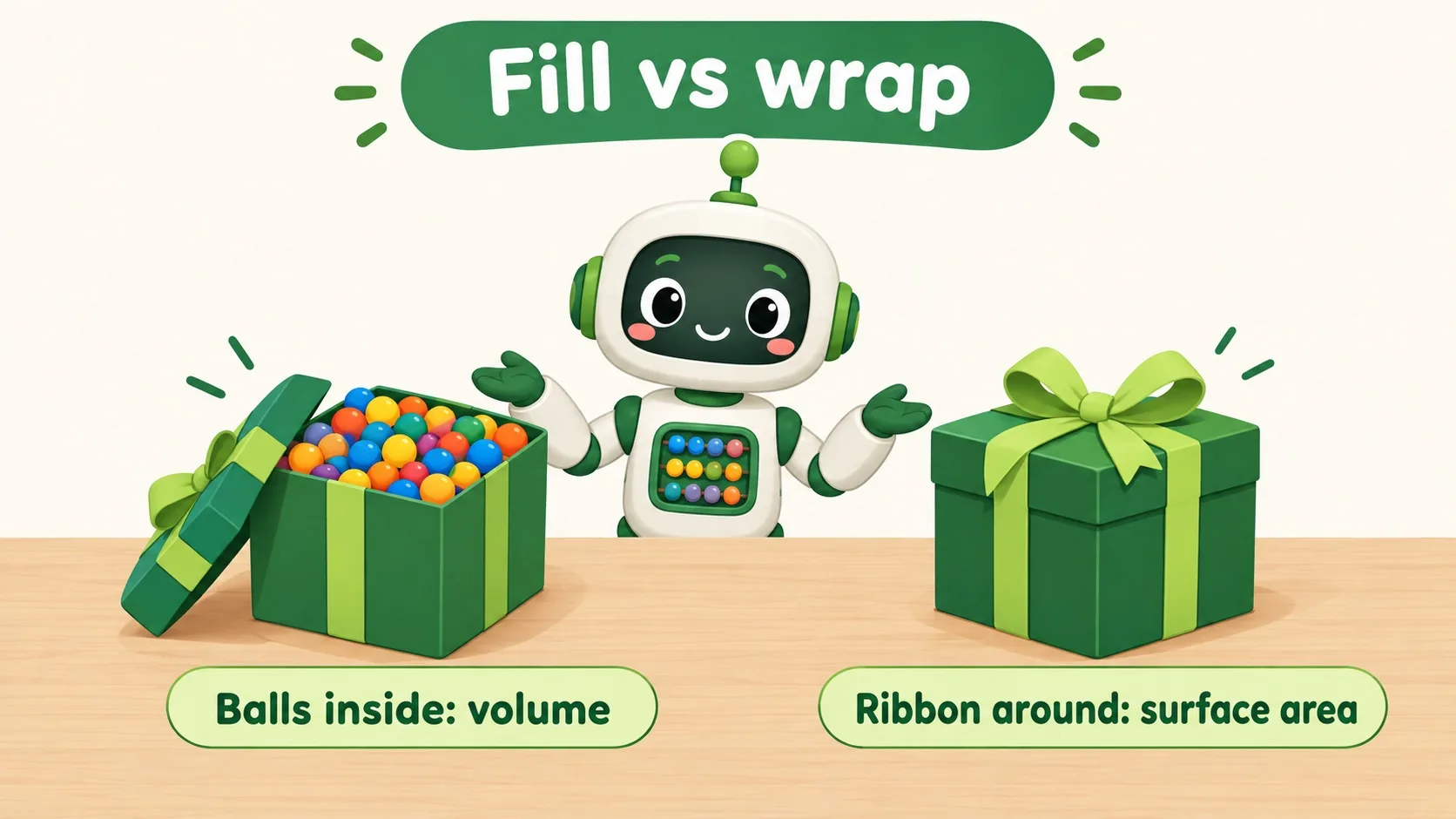
打包台上正好有两只一样的礼盒——一只在装,一只在包。Two identical gift boxes sit on the packing table — one is being filled, one is being wrapped.
左边盒里装满彩色小球——能装多少,是体积(volume),用立方单位(立方米);右边用丝带把盒子包起来——要包多大、多少纸,是表面积(surface area),用平方单位(平方米)。一个量“里面”,一个量“外面”。The left box is filled with colourful balls — how much fits inside is the volume, in cubic units (m³). The right box is wrapped with ribbon — how much paper and ribbon it takes is the surface area, in square units (m²). One measures the inside, the other the outside.
那两个量各自怎么算?机器人搬来一只水箱,当面算给你看。So how do you compute each one? The robot brings out a water tank and works it out on the spot.
第 2 步:水箱怎么算Step 2: The water tank test
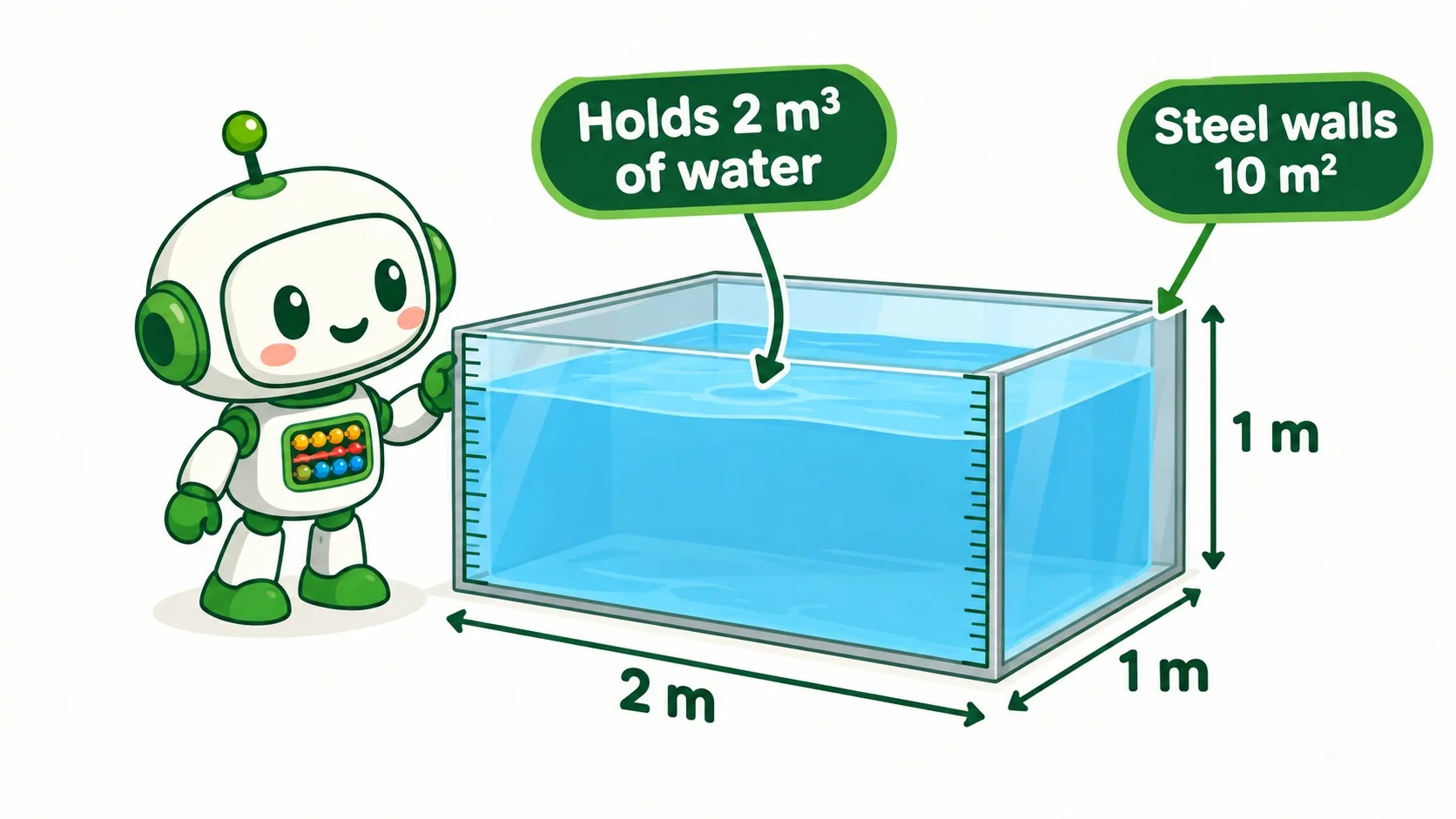
长方体:体积 = 长 × 宽 × 高;表面积 = 六个面加起来 =(长×宽 + 长×高 + 宽×高)× 2。这只 2 米 × 1 米 × 1 米的水箱:能装 2 立方米的水;包它需要的钢板是 10 平方米。一个数空间,一个数外壳。For a cuboid: volume = length × width × height; surface area = all six faces = (lw + lh + wh) × 2. This 2 m × 1 m × 1 m tank holds 2 m³ of water, while its steel skin takes 10 m². One measures space, the other the shell.
那快递盒为什么都要做得接近正方体?机器人算给你看。So why are parcel boxes designed close to a cube? The robot runs the numbers.
第 3 步:打包台的权衡Step 3: Trade-offs at the packing table
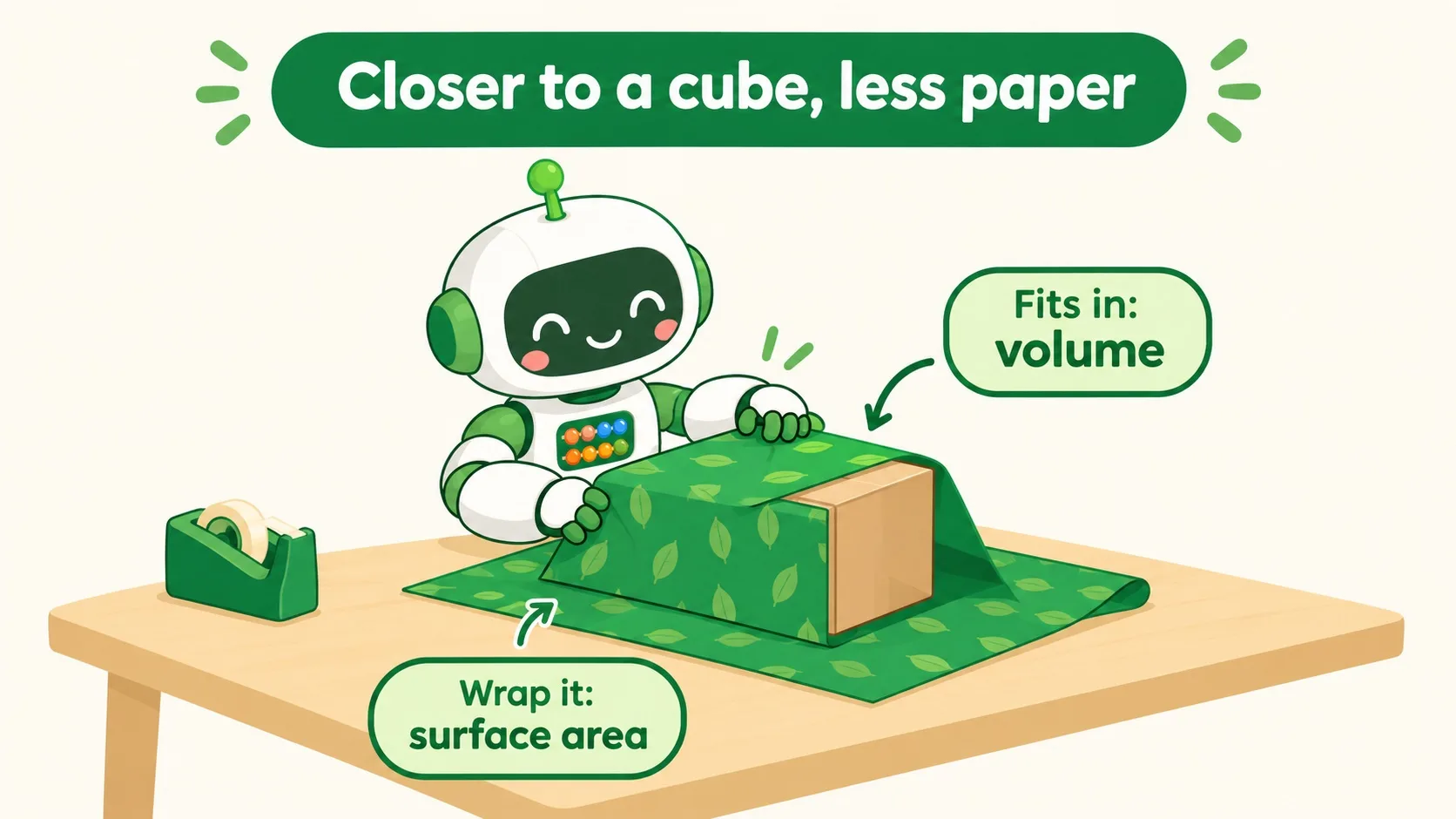
同样装 24 立方米:2×3×4 的盒子需要 52 平方米包装纸;换成 1×4×6 就要 68 平方米。体积一样,越接近正方体,表面积越小——越省纸。先保证装得下(体积),再挑最接近正方体的尺寸(省包装)。Same 24 m³ of contents: a 2×3×4 box needs 52 m² of paper; a 1×4×6 box needs 68 m². Same volume, but the closer to a cube, the smaller the surface — and the less paper. First fit the goods (volume), then pick the cube-like size (save paper).
🎮 你来设计盒子(1 分钟)🎮 Your turn: design the box (1 minute)
4 张订单等着你:体积要刚刚好,表面积还要尽量小。拖三根滑块试试。Four orders are waiting: hit each volume exactly, and keep the surface area as small as you can. Drag the three sliders.
一句话记住它:体积是“能装多少”(立方单位),表面积是“包壳多大”(平方单位);体积相同时,越接近正方体越省包装。Remember it in one line: volume is how much fits inside (cubic units); surface area is how much wraps outside (square units). For the same volume, closer to a cube means less wrapping.
体积 = 长 × 宽 × 高(立方米),量的是“里面”Volume = length × width × height (m³) — the inside表面积 = 六个面之和 =(长×宽 + 长×高 + 宽×高)× 2(平方米),量的是“外面”Surface area = six faces = (lw + lh + wh) × 2 (m²) — the outside体积一样时,越接近正方体,表面积越小、越省包装纸Same volume: closer to a cube → smaller surface → less paper
内容参考 OpenStax 等公开教材,多来源核对 · AI 生成、人工审核 · 发现错误欢迎指正,帮这片叶子长得更好。Based on OpenStax and other open textbooks, cross-checked across sources · AI-generated, human-reviewed · Spotted a mistake? Tell us — help this leaf grow.
 Back to tree