🚪 波的衍射:绕过障碍与钻过缝隙🚪 Wave Diffraction: Bending Around and Through
上一片里,两列波相遇时会叠加;这一片换一个方向:让一列波独自碰上缝隙和障碍——看它的路线怎么拐弯。Last leaf, two waves met and added up. This leaf goes the other way: send one wave alone at a gap or an obstacle — and watch its path bend.
第 1 步:只有一个缺口,港内照样起浪Step 1: One gap is enough
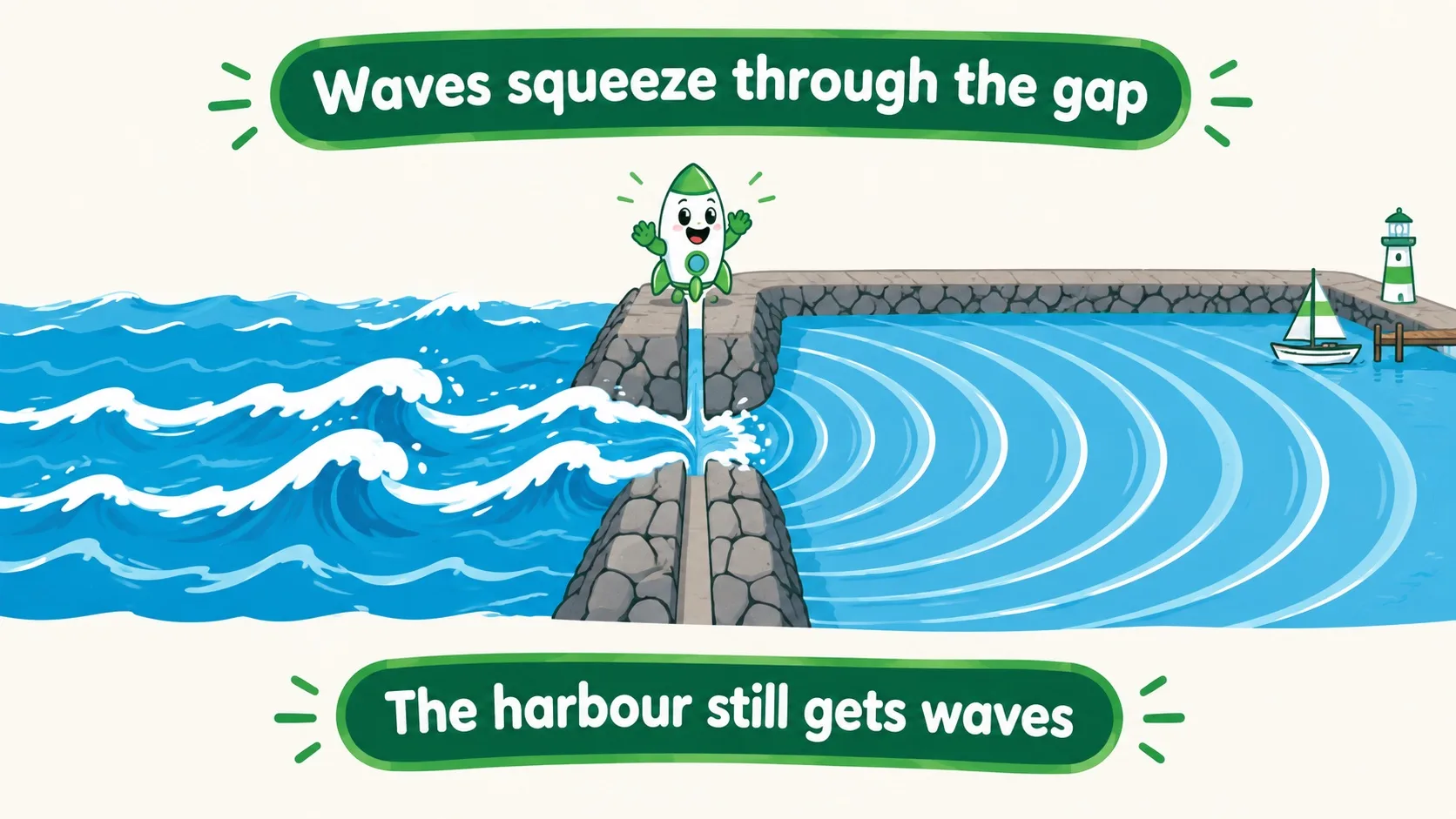
先跟着小火箭去海边看一座防波堤——堤上只有一个缺口。Follow the little rocket to the seaside: a breakwater with a single gap.
防波堤挡住大部分海浪,但浪从缺口一挤进来就“散架”:不再直着走,而是向两边拐,变成一圈圈扇形波纹铺满港内。波遇到障碍或缝隙时改变方向、绕着走,这种本领叫衍射(diffraction)。The breakwater blocks most of the waves, but the ones that squeeze through the gap fall apart: instead of going straight they bend sideways and spread into fans of ripples all over the harbour. When a wave changes direction around an obstacle or a gap, that's diffraction.
你可能会想:缝隙多大才叫“小”?You might ask: how small does a gap have to be?
第 2 步:缝越小,散得越开Step 2: The narrower the gap, the wider the spread
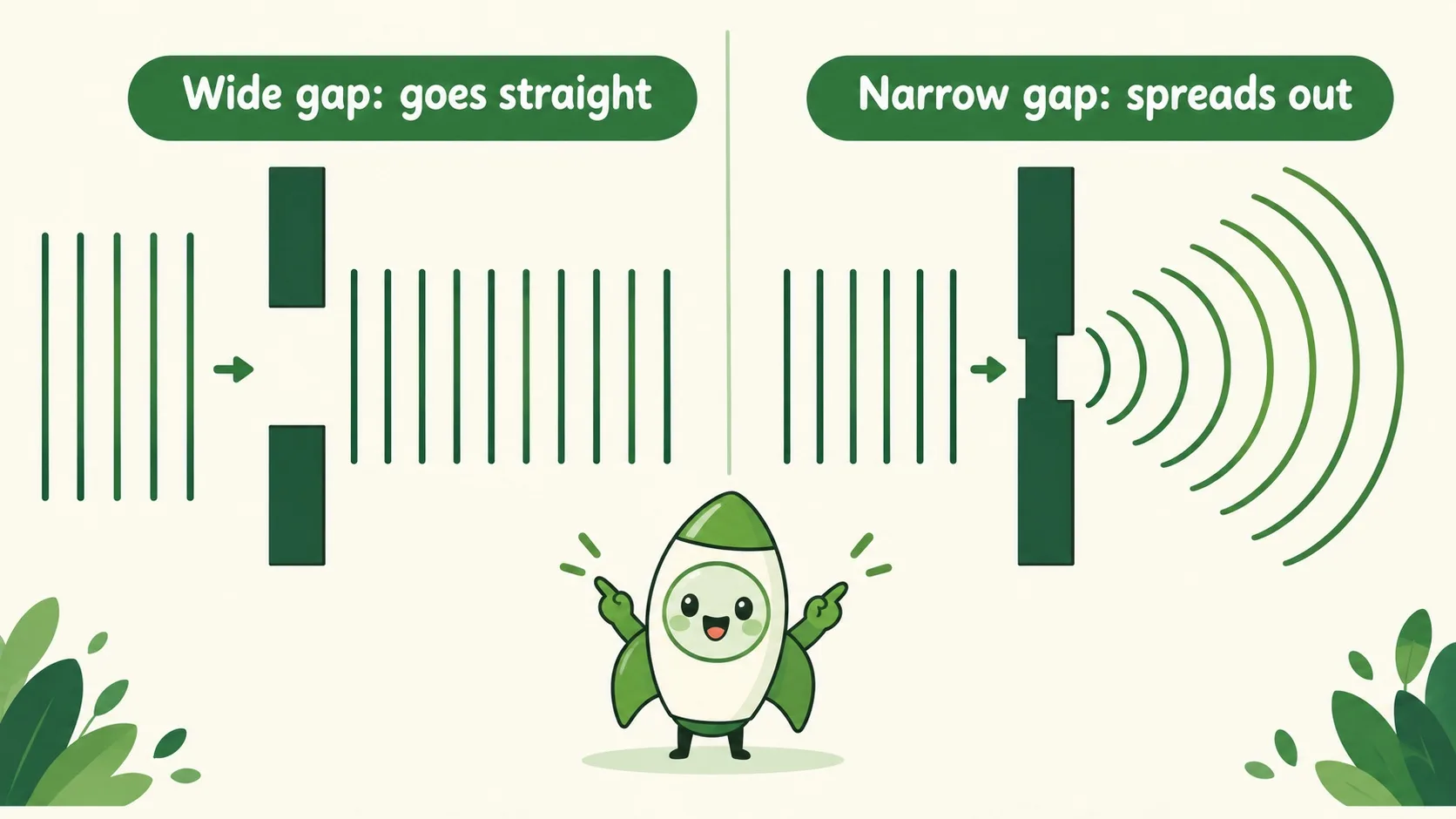
比一比:缝宽比波长大得多时(左),波几乎直直穿过;缝窄到和波长差不多、甚至更小时(右),穿过后散成半个圆。关键不是缝的绝对大小,而是缝宽与波长的比值——缝相对越小、波长越长,衍射越明显。Compare: when the gap is far wider than the wavelength (left), waves pass almost dead straight; when the gap shrinks to about the wavelength or smaller (right), they fan out into a half-circle. What matters isn't the gap's absolute size, but the ratio of gap width to wavelength — a smaller gap and a longer wavelength mean stronger diffraction.
那为什么人躲在墙后,看不到人却听得见说话声?So why can you hear someone talking behind a wall, but not see them?
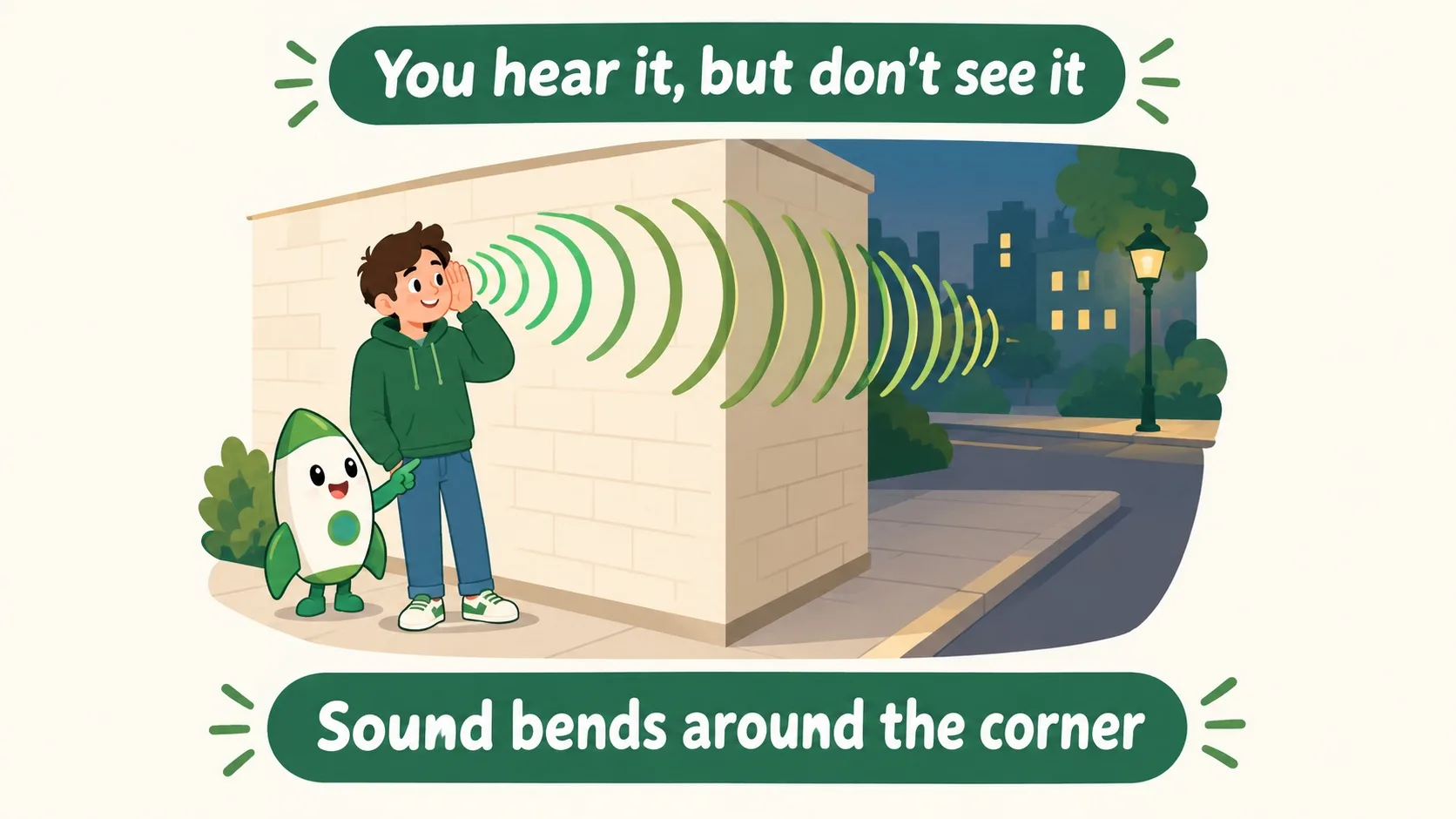
第 3 步:闻其声,不见其人Step 3: You hear it, but don't see it
声音的波长很长(人声约 1 米),墙角、门缝对它来说都是“小缝”,它绕个弯就钻进耳朵——所以“闻其声,不见其人”。光的波长只有几百纳米,远远小于墙缝,几乎不衍射,所以你看不见墙后的人。Sound has a long wavelength (a human voice is about 1 m), so walls and doorways count as narrow gaps — it simply bends around and reaches your ears. Light's wavelength is only a few hundred nanometres, far smaller than the gap, so it barely diffracts: you can't see the person behind the wall.
🎮 你来当实验员(30 秒)🎮 Your turn: run the lab (30 seconds)
道理讲完了。拖动“缝隙宽度”和“波长”两个滑块,看波纹是直着走还是散成扇面;4 个实验任务在等你。Theory done. Drag the “gap width” and “wavelength” sliders to see whether ripples go straight or spread wide — 4 experiments await.
一句话记住它:衍射 = 波遇到缝隙或障碍时“拐弯”的本领;缝相对波长越小、波长越长,衍射越明显。Remember it in one line: diffraction is a wave's talent for bending around gaps and obstacles — the smaller the gap relative to the wavelength, the stronger it is.
波遇到缝隙或障碍会绕行、散开——这就是衍射(diffraction)Waves bend and spread around gaps and obstacles — that's diffraction缝宽比波长大得多:几乎直着走;缝宽接近或小于波长:散成大扇面Gap far wider than wavelength: almost straight; gap near or smaller: a wide fan声波波长长(约 1 米),能绕过墙角——“闻其声,不见其人”;光波太短,绕不过墙Sound's wavelength is long (about 1 m) so it bends around corners; light's is tiny, so it can't
内容参考 OpenStax 等公开教材,多来源核对 · AI 生成、人工审核 · 发现错误欢迎指正,帮这片叶子长得更好。Based on OpenStax and other open textbooks, cross-checked across sources · AI-generated, human-reviewed · Spotted a mistake? Tell us — help this leaf grow.
 Back to tree