三角枝告一段落,统计枝从这片叶子发芽。第一个问题天天都会遇到:一堆高高低低的数,怎么用一个数说出它们的“一般水平”?小算盘机器人先端来三杯水。The trigonometry branch is done; the statistics branch sprouts here. Our first question comes up every day: how can one number describe the “typical level” of a pile of ups and downs? The little abacus robot starts with three glasses of water.
第 1 步:移多补少的直觉Step 1: The intuition — pour from the full
三个杯子的水不一样高,怎么让它们一样高,又一滴水都不浪费?Three glasses hold different amounts. How do you level them without wasting a single drop?
小算盘机器人把 6 号杯里多的 2 份水倒进 2 号杯:6 降到 4,2 升到 4,三杯齐平在 4。像这样“移多补少”,最后一样高的那个数,就是平均数(mean)。水一滴没多、一滴没少——总量始终不变。The robot pours the extra from glass 6 into glass 2: 6 drops to 4, 2 rises to 4, and all three settle level at 4. This “pour from the full, fill the empty” move is the intuition behind the mean. Not a drop is added or lost — the total never changes.
可要是一堆数有几十个,倒来倒去太慢了——能不能直接算出来?But with dozens of numbers, pouring gets slow — can we just compute it?
第 2 步:总量 ÷ 个数,一个算式搞定Step 2: Total ÷ count — one formula does it
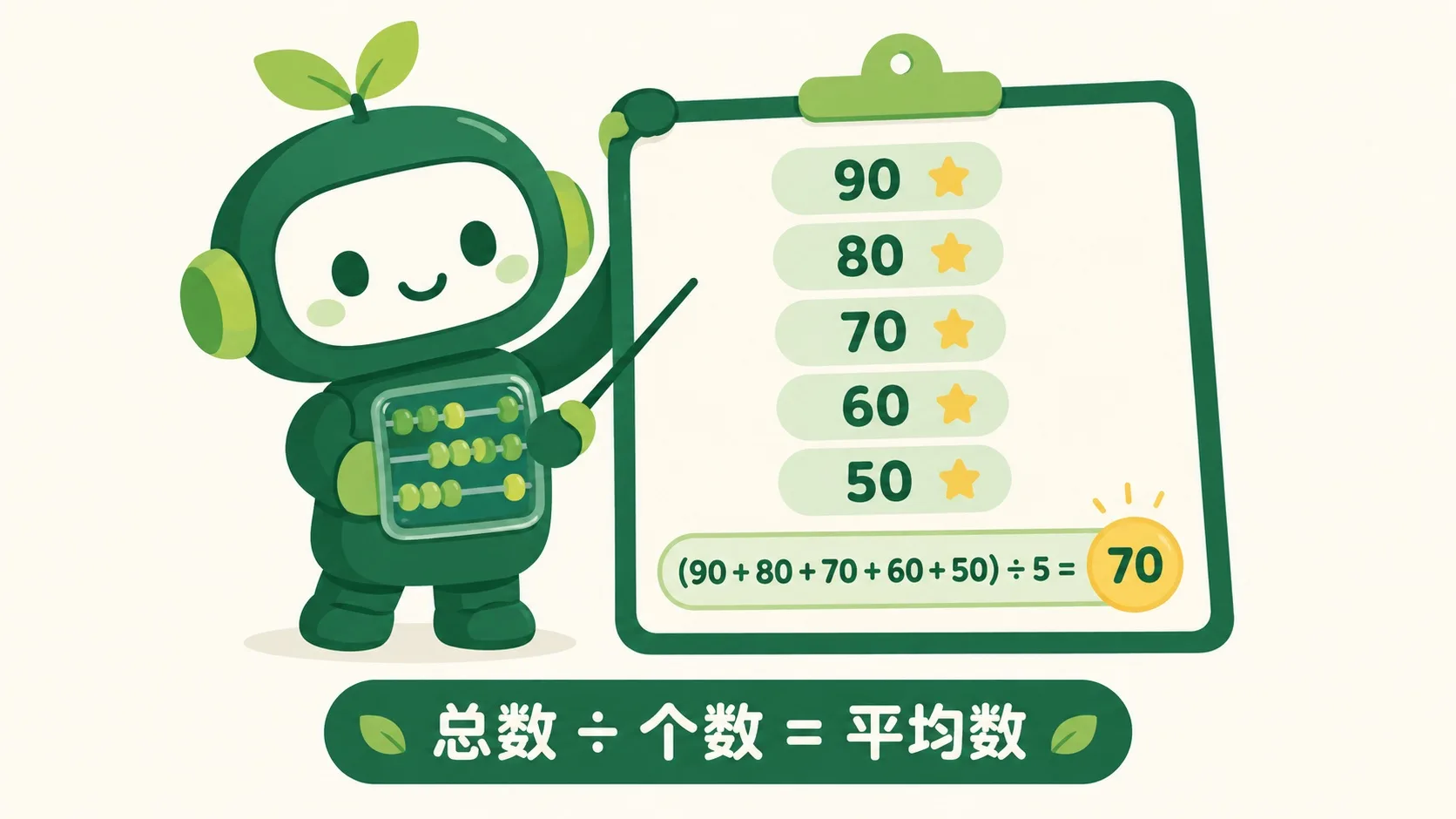
能。先把所有数加起来得到总量,再平摊给每个数:总量 ÷ 个数 = 平均数。五张成绩单 90、80、70、60、50,加起来是 350;350 ÷ 5 = 70。移多补少和总量均摊,其实是同一件事的两面。Yes. Add every value to get the total, then share it out evenly: total ÷ count = mean. The five scores 90, 80, 70, 60, 50 add up to 350; 350 ÷ 5 = 70. Pouring and sharing out are two faces of the same idea.
听起来很好用。但它有没有怕的东西?Sounds handy. Is there anything it fears?
第 3 步:它对极端值很敏感Step 3: One extreme value tugs it
四位同学平均身高 1.4 米,看起来很稳——可这个 1.4 是怎么来的?队伍里有一位 1.7 米的高个子,比最矮的 1.2 米高出半米。他一个人就把平均数从 1.3 米抬到 1.4 米,另外三人谁也够不着这条线。平均数对极端值很敏感:一个特别大(或特别小)的值,会把整体拉向自己。The four friends average 1.4 m — seems steady. But where does that 1.4 come from? One of them stands 1.7 m, half a metre above the shortest at 1.2 m. He alone lifts the mean from 1.3 m to 1.4 m — a line the other three cannot reach. The mean is sensitive to extreme values: one unusually big (or small) value drags the whole thing toward itself.
🎮 调平器:让平均线对准目标(4 关)🎮 The leveler: aim the mean at the target (4 levels)
拖动柱子或下面的滑块,先看清“总共差多少”,再移多补少;第 4 关调平就撒花。Drag the bars or the sliders below. Watch how far the total is off, then pour from the full into the empty. Level all 4 for confetti.
一句话记住它:平均数 = 总量 ÷ 个数;它把“移多补少”写成了一个算式,也因此害怕极端值。Remember it in one line: the mean = total ÷ count. It turns “pour from the full” into a formula — and that is why extreme values can tug it.
移多补少:多的补给少的,总量始终不变Pour from the full into the empty; the total never changes算法:把所有数加起来,再除以个数The recipe: add every value, then divide by how many there are一个特别大或特别小的值,会把平均数拉向自己One unusually big or small value pulls the mean toward itself
内容参考 OpenStax 等公开教材,多来源核对 · AI 生成、人工审核 · 发现错误欢迎指正,帮这片叶子长得更好。Based on OpenStax and other open textbooks, cross-checked across sources · AI-generated, human-reviewed · Spotted a mistake? Tell us — help this leaf grow.
 Back to tree