🪜 等差数列:每步都跨一样远🪜 Arithmetic Sequences: Equal Steps Every Time
上一片,机器人把糖一份份分匀,每一步都稳稳当当。今天它要爬一段楼梯——每一级都抬高同样的高度。这种“每步一样远”的数列,就叫等差数列。Last leaf, the robot shared candies evenly — every step steady. Today it climbs a staircase where each step rises by exactly the same amount. A sequence that takes equal steps everywhere: that's an arithmetic sequence.
第 1 步:楼梯上的数列Step 1: A sequence on the stairs
一串数要满足什么,才叫“等差”?What makes a list of numbers “arithmetic”?
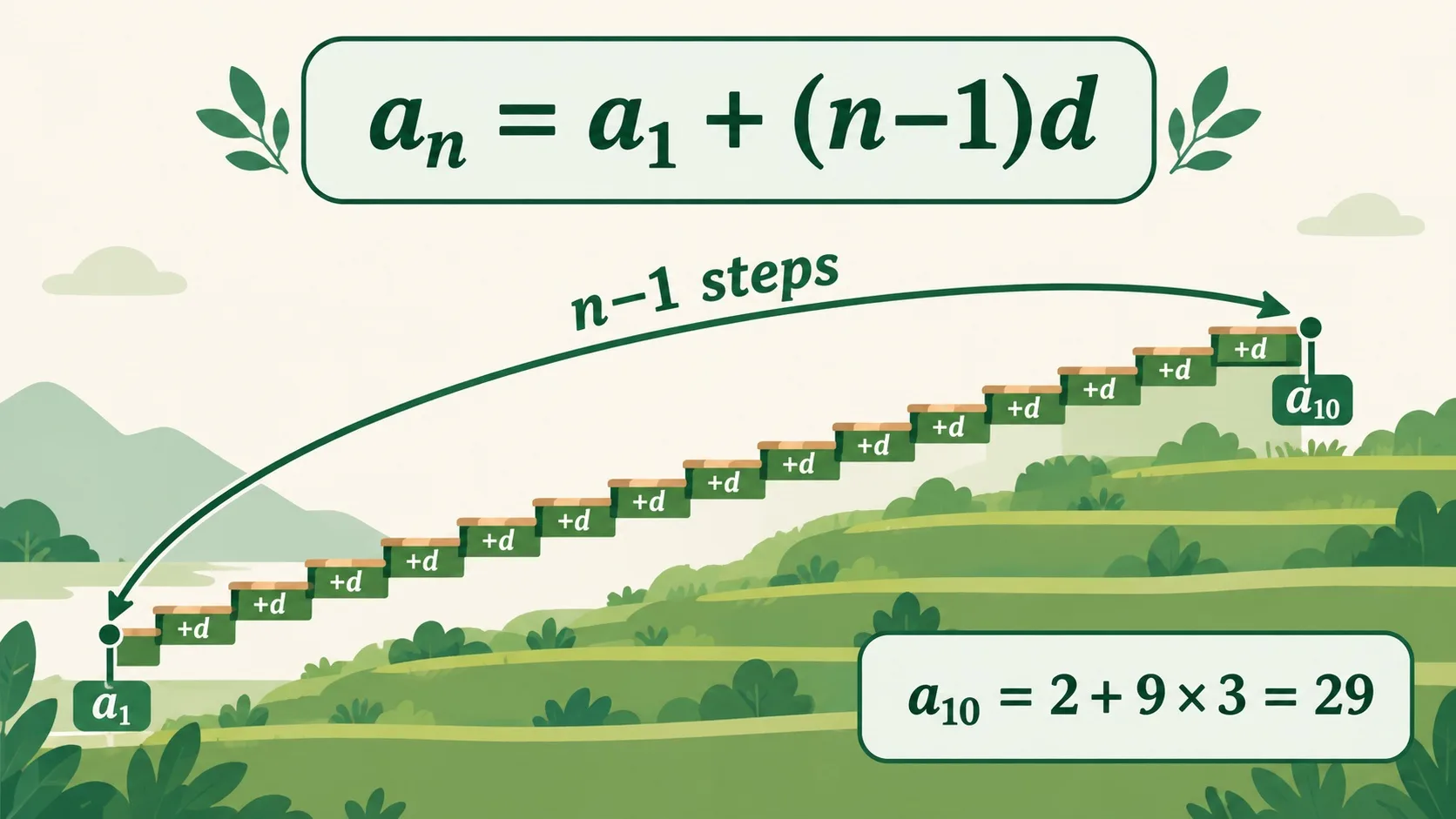
楼梯每一级都抬高 3:2、5、8、11……每个数都比前一个大 3。像这样相邻两项的差固定不变的数列,叫等差数列;这个固定的差叫公差,通常用 d 表示。最前面的数叫首项 a₁,这里 d = 3。Every step rises by 3: 2, 5, 8, 11…, each number exactly 3 more than the one before. A sequence whose neighbouring terms always differ by the same amount is an arithmetic sequence; that fixed amount is the common difference d. The first term is a₁ — here d = 3.
不想一级一级数,能直接算出第 100 级吗?Counting step by step is slow — can we jump straight to step 100?
第 2 步:通项公式,一步登顶Step 2: The general term — straight to the top
从第 1 级到第 n 级,要走 n−1 步(第 1 级本身不算走)。每步加一个 d,所以第 n 级 = 首项 + (n−1) 个 d,写成公式:aₙ = a₁ + (n−1)d。想算第 10 级?a₁₀ = 2 + 9 × 3 = 29——一次算出,不用数九遍。From step 1 to step n there are n−1 jumps (step 1 itself is not a jump). Each jump adds one d, so the nth term = first term + (n−1) copies of d: aₙ = a₁ + (n−1)d. Want step 10? a₁₀ = 2 + 9 × 3 = 29 — one calculation, no counting.
这条规律只出现在楼梯上吗?Does this pattern only live on staircases?
第 3 步:电影院里的等差数列Step 3: Arithmetic in the cinema
电影院每排座位常常比前一排多 2 个:第 1 排 10 号起、第 2 排 12 号起、第 3 排 14 号起……排号就是一个等差数列,a₁ = 10、d = 2,第 8 排的起始号 = 10 + 7 × 2 = 24。存钱罐每天多存 5 元、日历每 7 天一个循环……只要“每步一样多”,都能用 aₙ = a₁ + (n−1)d 一步算出来。Cinema rows often gain 2 more seats each: row 1 starts at 10, row 2 at 12, row 3 at 14… The row numbers form an arithmetic sequence with a₁ = 10 and d = 2; row 8 starts at 10 + 7 × 2 = 24. Saving 5 yuan more each day, a calendar cycling every 7 days… whenever the steps are equal, aₙ = a₁ + (n−1)d gets you there in one jump.
🎮 你来砌楼梯(1 分钟)🎮 Your turn: build the stairs (1 minute)
从 a₁ = 2 出发,每级 +3,一级一级砌到第 9 级——然后猜猜第 10 级有多高。Start at a₁ = 2, add 3 per step, build up to step 9 — then guess how tall step 10 will be.
一句话记住它:等差数列 = 每步跨一样远;通项公式 aₙ = a₁ + (n−1)d,一步算到任何一级。Remember it in one line: an arithmetic sequence takes equal steps every time; the general term aₙ = a₁ + (n−1)d jumps straight to any step.
相邻两项的差固定不变,这个差就是公差 dThe difference between neighbours is constant — that's the common difference d通项公式 aₙ = a₁ + (n−1)d:走 n−1 步,每步加一个 dGeneral term aₙ = a₁ + (n−1)d: n−1 jumps, one d each生活里到处是:楼梯、电影院排号、每天多存的钱……They are everywhere: stairs, cinema rows, extra savings each day…
内容参考 OpenStax 等公开教材,多来源核对 · AI 生成、人工审核 · 发现错误欢迎指正,帮这片叶子长得更好。Based on OpenStax and other open textbooks, cross-checked across sources · AI-generated, human-reviewed · Spotted a mistake? Tell us — help this leaf grow.
 Back to tree