🔗 化学键:原子之间为什么抱团🔗 Chemical Bonds: Why Atoms Stick Together
上一片里,原子会手拉手组成分子,也会带电抱团成离子。可它们到底靠什么黏在一起?⚗️ 小烧瓶递来三瓶"胶水"。Last leaf, atoms held hands into molecules and charged up into ions. But what actually glues them together? ⚗️ Our flask brings out three bottles of "glue".
第 1 步:共价键——共用电子对Step 1: Covalent bond — a shared electron pair
先看"手拉手"用的那瓶胶水。First, the glue behind "holding hands".
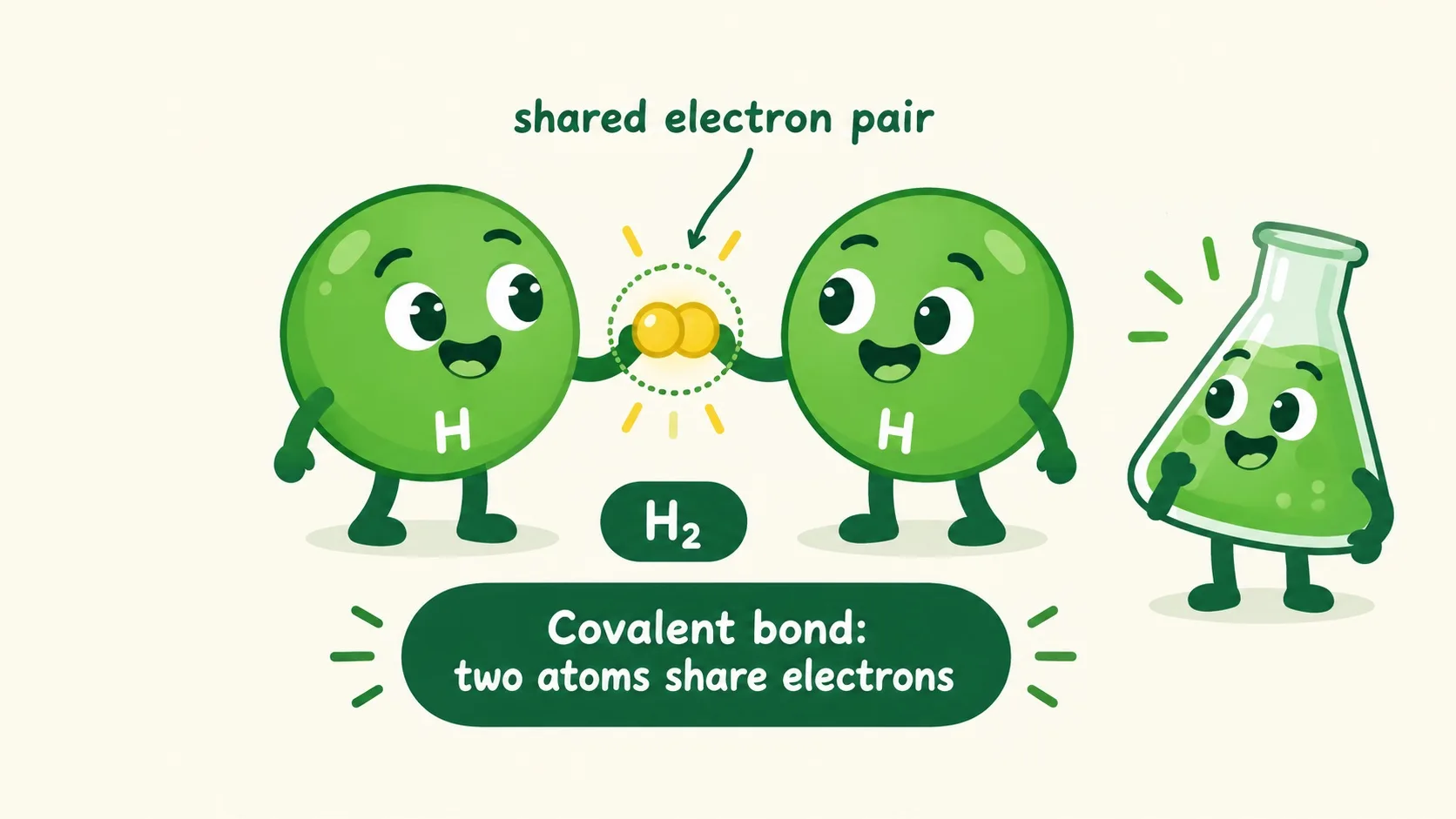
两个氢原子各出 1 个电子,凑成一对"共用电子"。这对电子像两只手抓住同一个小球,把两个原子牢牢黏住——这种胶水叫共价键。水、氧气、二氧化碳里,装的全是共价键。Two hydrogen atoms each contribute 1 electron, forming one shared pair. Like two hands gripping the same ball, that pair glues the atoms together — this glue is a covalent bond. Water, oxygen and carbon dioxide are all held by covalent bonds.
那"带电抱团"用的,又是哪瓶胶水?So which glue holds the "charged team-ups" together?
第 2 步:离子键——正负相吸Step 2: Ionic bond — opposite charges attract
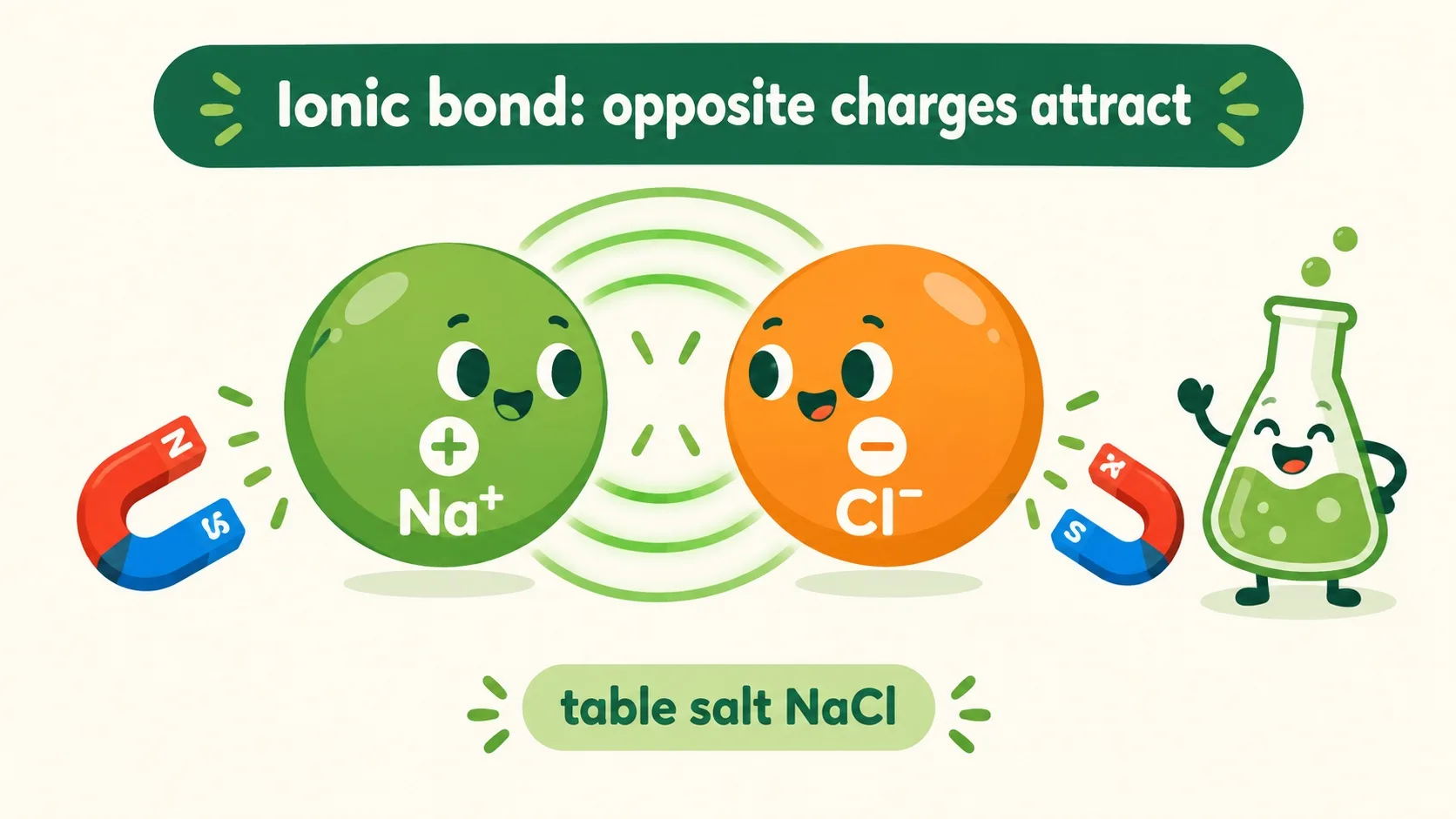
钠把 1 个电子让给氯:Na 变成 Na⁺,Cl 变成 Cl⁻。正负电荷像两块磁铁,隔着距离也互相吸住——这瓶胶水叫离子键。食盐里,每个 Na⁺ 四周全是 Cl⁻,码成整齐的晶格。Sodium hands 1 electron over to chlorine: Na becomes Na⁺, Cl becomes Cl⁻. Like two magnets, opposite charges attract across a distance — that glue is an ionic bond. In salt, every Na⁺ is surrounded by Cl⁻, packed into a neat lattice.
还有第三种胶水藏在金属里;顺便看看拆胶水要花多大力气。A third glue hides inside metals — and let's also check the effort it takes to pull glue apart.
第 3 步:金属键彩蛋,与拆开的代价Step 3: Metallic bond bonus — and the price of pulling apart
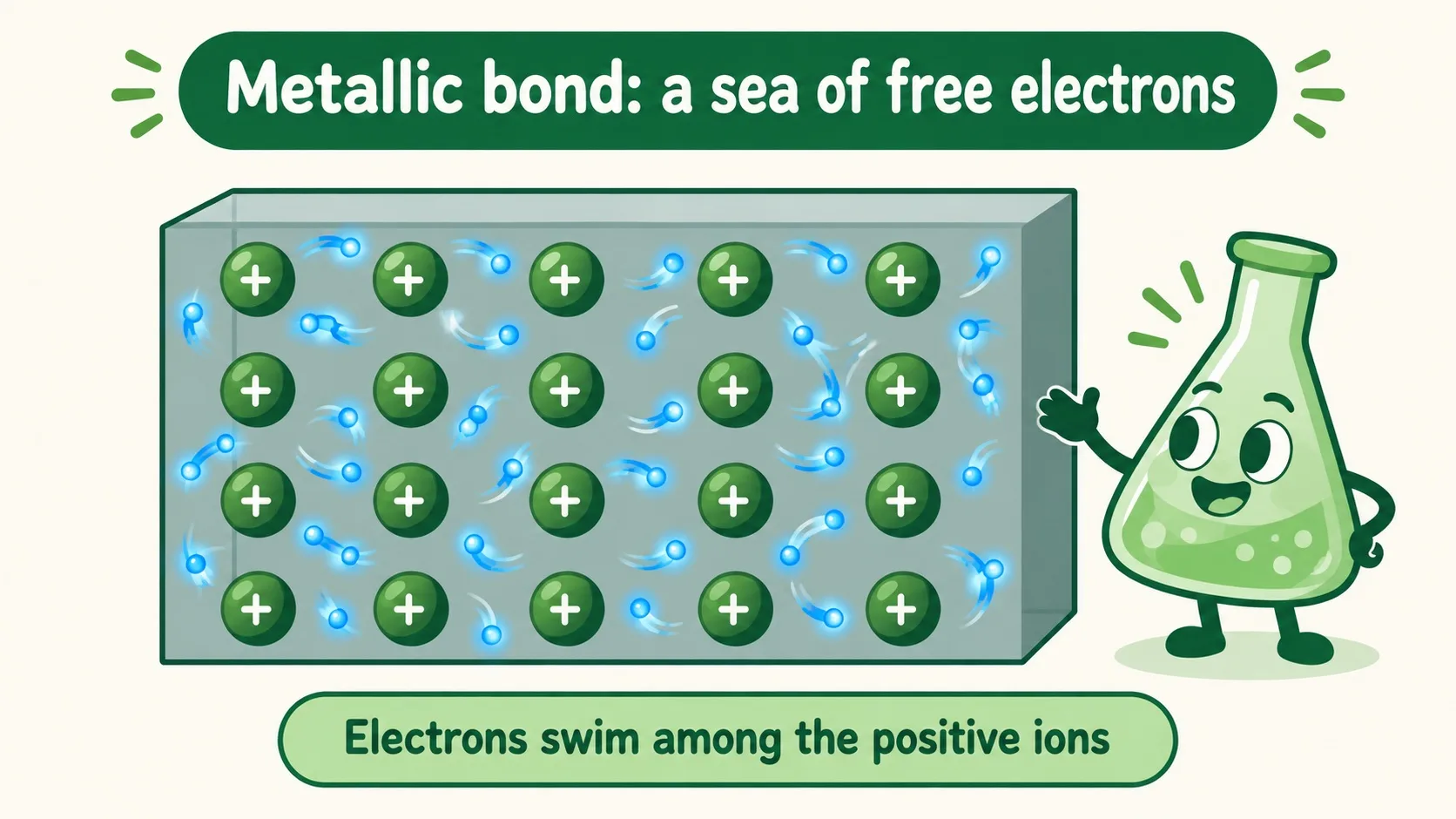
金属里,外层电子离开原子,汇成一片"自由电子海"。正离子泡在海里,被电子牢牢吸住——这就是金属键,它让金属能导电、能捶成薄片。每种胶水黏力不同:拆开一对 H₂ 要花约 436 千焦/摩尔的能量,这叫键能——拆开键要花的力气。In a metal, outer electrons leave their atoms and pool into a sea of free electrons. The positive ions sit in that sea, held tight — this is the metallic bond, and it lets metals conduct and be hammered into sheets. Every glue has its strength: pulling an H₂ pair apart costs about 436 kJ/mol — that's bond energy, the effort it takes to break a bond.
🎮 你来当键合实验员(60 秒)🎮 Your turn: bonding lab bench (60 seconds)
拖原子、判键型——4 关:NaCl 和 H₂ 的组队方式,等你亲手试出来。Drag atoms and judge bond types — 4 levels to discover how NaCl and H₂ team up.
一句话记住它:化学键=原子组队的"胶水":共价键靠共用电子对,离子键靠正负相吸,金属键靠自由电子海;拆开它要花键能。Remember it in one line: chemical bonds are the glue of atoms — covalent shares electron pairs, ionic attracts plus to minus, metallic floats in a sea of electrons; breaking a bond costs bond energy.
共价键:共用电子对(H₂、H₂O、O₂)Covalent bond: shared electron pairs (H₂, H₂O, O₂)离子键:正负电荷相吸,码成 NaCl 晶格Ionic bond: opposite charges attract, packing the NaCl lattice金属键:自由电子海让金属能导电;键能=拆开键要花的能量Metallic bond: a sea of free electrons makes metals conduct; bond energy = the cost of breaking a bond
内容参考 OpenStax 等公开教材,多来源核对 · AI 生成、人工审核 · 发现错误欢迎指正,帮这片叶子长得更好。Based on OpenStax and other open textbooks, cross-checked across sources · AI-generated, human-reviewed · Spotted a mistake? Tell us — help this leaf grow.
 Back to tree