🏭 复合函数:一台机器的出口接另一台的入口🏭 Composite Functions: One Machine Feeds the Next
上一片把函数画成了线,看得见形状了。这一片换个视角:把两台"函数机器"接起来——一台的出口,正好接另一台的入口,原料要连过两道工序。Last leaf we drew functions as lines and gave them shape. This leaf connects two "function machines": one machine's exit plugs straight into the next machine's entrance, and the raw material goes through both.
第 1 步:一台接一台Step 1: One machine feeds the next
工厂里常常不止一道工序——一个函数算出的结果,正好是另一个函数的输入,会怎样?Factories rarely run a single step — what if one function's output is exactly the next function's input?
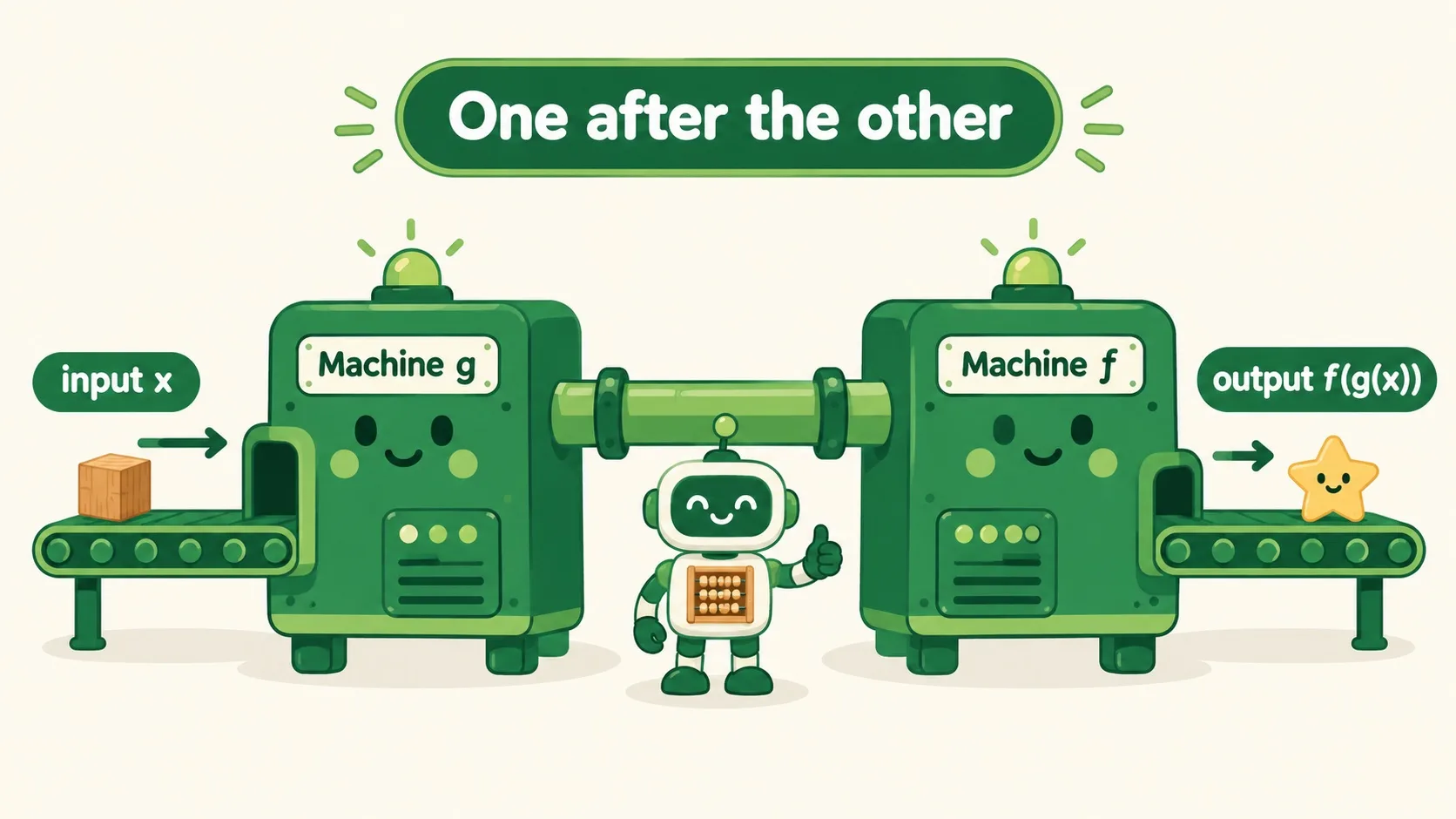
把两台机器首尾接起来:原料 x 先进机器 g,出来的 g(x) 不停留,顺着管道直接送进机器 f,出来的就是 f(g(x))。出口接入口、一台接一台——这就是复合函数。Join the two machines end to end: the input x enters machine g first; the g(x) that comes out does not stop — it flows down the pipe straight into machine f, whose output is f(g(x)). Exit into entrance, one into the next — that is a composite function.
那具体怎么算?拿个数字走一遍流水线。So how do you actually compute it? Walk a number down the line.
第 2 步:先过 g,再过 fStep 2: Through g first, then f
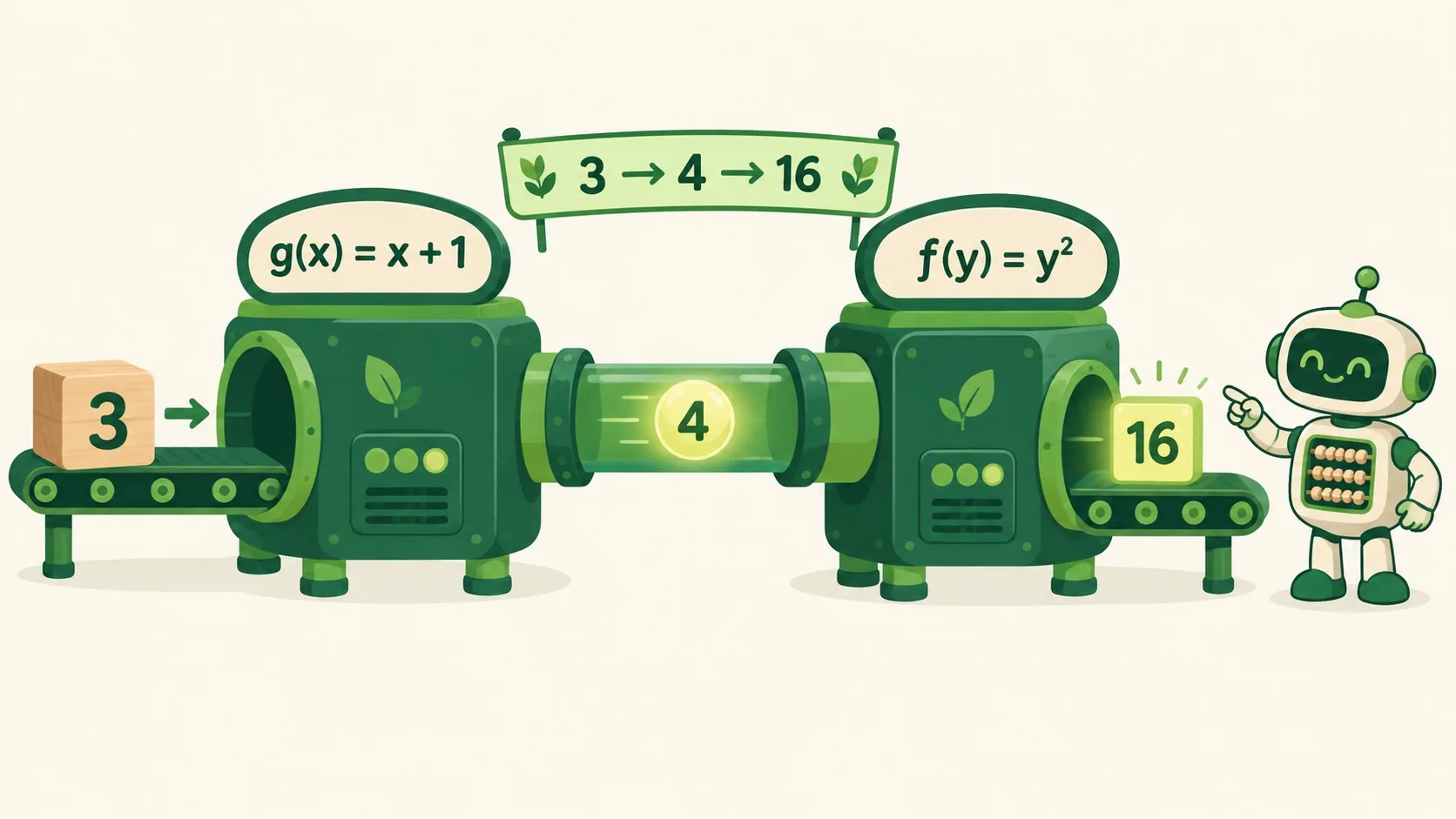
设 g(x)=x+1、f(y)=y²:x=3 先放进 g,得 3+1=4;再把 4 整个放进 f,得 4²=16。写成链子就是 3 → 4 → 16。中间那一站不能跳过——它是第二台机器的原料。Take g(x)=x+1 and f(y)=y²: x=3 goes into g first, giving 3+1=4; then 4 goes whole into f, giving 4²=16. The chain reads 3 → 4 → 16. The middle stop cannot be skipped — it is the second machine's raw material.
这种"套娃"操作,能不能用一行写下来?Can this nested job be written in one line?
第 3 步:写成 (f∘g)(x)Step 3: Write it as (f∘g)(x)
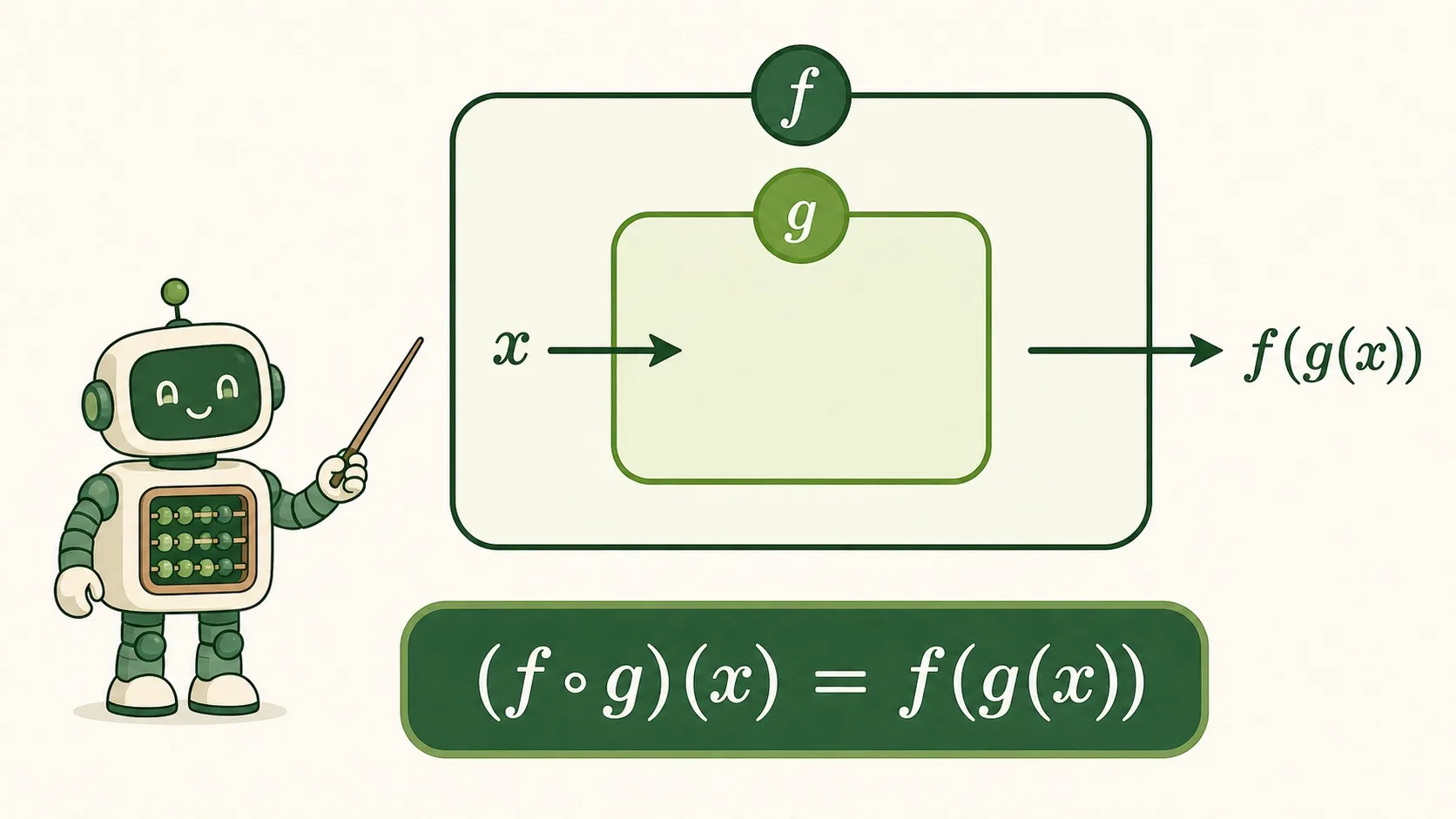
(f∘g)(x) = f(g(x)) 读作"f 复合 g":离 x 最近的 g 先动手,算完的结果再交给外面的 f。注意 f∘g 和 g∘f 是两条不同的流水线——机器还是那两台,顺序一换,成品常常不一样。(f∘g)(x) = f(g(x)) reads "f composed with g": the g closest to x works first, and its result is handed to the outer f. Note f∘g and g∘f are different lines — same two machines, but swap the order and the product often changes.
🎮 你来当流水线工人(30 秒)🎮 Your turn: work the line (30 seconds)
道理讲完了。4 批原料等着你:每一步都替机器人算出正确的数字,让它顺利流进下一台机器。Theory done. Four batches await: work out each number so the material flows into the next machine.
一句话记住它:复合函数 = 流水线串联,先过 g、再过 f,出口接入口——(f∘g)(x) = f(g(x))。Remember it in one line: a composite function is a production line — through g first, then f, exit into entrance: (f∘g)(x) = f(g(x)).
(f∘g)(x) = f(g(x)):离 x 最近的 g 先算,结果再交给 f(f∘g)(x) = f(g(x)): the g next to x runs first, then f gets the result算例:g(x)=x+1、f(y)=y²,x=3 走一遍:3 → 4 → 16Worked example: g(x)=x+1, f(y)=y², x=3: 3 → 4 → 16顺序不能换:f∘g 和 g∘f 通常是两条不同的流水线Order matters: f∘g and g∘f are usually different lines
内容参考 OpenStax 等公开教材,多来源核对 · AI 生成、人工审核 · 发现错误欢迎指正,帮这片叶子长得更好。Based on OpenStax and other open textbooks, cross-checked across sources · AI-generated, human-reviewed · Spotted a mistake? Tell us — help this leaf grow.
 Back to tree