🎯 置信区间:给估计值一个范围🎯 Confidence Intervals: a range for your estimate
上一片里,小算盘机器人把抽样收回的身高画成了钟形曲线。今天它只问了 100 个同学,算出平均 168 cm——可全校的平均,真的刚好是 168 吗?Last leaf, sampling brought the robot the whole height table and it drew a bell curve. Today it asked only 100 students and got a mean of 168 cm — but is the whole school's mean really 168?
第 1 步:撒一张兜底的网Step 1: Cast a safety net
样本只是全校的一小部分,凭什么代表全校?先承认:估计不可能百分百准。A sample is only a slice of the school — how can it stand for everyone? Admit it first: an estimate can never be exactly right.
小算盘机器人把网撒进数据海:网的圆心是样本均值 168 cm,网罩住的整片范围就是 95% 置信区间。单说 168,是一个点估计;配上这张网,才承认"真值可能在附近"。网越宽,罩住真值的把握越大。The robot casts its net into the sea of data: the centre of the net is the sample mean, 168 cm, and the whole area it covers is the 95% confidence interval. Saying just "168" is a point estimate; the net admits "the truth is somewhere nearby". A wider net has a better chance of catching it.
网不可能每次都中。想让网收得更小、更稳,靠什么?The net cannot always hit. What makes it smaller and steadier?
第 2 步:样本越多,网越小Step 2: More samples, a smaller net
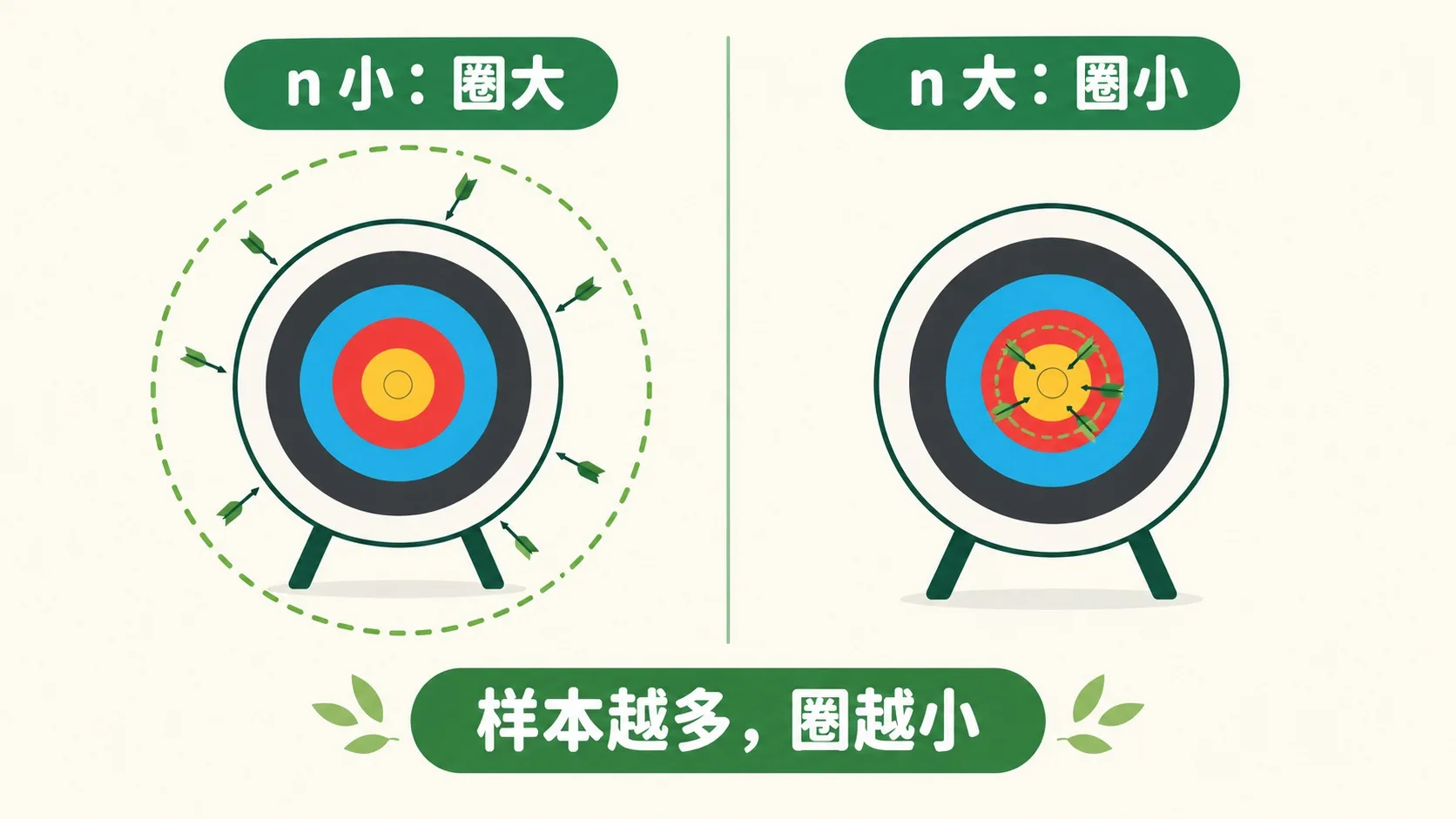
把误差想成靶心外的圈:n 小,样本太少、运气成分大,圈就大;n 大,数据互相"抵消"随机误差,圈就小。问 10 个人算的均值很飘,问 400 个人算的均值稳得多。所以样本量越大,置信区间越窄。Picture the error as a circle around the bullseye: with a small n, luck matters and the circle is wide; with a large n, random errors cancel out and the circle shrinks. A mean from 10 people wanders; a mean from 400 is steady. So the larger the sample, the narrower the interval.
网有宽有窄,那"95% 置信"到底在保证什么?Wide or narrow, what exactly does "95% confidence" promise?
第 3 步:"95% 置信"到底保证什么Step 3: What "95% confidence" really promises
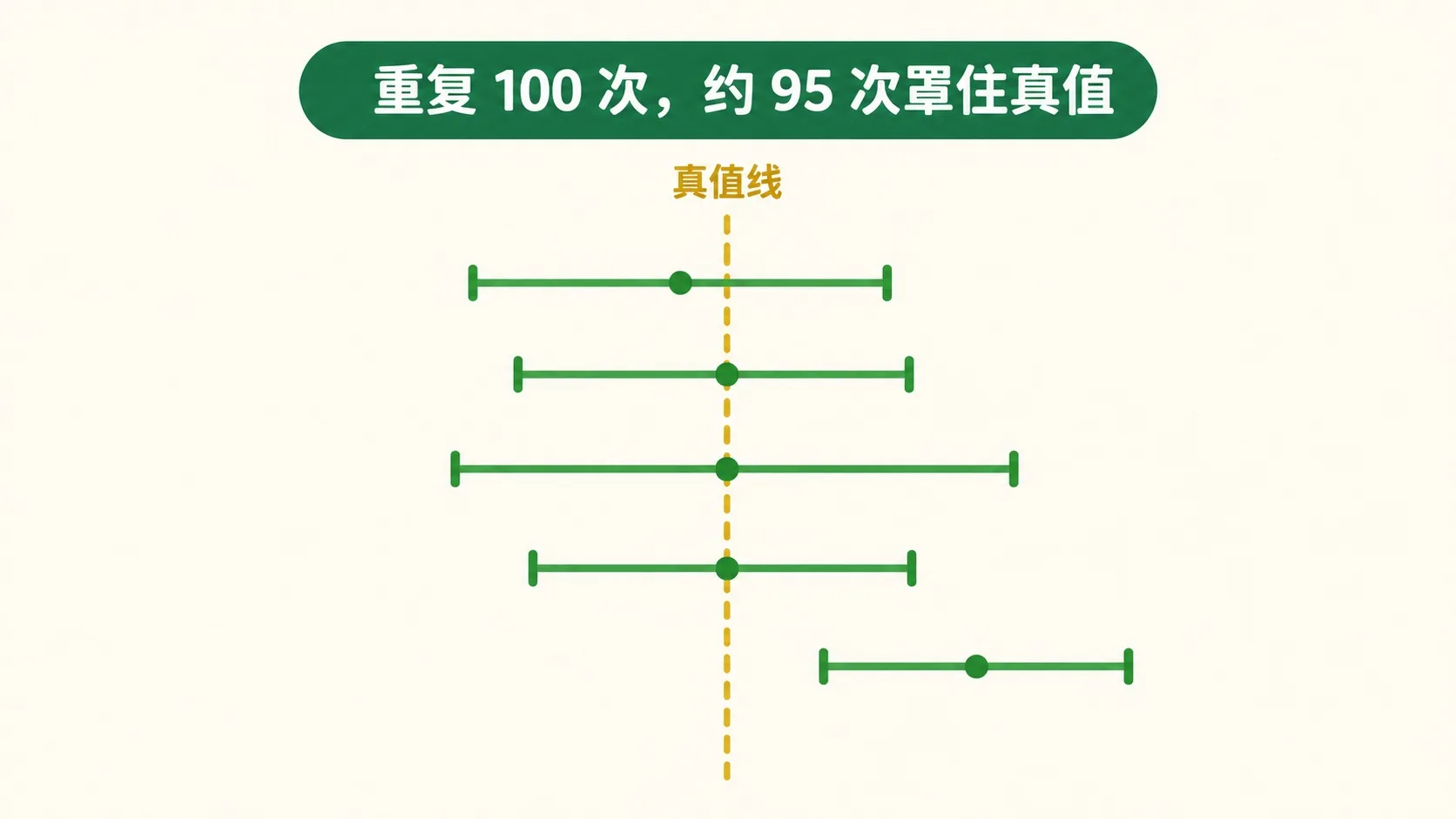
把同样的调查重复 100 次,每次都画一条"带帽子"的区间。约 95 条罩住真值线,约 5 条错过。"95%"说的是这套撒网的方法:长期重复,约 95% 的网能中;至于下一次中不中,谁也说不准。Repeat the same survey 100 times and draw a "hatted" interval each time. About 95 segments cover the true-value line; about 5 miss it. "95%" describes the method: over the long run, about 95 nets catch the truth. Whether the next one will, nobody can say.
🎮 你来调区间(40 秒)🎮 Your turn: narrow the interval (40 seconds)
拖动样本量滑块,看区间实时收窄;4 关把区间压进绿色目标带。Drag the sample-size slider and watch the interval shrink live; pass 4 tasks by squeezing it into the green band.
一句话记住它:点估计给一个数,置信区间给一张网;95% 说的是重复撒网的命中率,样本越多网越小。Remember it in one line: a point estimate gives a number, a confidence interval gives a net; 95% is the long-run hit rate, and more samples make the net smaller.
只报 168 是点估计;报一个范围才是置信区间Reporting just 168 is a point estimate; reporting a range makes it an interval95% 置信 = 重复 100 次,约 95 次的网罩住真值95% confidence = about 95 of 100 repeated nets cover the truth样本量越大,区间越窄(宽度约按 1/√n 缩小)Larger samples give narrower intervals (width shrinks like 1/√n)
内容参考 OpenStax 等公开教材,多来源核对 · AI 生成、人工审核 · 发现错误欢迎指正,帮这片叶子长得更好。Based on OpenStax and other open textbooks, cross-checked across sources · AI-generated, human-reviewed · Spotted a mistake? Tell us — help this leaf grow.
 Back to tree