上一片,电脑学会了搭出三维的形状。形状看得见,声音却看不见、摸不着。电脑是怎么把你哼的一句歌,装进一个文件里的?Last leaf, the computer learned to build 3D shapes. Shapes you can see — but sound is invisible and untouchable. So how does a computer pack the tune you hum into a file?
第 1 步:声音是空气在抖Step 1: Sound is shaking air
先弄清楚:手机要记下的,到底是什么?First: what exactly is the phone trying to record?
你对着手机哼一声「啦」,声带就在来回抖。它推着空气一疏一密地传出去,这就是声波。抖得越快,音越高;抖得越猛,声越响。手机里的麦克风,把空气的抖动变成一条电信号曲线——平滑、连续,像起伏的波浪。You sing “La” into your phone, and your vocal cords shake back and forth. They push the air into squeezed and stretched bands that travel outward — a sound wave. Faster shaking means a higher note; harder shaking means a louder one. The phone's microphone turns that shaking air into an electrical curve — smooth and continuous, like rolling waves.
可电脑只认数字,一条连续的曲线怎么存?But a computer only stores numbers. How do you store a smooth curve?
第 2 步:每秒拍几万张快照Step 2: Tens of thousands of snapshots a second
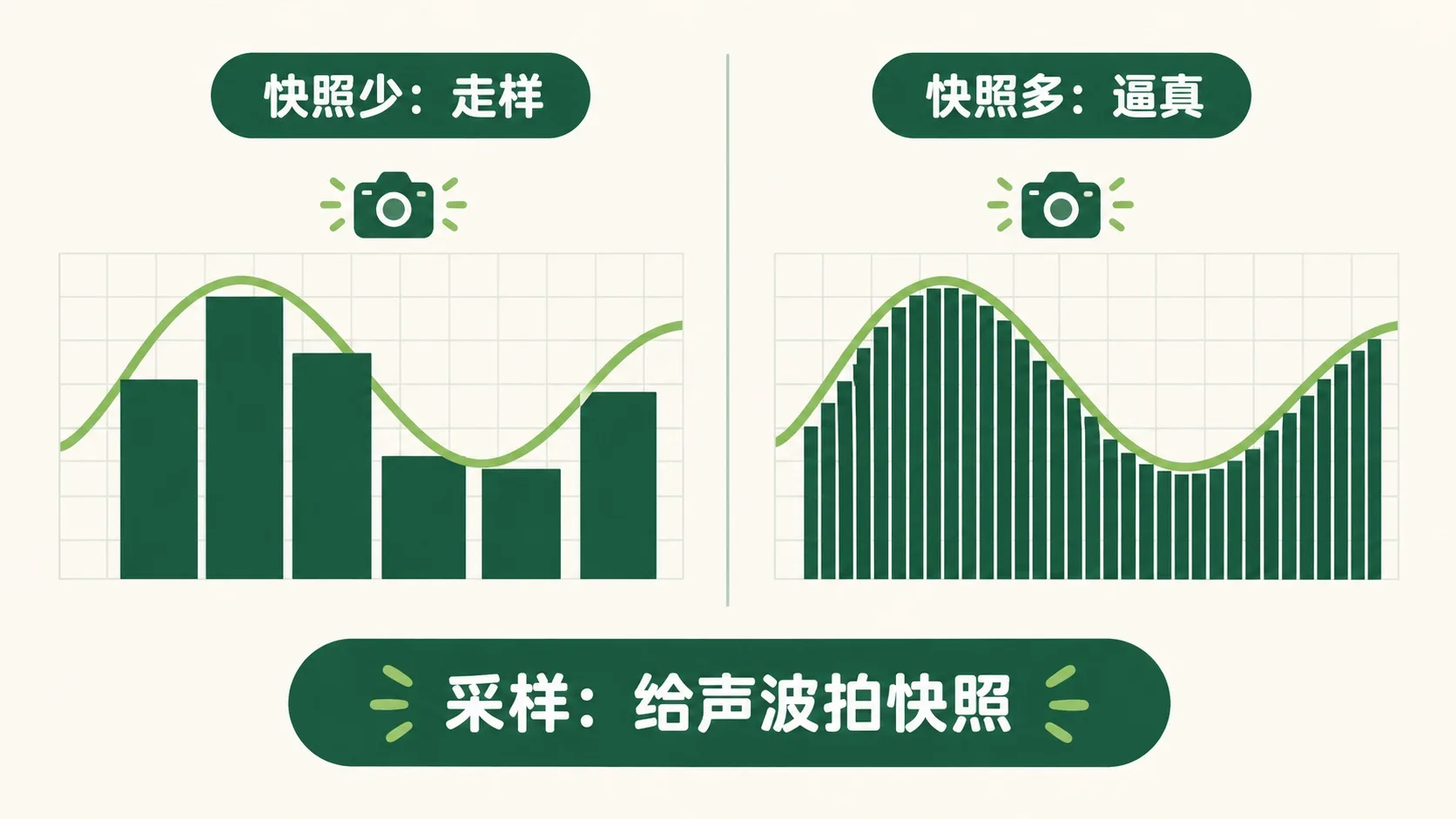
办法是拍快照:每隔一小会儿,量一次波的高度,记成一个数。这叫采样;每秒拍几张,叫采样率。采样不足会混淆原来的频率。图中台阶是显示方式;实际播放还需要重建滤波,并非让耳机逐格跳动。每张快照的高度,还要用一把刻度尺来量:刻度越细(位深越大),记得越准。CD 每秒拍 44,100 张;人耳最高能听到每秒约 2 万次的振动,拍的次数要超过它的两倍才记得住。CD 的刻度尺是 16 位,足足 65,536 格。The trick is snapshots: every tiny moment, measure the wave's height and store it as a number. That's sampling; how many snapshots per second is the sample rate. Too few samples can confuse the original frequencies. The staircase is a display convention; playback also uses reconstruction filtering rather than making an earphone jump between steps. Each height is read off a ruler, too: the finer the ruler (the higher the bit depth), the more exact the number. A CD takes 44,100 snapshots a second; human ears top out around 20,000 vibrations a second, and you need more than twice that many snapshots to catch them. A CD's ruler is 16-bit — a full 65,536 marks.
拍了这么多数字,文件岂不是很大?All those numbers — won't the file be huge?
第 3 步:存起来、传出去、再放出来Step 3: Store it, send it, play it back
确实大:图上的 44.1 kHz,就是每秒 44,100 张快照。CD 音质的立体声,一分钟约 10 MB。MP3 这类压缩,会删掉耳朵几乎听不出的细节,在某些码率下可缩到约十分之一,手机里就装得下上千首歌。播放时,芯片把数字变回电压,推动耳机振动空气。一圈下来:空气 → 数字 → 空气,你又听到了那声「啦」。It would be: the 44.1 kHz in the picture means 44,100 snapshots a second, and one minute of CD-quality stereo is about 10 MB. Compression like MP3 throws away details your ears can barely notice, at some bitrates shrinking the file to about a tenth — that's how a phone holds thousands of songs. On playback, a chip turns the numbers back into voltage, which drives your earphones to shake the air. Full circle: air → numbers → air, and you hear that “La” again.
🎮 你来当录音师(30 秒)🎮 Your turn: recording engineer (30 seconds)
道理讲完了。先拖两个滑块,看台阶怎么贴上原波;再接 4 张录音订单,既要够逼真,又不能超数据量。Theory done. Drag the two sliders and watch the steps hug the wave; then fill 4 recording orders — true enough, but within the data limit.
一句话记住它:数字音乐 = 给声波拍快照。采样率和位深决定记录方式。满足频率范围后,更高采样率不保证听起来更好;未压缩数据量会增加。Remember it in one line: digital music = snapshots of a sound wave. Sample rate and bit depth determine representation. Beyond the required bandwidth, a higher sample rate does not guarantee better perceived sound; uncompressed data size increases.
声音是空气的振动波;麦克风把它变成连续的电信号Sound is a wave of vibrating air; a microphone turns it into a smooth electrical signal采样率 = 每秒拍几张,位深 = 刻度尺有多细;CD 是 44,100 次/秒、16 位Sample rate = snapshots per second; bit depth = how fine the ruler is. CD: 44,100 a second, 16-bit采样要满足信号频率范围;压缩率与损失取决于编码方式和码率Sampling must suit signal bandwidth; compression size and loss depend on encoding and bitrate
把握度:数字音频基本概念较高。游戏的还原度是自定义波形差异指标,不是听感测试。图中的十分之一仅为压缩示例。AI 辅助制作与资料核对。Confidence: high for digital-audio basics. The game uses a custom waveform-difference score, not a listening-quality test. One-tenth size is only a compression example. AI-assisted production and source checking.
 Back to tree