⚗️ 元素与原子:118 种积木⚗️ Elements & Atoms: 118 Kinds of Building Blocks
上一片里,太阳把氢“变成”了氦,轻掉的质量变成了光。可“变成”到底是变了什么?⚗️ 小烧瓶来接班:答案要先从 118 种积木——元素说起。Last leaf, the Sun “turned” hydrogen into helium, and the lost mass became light. But what does “turned into” really mean? ⚗️ Little Flask takes over from here: the answer starts with 118 kinds of building blocks — the elements.
第 1 步:元素 = 同种原子的统称Step 1: An element is a family of identical atoms
从上一片的原子核说起——到底是什么在决定“我是谁”?Start from last leaf's nucleus — what exactly decides “who am I”?
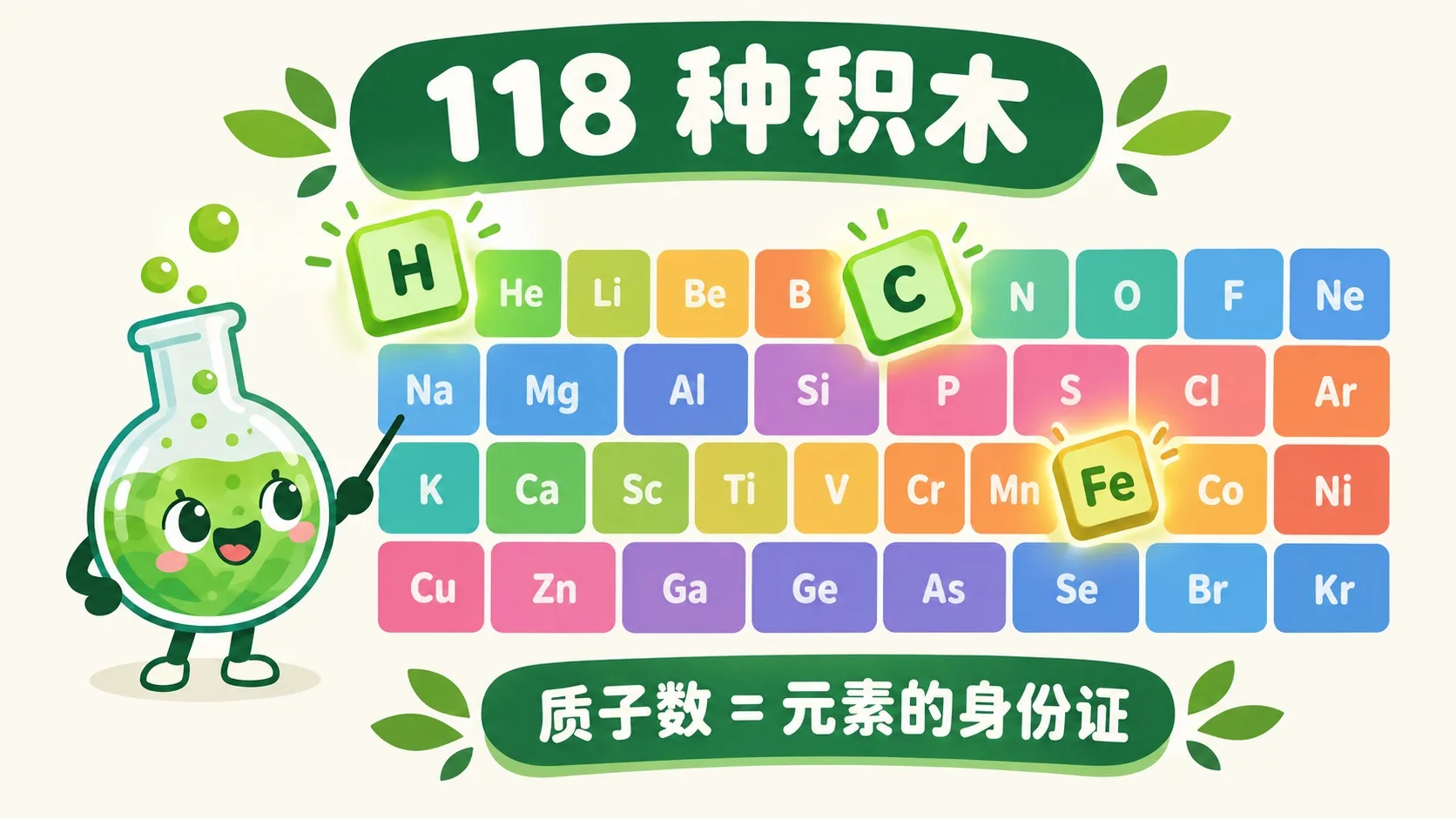
化学世界里只有 118 种“积木”——元素。同一种元素的所有原子都一模一样:一样的质子数。图里这面墙是元素大家庭的合影:每格一种元素。氢 H 是 1 号,碳 C 是 6 号,铁 Fe 是 26 号——质子数就是它们的号码,也是排队的顺序。The whole of chemistry has just 118 kinds of “building blocks” — the elements. Every atom of the same element is identical: same proton count. The wall in the picture is a family portrait of the elements: one tile each. Hydrogen H is number 1, carbon C is 6, iron Fe is 26 — the proton count is each element's number, and the order it lines up in.
那这面墙按什么排队?回到上一片说的“氢变氦”就明白了。So what is the wall sorted by? The “hydrogen into helium” story from last leaf holds the key.
第 2 步:质子数是元素的身份证Step 2: The proton count is the ID card
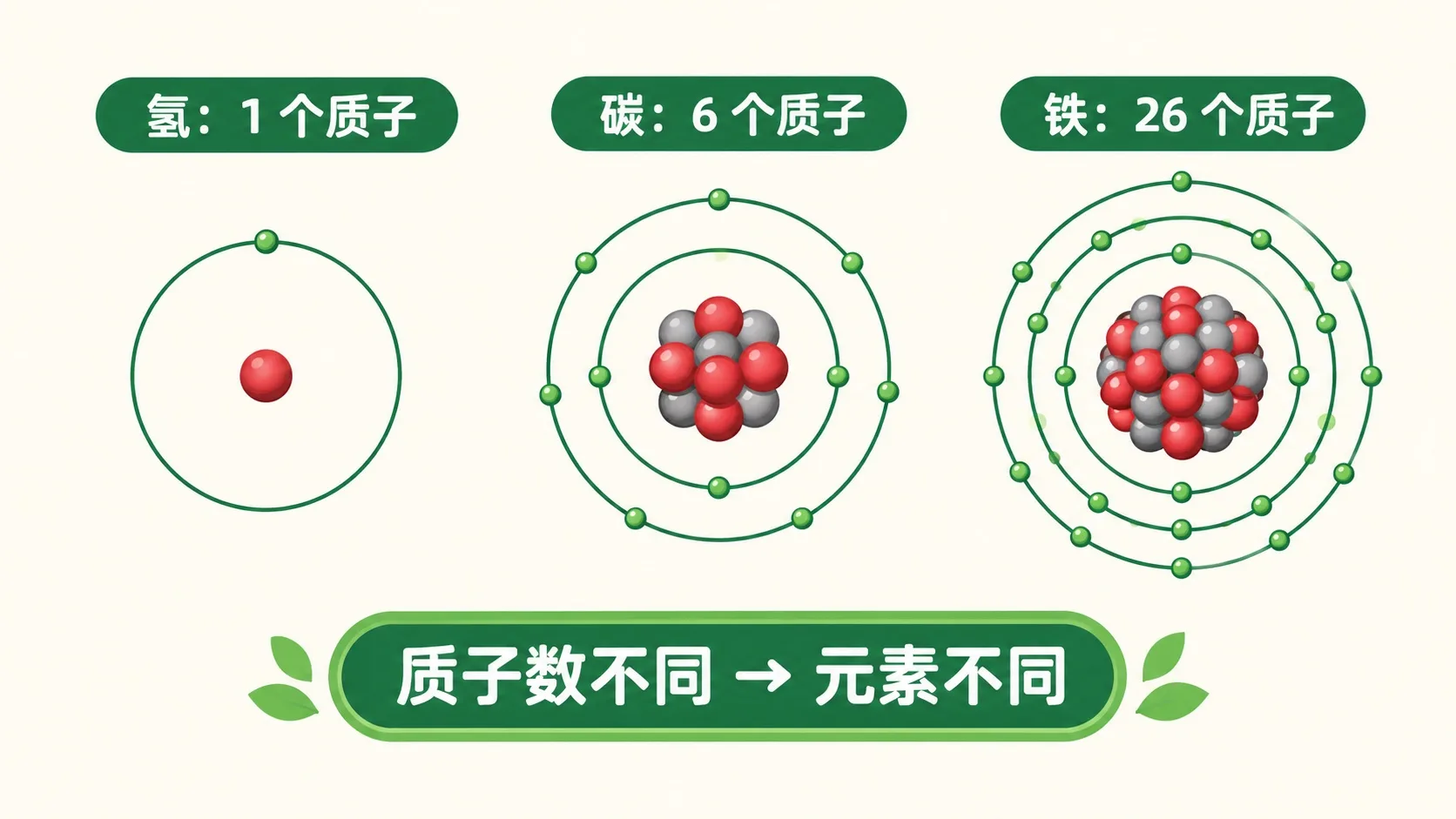
原子核里的质子数就是元素的身份证:氢 1 个、碳 6 个、铁 26 个。中子数可以不同(那是同位素),电子数也能加减(那是离子),但质子数一变,就换元素了——核聚变把 1 个质子的氢,变成 2 个质子的氦,这就是“变成”的全部秘密。周期表就按质子数排队:横着叫“周期”,竖着叫“族”,同一竖列的成员性格相似。The proton count in the nucleus is the element's ID: hydrogen 1, carbon 6, iron 26. Neutron counts may differ (those are isotopes) and electrons can come and go (those are ions), but change the proton count and you change the element. Nuclear fusion turned 1-proton hydrogen into 2-proton helium — that's the whole secret of “turned into”. The table sorts by proton count: rows are “periods”, columns are “groups”, and members of the same column behave alike.
最后一个大问题:这 118 种积木,宇宙是从哪儿弄来的?One big question left: where did the universe get these 118 blocks?
第 3 步:宇宙元素从哪来Step 3: Where the elements came from
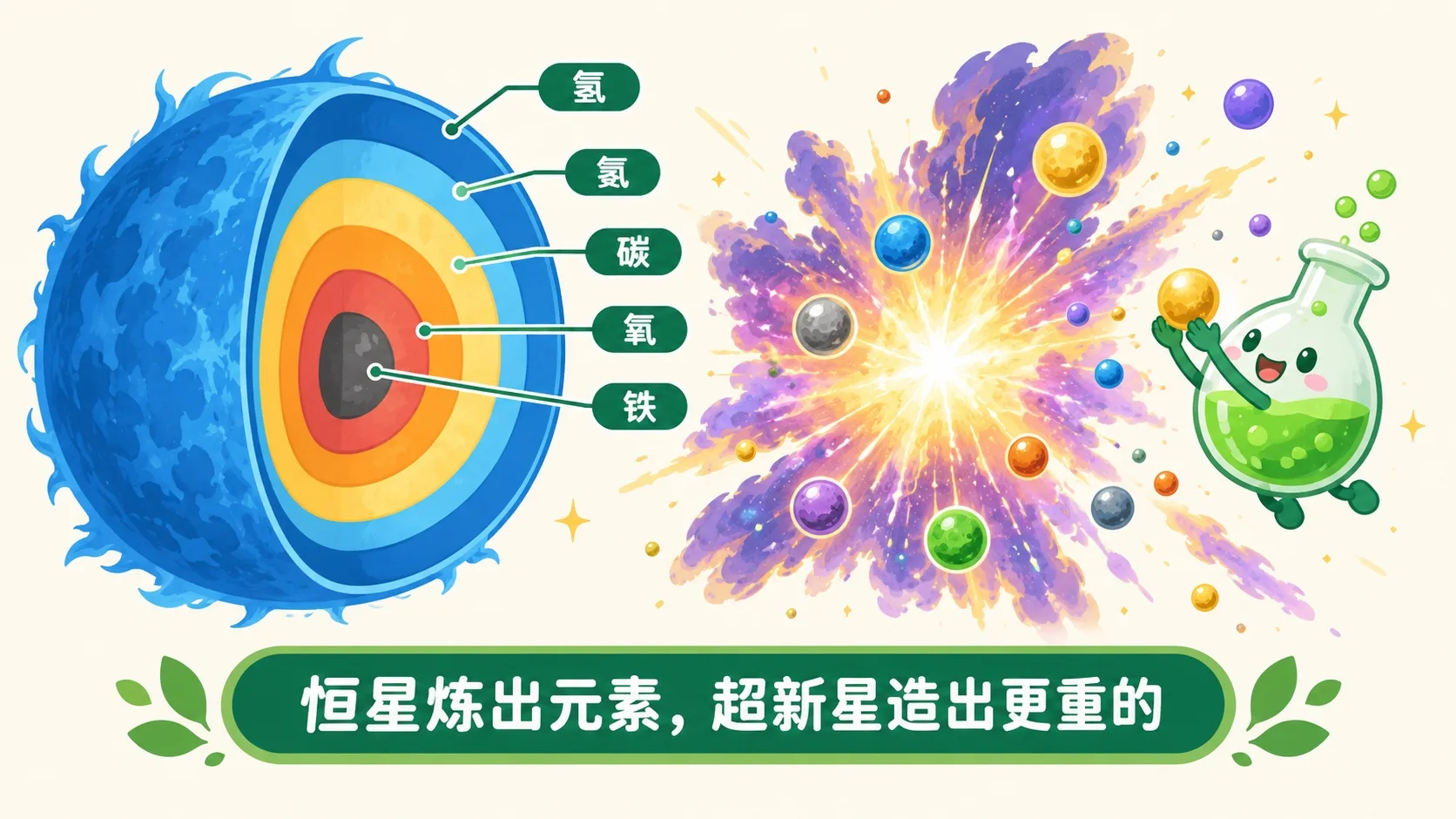
宇宙大爆炸只造出了氢和氦(还有一丁点锂),其余元素都是恒星“炼”出来的:恒星核心一层层聚变,氢→氦→碳→氧……到铁就停了(铁再聚变不再放能)。比铁更重的金、银、铀,要在超新星爆发或中子星并合这样的极端事件里才能诞生。你身体里的碳、血液里的铁,都是远古恒星的遗物。The Big Bang made only hydrogen and helium (plus a pinch of lithium); every other element was forged in stars. A star's core fuses in layers: hydrogen → helium → carbon → oxygen… and stops at iron (fusing iron releases no more energy). Elements heavier than iron — gold, silver, uranium — need extreme events like supernova explosions or neutron-star mergers. The carbon in your body and the iron in your blood are relics of ancient stars.
🎮 你来当元素侦探(30 秒)🎮 Your turn: element detective (30 seconds)
认识座位表的办法,是去上面找元素。4 条线索,把嫌疑元素一个一个抓出来——找不到就点提示。The way to learn a seating chart is to use it. Four clues, four suspects — catch them one by one, and tap the hint button if you get stuck.
一句话记住它:元素 = 同种原子的统称;质子数是元素的身份证;118 种元素按号码排队,就是元素周期表。Remember it in one line: an element is a family of identical atoms; the proton count is its ID card; 118 elements line up by number to form the periodic table.
质子数决定元素身份:氢 1、碳 6、铁 26;中子/电子变化不换元素Proton count sets the element: H 1, C 6, Fe 26; neutrons and electrons can change without switching element周期表按质子数排队:横排是周期,竖列是族,同族性格相似The table sorts by proton count: rows are periods, columns are groups with similar behaviour氢氦来自大爆炸,其余元素在恒星里炼成,比铁重的来自超新星H and He came from the Big Bang; stars forged the rest, and supernovae made what's heavier than iron
内容参考 OpenStax 等公开教材,多来源核对 · AI 生成、人工审核 · 发现错误欢迎指正,帮这片叶子长得更好。Based on OpenStax and other open textbooks, cross-checked across sources · AI-generated, human-reviewed · Spotted a mistake? Tell us — help this leaf grow.
 Back to tree