🏛️ 哥德尔不完备定理:总有些真话证不出来🏛️ Gödel's Incompleteness Theorems: Some Truths Can't Be Proved
上一片「自指」里,一句话学会了谈论自己。小算盘机器人 🧮 把这种句子带进数学图书馆,翻出了一件怪事:书架上有一本书,明明在,却怎么都进不了索引。In the last leaf, a sentence learned to talk about itself. The little abacus robot 🧮 carried such sentences into the math library — and found something strange: one book on the shelf, clearly there, that never makes it into the index.
第 1 步:每本书都有编号Step 1: every book gets a number
想知道那本书为什么进不了索引,先学图书馆的编号魔法。To see why that book never makes the index, first learn the library's numbering magic.
图书馆靠编号找书:每本书一个号码,索引一查就到。哥德尔(Kurt Gödel)发现,句子也能这么办——把「雪是白的」拆成一个个词,每个词配一个数字(雪 = 4,是 = 17,白 = 25),整句话就变成数字串 4-17-25。语言穿上数字的外衣,关于句子的句子,就变成了关于数字的算术。A library finds books by number: one number per book, look it up in the index and you're there. Gödel found that sentences can play the same game — split “snow is white” into words, give each word a number (snow = 4, is = 17, white = 25), and the sentence becomes the number string 4-17-25. Dress language in numbers, and sentences about sentences turn into arithmetic about numbers.
句子都变成数字了,那小算盘能用它做什么?Now that sentences are numbers, what can the little robot do with them?
第 2 步:照镜子的句子Step 2: the sentence in the mirror
小算盘造出了一句会照镜子的话:「本句在系统里证不出来。」它用数字谈论自己,像站在两面镜子中间,一眼望不到头。麻烦来了:如果系统能证明它,证明的就是一句假话,系统自相矛盾;所以系统只能证不出它。可它说的正是「证不出来」——于是它是一句真话,只是系统永远够不着。The robot built a sentence that sees itself in the mirror: “This sentence cannot be proved in the system.” It talks about itself through numbers, like standing between two mirrors — reflections with no end. Trouble follows: if the system proves it, what it proves is a false sentence, and the system contradicts itself; so the system cannot prove it. But that is exactly what the sentence says — so it is true, and forever out of the system's reach.
一句够不着,也许只是特例?把整个系统摊开看看。One unreachable sentence — maybe just a special case? Lay the whole system out and look.
第 3 步:链条缺了一环Step 3: one link missing
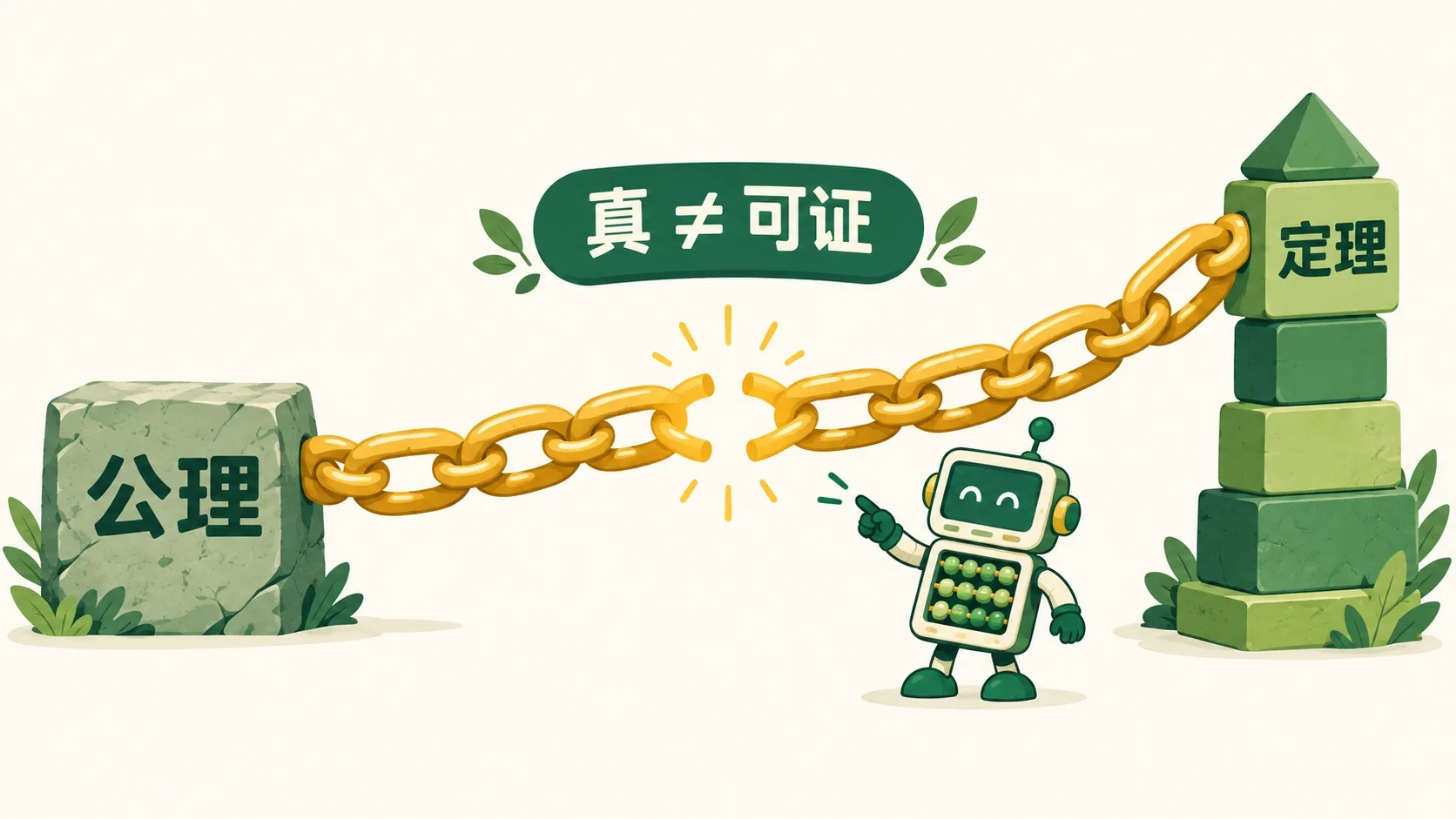
把系统里所有证明摆成一条长链:从公理出发,一环扣一环,推出一个个定理。哥德尔说,链条上必然缺着一环——「真」和「可证」不是一回事。只要系统足够强、又不自相矛盾,就一定有真话证不出来;它还没法从内部证明自己不会矛盾(哥德尔第二不完备定理)。这不是数学失败,是边界——像图书馆的索引,永远收不全所有书。Lay every proof in the system into one long chain: it starts at the axioms, link by link, proving theorem after theorem. Gödel says a link must be missing — “true” and “provable” are not the same thing. Any system strong enough to do arithmetic, if it never contradicts itself, must contain truths it cannot prove; and it cannot prove from the inside that it never contradicts itself (his second incompleteness theorem). Not a failure of mathematics — a boundary: like a library index that can never hold every book.
🎮 你来走三步(1 分钟)🎮 Your turn: three moves (1 minute)
道理讲完了。先编码、再自指、最后连过 4 关问答——小算盘 🧮 在旁边看着你。Theory done. Encode a sentence, build a self-referring one, then pass 4 quiz gates — the little robot 🧮 is watching.
一句话记住它:真 ≠ 可证——再强的系统,也有它证不出来的真话;它也无法从内部证明自己一致。Remember it in one line: true ≠ provable — however strong a system is, some truths stay unprovable, and it cannot certify its own consistency.
句子可以编码成数字,于是句子能谈论自己(哥德尔编码)Sentences can be encoded as numbers, so they can talk about themselves (Gödel coding)「本句不可证」系统够不着,却是真的(第一不完备定理)“This sentence is unprovable” is out of reach yet true (first incompleteness theorem)足够强的系统无法自证一致(第二不完备定理)——这是边界,不是失败A strong system cannot prove its own consistency (second theorem) — a boundary, not a failure
内容参考 OpenStax 等公开教材,多来源核对 · AI 生成、人工审核 · 发现错误欢迎指正,帮这片叶子长得更好。Based on OpenStax and other open textbooks, cross-checked across sources · AI-generated, human-reviewed · Spotted a mistake? Tell us — help this leaf grow.
 Back to tree