上一片里,机器人学会了给自己打分:损失,错得越多、分越高。可光知道错了多少还不够,它得知道往哪边改。这一片,给机器人蒙上眼,让它自己摸下山。Last leaf, the robot learned to score itself: the loss, higher the more wrong it is. But knowing how wrong isn't enough — it needs to know which way to fix it. This leaf, we blindfold the robot and let it feel its own way down.
第 1 步:错得越多,站得越高Step 1: The more wrong, the higher you stand
把损失想成高度:机器人每换一次旋钮,就站上山谷的某个位置——错得越多,站得越高。训练的目标只有一个:从高处一步步下到谷底,让损失尽可能小。它蒙着眼看不见路,但脚下的坡度骗不了它。Picture the loss as height: every time the robot turns its knobs, it stands somewhere on a valley — the more wrong it is, the higher it stands. Training has just one goal: walk down to the valley floor and make the loss as small as possible. It's blindfolded and can't see the way, but the slope under its feet never lies.
可蒙着眼,它怎么知道脚下该往哪边挪?But blindfolded — how does it know which way to move?
机器人原地摸一圈:哪个方向坡最陡,就朝哪边迈一小步。这个「最陡的下坡方向」用数学量出来,就叫梯度(gradient)——它像一支箭头,告诉机器人下坡往哪走。沿箭头挪一小步,高度就降一点;再摸、再挪,循环往复。步子太大容易冲过头,太小又走得太慢,这一步的大小叫学习率(learning rate)。The robot feels around on the spot: whichever direction dips the steepest, it takes one small step that way. Measured out in math, that direction is called the gradient — an arrow that tells the robot where downhill is. Follow it one small step and the height drops a little; feel again, step again, loop. A step too big overshoots, too small crawls — and that step size is called the learning rate.
在纸上这么走没问题——真实网络里,这张「地图」长什么样?That works on paper — but what does this “map” look like inside a real network?
第 3 步:百万维的损失地图Step 3: A loss map with millions of dimensions
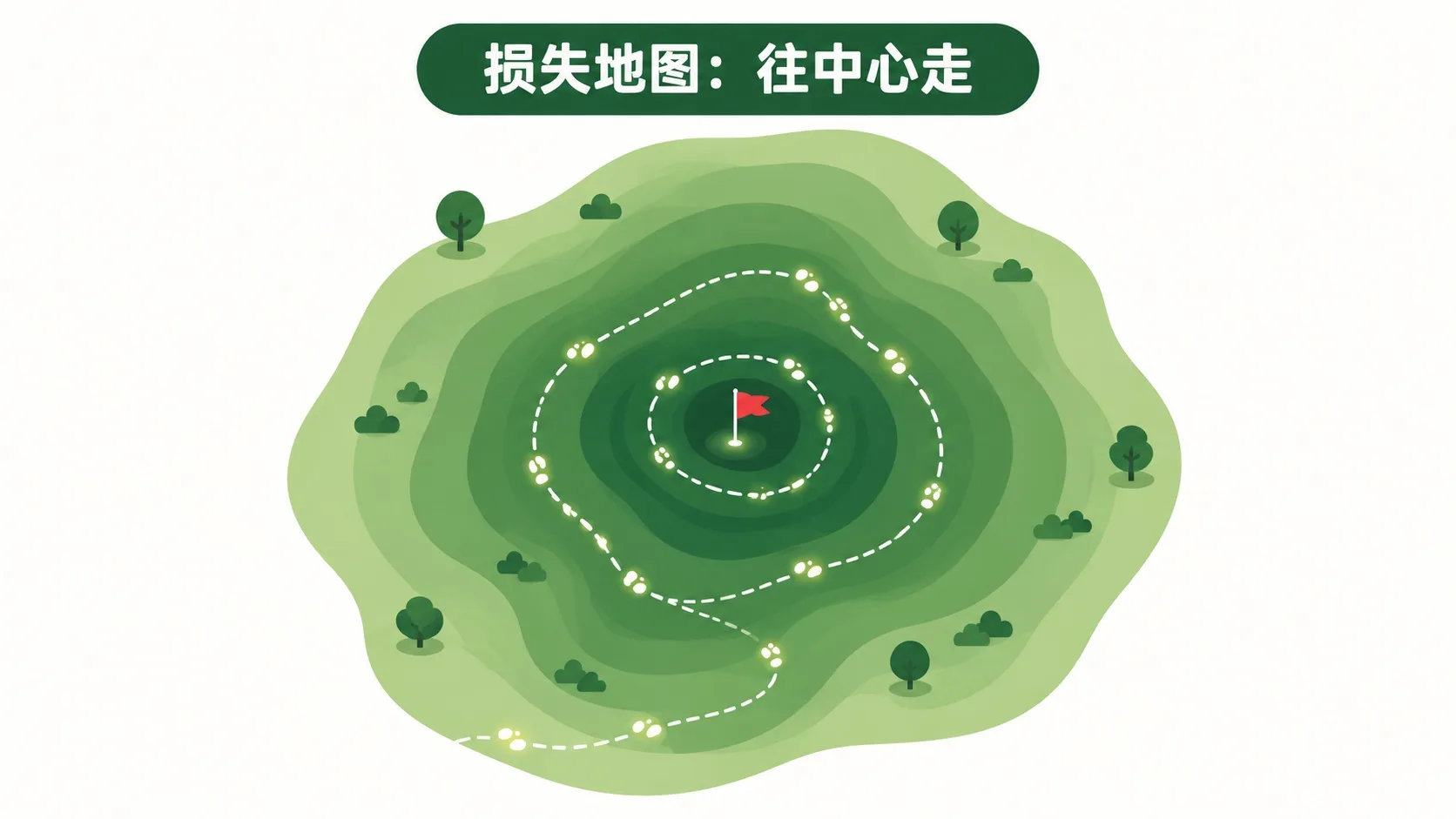
真实网络有几百万个旋钮(权重),每一个都对应地图的一个方向——几百万维的损失地图,我们画不出来,但走法完全一样。把它压扁成俯视图,就是一圈圈等高线:越靠中心越低。机器人沿着虚线路径一圈圈往中心(误差最小处)走。这套「摸最陡下坡、挪一小步、循环往复」的下山方法,就是梯度下降(Gradient Descent)——今天几乎所有神经网络训练,都靠它下山。A real network has millions of knobs (weights), each one a direction on the map — a loss landscape with millions of dimensions that nobody can draw, yet the walk is exactly the same. Flatten it into a bird's-eye view and you get contour rings: the closer to the centre, the lower the loss. The robot spirals lap by lap toward the centre, where the error is smallest. Feel the steepest downhill, take a small step, repeat — that downhill method is gradient descent, and nearly every neural network today trains with it.
🎮 你来走下山(30 秒)🎮 Your turn: walk it down (30 seconds)
道理讲完了。点「走一步」,帮蒙眼的小机器人摸最陡下坡、挪一小步——看看它走几步能到谷底红旗。Theory done. Hit “One step” and help the blindfolded robot feel for the steepest downhill and shuffle one small step — see how many steps it takes to reach the flag.
一句话记住它:梯度下降 = 蒙眼下山:摸出最陡下坡(梯度)、朝那边挪一小步(学习率),一圈一圈循环,直到谷底——损失最小。Remember it in one line: gradient descent = walking downhill blindfolded: feel the steepest way down (the gradient), take one small step (the learning rate), and loop until you reach the bottom — the smallest loss.
损失 = 山谷高度:错得越多站得越高;训练就是一路往下走Loss = valley height: the more wrong, the higher you stand; training walks it down梯度 = 最陡的下坡方向;沿它挪一小步,损失就低一点The gradient = the steepest downhill; step along it and the loss drops步子大小是学习率:太大冲过头、太小走太慢;循环往复直到谷底Step size = learning rate: too big overshoots, too small crawls; loop until the bottom
内容参考 OpenStax 等公开教材,多来源核对 · AI 生成、人工审核 · 发现错误欢迎指正,帮这片叶子长得更好。Based on OpenStax and other open textbooks, cross-checked across sources · AI-generated, human-reviewed · Spotted a mistake? Tell us — help this leaf grow.
 Back to tree