🪐 开普勒定律:行星轨道的三条规律🪐 Kepler's Laws: Three Rules of Planetary Orbits
上一片的引力拉住了行星。可行星到底沿着什么路线跑?开普勒盯着观测数据看了几十年,总结出三条规律;牛顿后来用引力把它们全部算了出来。Last leaf, gravity holds the planets. But along what path do they run? Kepler stared at decades of observations and distilled three rules; Newton later derived them all from gravity.
第 1 步:轨道是椭圆,太阳在一个焦点Step 1: The orbit is an ellipse, the Sun at one focus
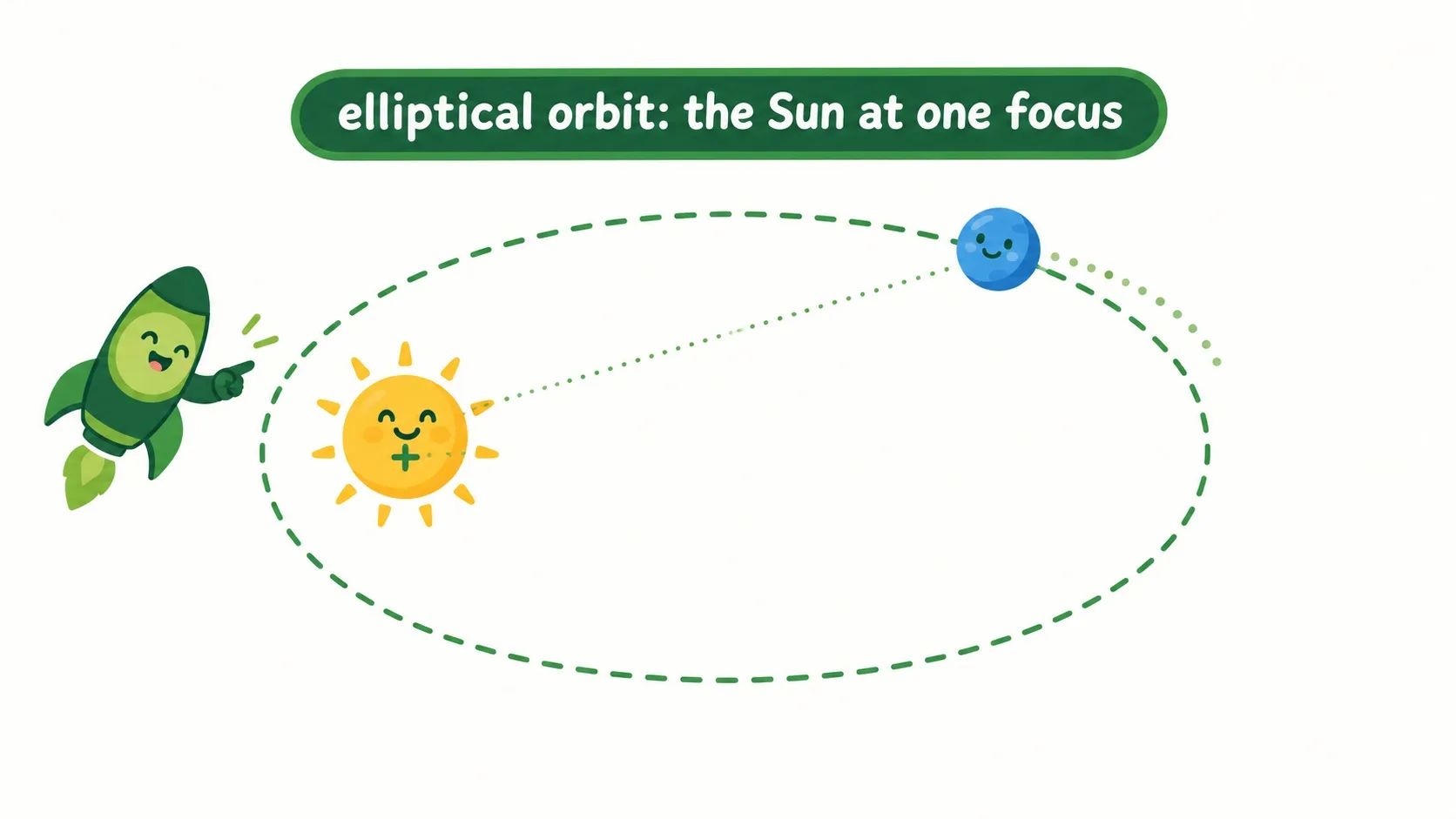
第一条,先把“圆形”改掉——行星的轨道不是正圆。Rule one replaces the circle — planetary orbits are not round.
行星绕太阳的轨道是椭圆:一个拉长一点的圆。太阳不在椭圆的中心,而在其中一个焦点上。所以行星有时离太阳近(近日点),有时远(远日点)——地球 1 月初离太阳最近。A planet's orbit is an ellipse — a slightly stretched circle. The Sun is not at the centre but at one focus. So a planet drifts closer (perihelion) and farther (aphelion) — Earth comes closest in early January.
那行星什么时候跑得快、什么时候慢?So when does a planet race, and when does it crawl?
第 2 步:相等时间扫过相等面积Step 2: Equal times sweep equal areas
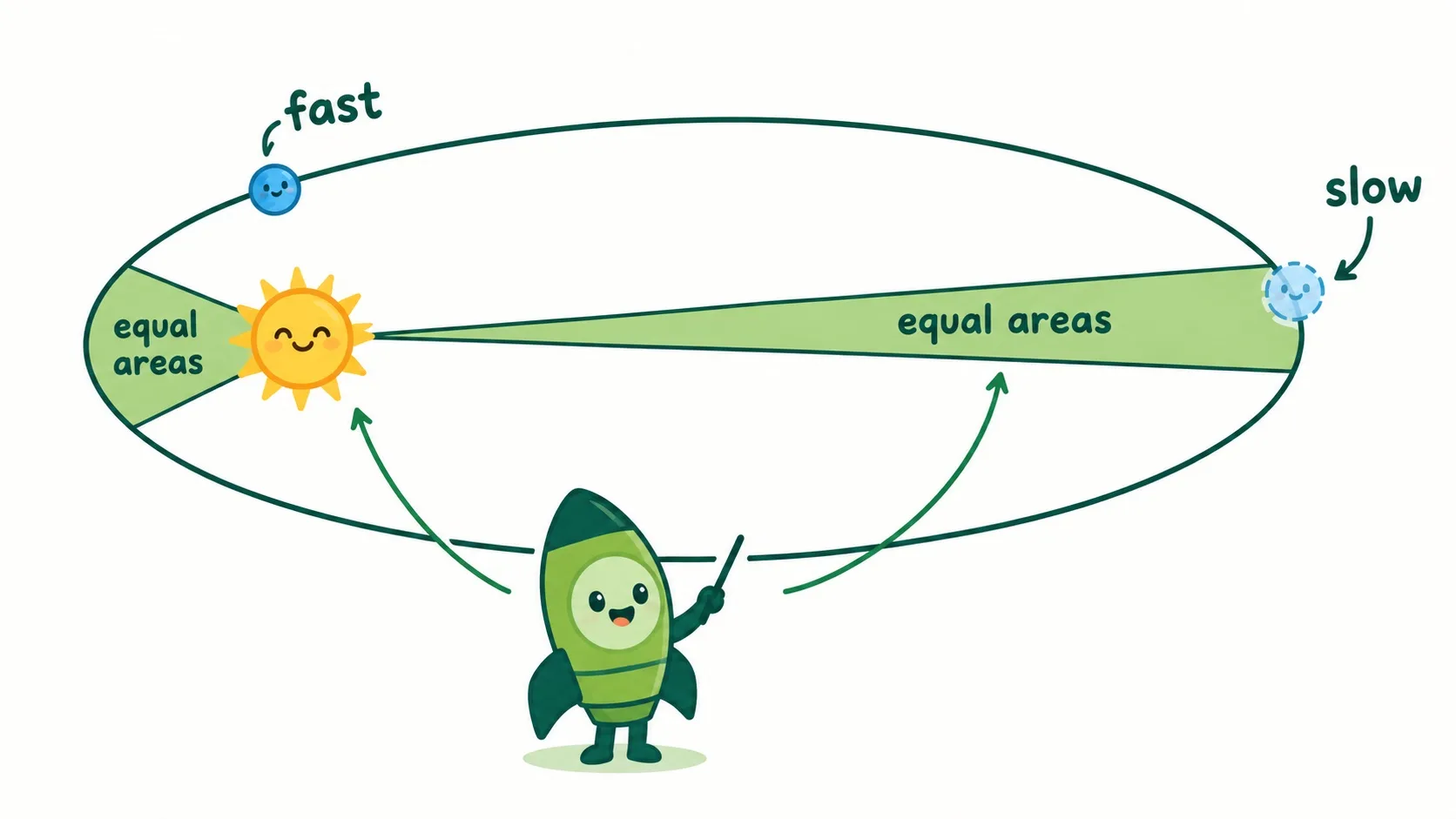
把行星和太阳连一条线,行星走的时候,线扫过一片扇形。同样长的时间里,扫过的面积永远一样大:靠近太阳时走得快(扇子宽而短),远离太阳时走得慢(扇子窄而长)。近快远慢,就这么来的。Draw a line from the Sun to the planet; as the planet moves, the line sweeps a pie slice. In equal times it sweeps equal areas: near the Sun the planet moves fast (wide, short slice), far away it moves slow (narrow, long slice). That is why closer means faster.
如果给所有行星排名,谁的一年最长?Rank all the planets — who has the longest year?
第 3 步:T² ∝ a³,越远一年越长Step 3: T² ∝ a³ — farther means a longer year
第三条:轨道半长轴 a 的立方,与周期 T 的平方成正比——T² ∝ a³。地球 a=1、一年;火星 a≈1.52、约 1.88 年。越靠外的行星,路程更长、跑得还更慢,所以它的一年长得多。Rule three: the cube of the orbit's semi-major axis a is proportional to the square of the period T — T² ∝ a³. Earth: a=1, one year; Mars: a≈1.52, about 1.88 years. Farther planets travel longer paths at slower speeds, so their years stretch far longer.
🎮 你来当观测员(30 秒)🎮 Your turn: observatory duty (30 seconds)
拖一拖离心率滑块,看行星在近日点如何加速、远日点如何减速;再完成 4 个观察任务。Drag the eccentricity slider to watch the planet speed up near the Sun and slow down far away — then finish 4 observation tasks.
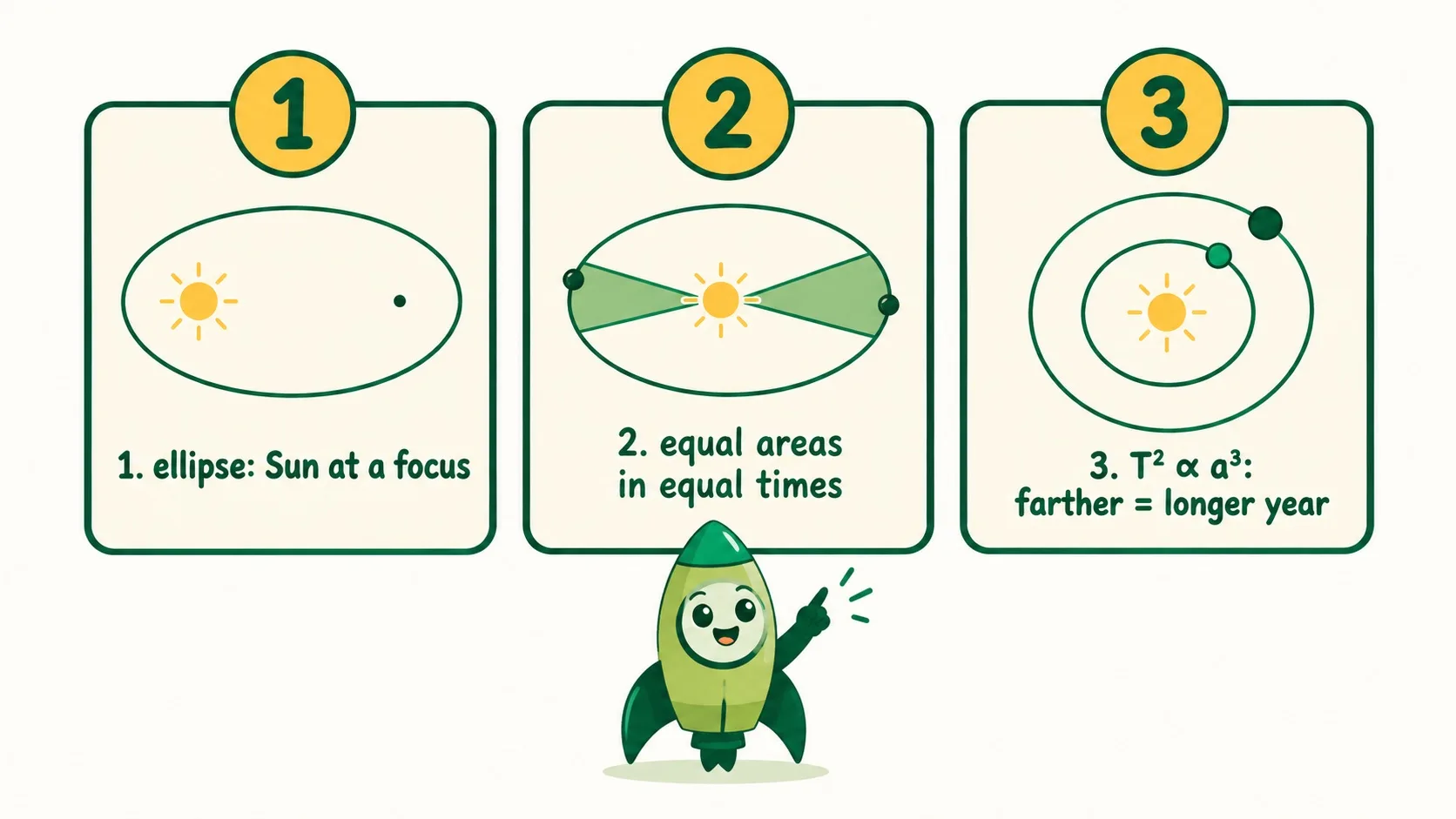
一句话记住它:开普勒三定律 = 轨道是椭圆(太阳在焦点)+ 等时间扫过等面积(近快远慢)+ T² ∝ a³(越远一年越长)。它们是引力的“果”,牛顿后来全算出来了。Remember it in one line: Kepler's three laws = elliptical orbits (Sun at a focus) + equal areas in equal times (fast near, slow far) + T² ∝ a³ (farther means a longer year). They are consequences of gravity — Newton derived them all.
轨道是椭圆,太阳在一个焦点上,不在中心Orbits are ellipses with the Sun at one focus, not the centre相等时间扫过相等面积:近日点快、远日点慢Equal times sweep equal areas: fast at perihelion, slow at aphelionT² ∝ a³:轨道越大,公转周期越长(火星约 1.88 年)T² ∝ a³: a bigger orbit means a longer year (Mars: about 1.88 years)
内容参考 OpenStax 等公开教材,多来源核对 · AI 生成、人工审核 · 发现错误欢迎指正,帮这片叶子长得更好。Based on OpenStax and other open textbooks, cross-checked across sources · AI-generated, human-reviewed · Spotted a mistake? Tell us — help this leaf grow.
 Back to tree