上一片里,反向传播把每个权重的“责任”算了回来——往哪走,机器人知道了。可往哪走只是一半,另一半是:每一步,迈多大?Last leaf, backpropagation traced the blame back to every weight — so the robot knows which way to go. But direction is only half the story. The other half: how big should each step be?
第 1 步:三种步伐,三种命运Step 1: Three step sizes, three fates
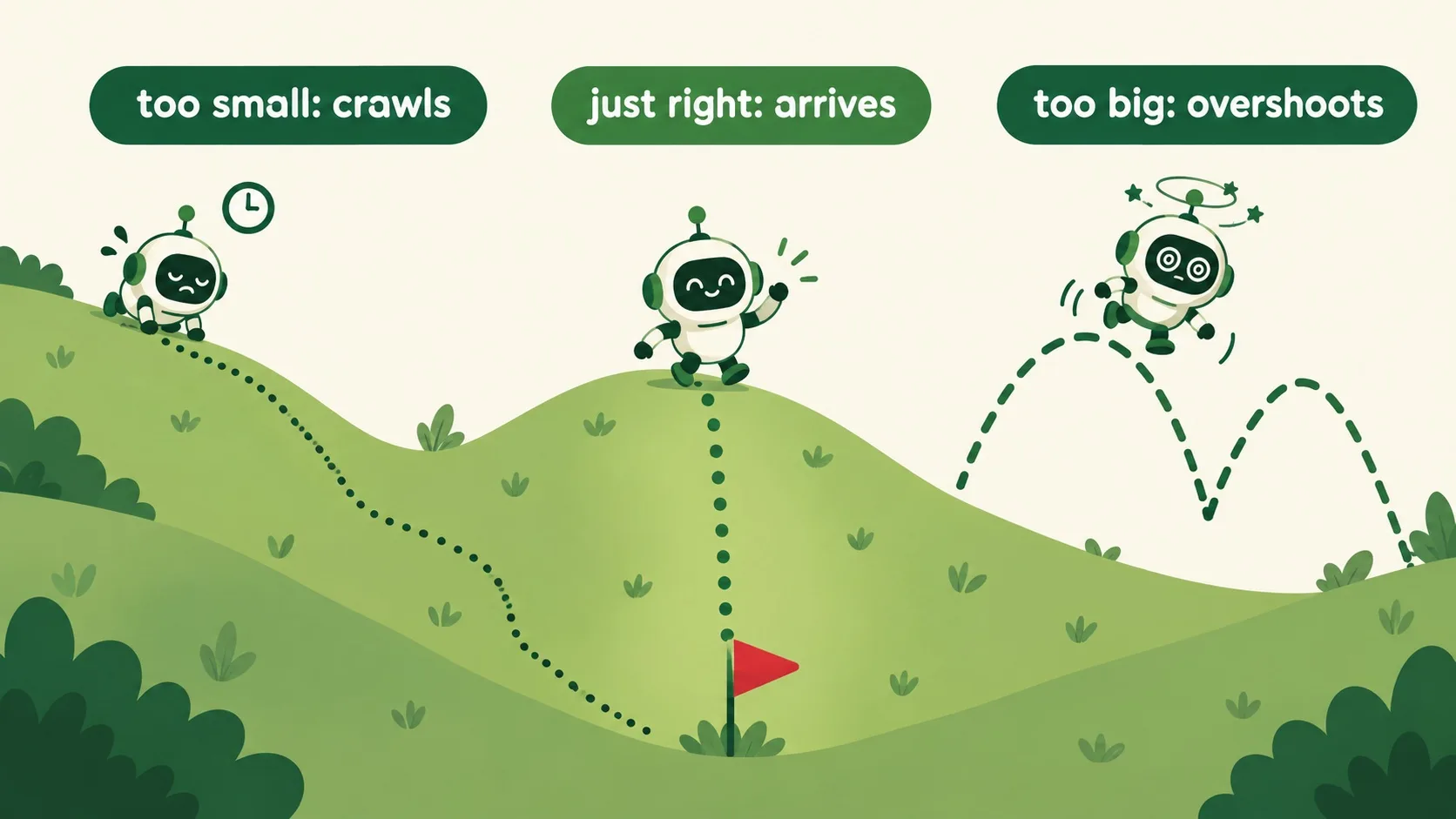
答案藏在一个小实验里:同一条山路,让三个机器人各走各的。The answer hides in a small experiment: one hill, three robots, three walking styles.
三个机器人下山找红旗。小步机器人一路小碎步,磨磨蹭蹭挪了几十步才到山脚;中步机器人步幅均匀,十来步稳稳滑到底;大步机器人一迈就跳过头,在两侧山坡来回了半天,怎么也落不到红旗边。Three robots head down the hill to the red flag. The small-step robot shuffles in tiny hops and needs dozens of steps to crawl to the bottom; the medium-step robot strides evenly and glides to the flag in about ten; the big-step robot leaps clean over the target and bounces between the slopes, never landing by the flag.
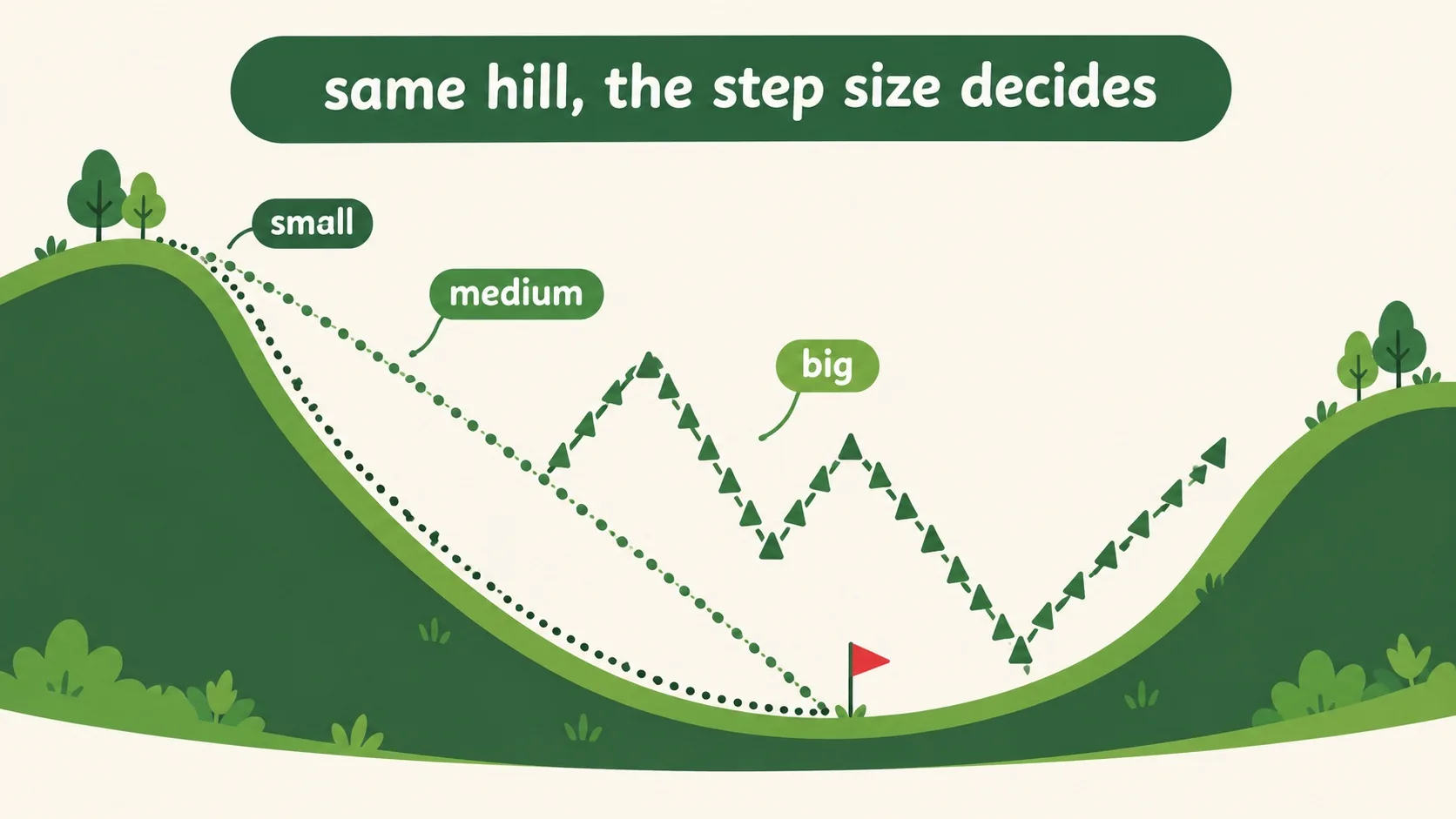
为什么只差一点点,结局却完全不同?三条路线画在同一个山坡上就知道了。Why does a slight difference change everything? Put all three routes on one slope and you'll see.
第 2 步:同一条山谷,三条路径Step 2: Same valley, three paths
山坡的陡峭程度(梯度)只说往哪走;迈多远,由每一步的大小定。小步贴着山壁一点点挪,安全但慢吞吞;中步每一步都踩在好位置,平滑滑到底;大步直接跨过谷底,弹到对面山坡,画出一个来回震荡的大三角。这个步子的大小,就是学习率(learning rate)——每次更新权重时迈出的距离。The slope's steepness (the gradient) only says which way to go; how far you travel is set by the size of each step. Small steps hug the wall — safe but slow; medium steps land well every time and glide to the bottom; big steps fly clean over the valley floor and land on the opposite slope, tracing a zigzag that never settles. That step size is the learning rate — the distance covered by each weight update.
道理懂了。那真实训练里,这个步子该从多大开始?Now you get it. But in real training, what number should the step start at?
第 3 步:起步 0.001 ~ 0.01,再慢慢收Step 3: Start at 0.001–0.01, then slow down
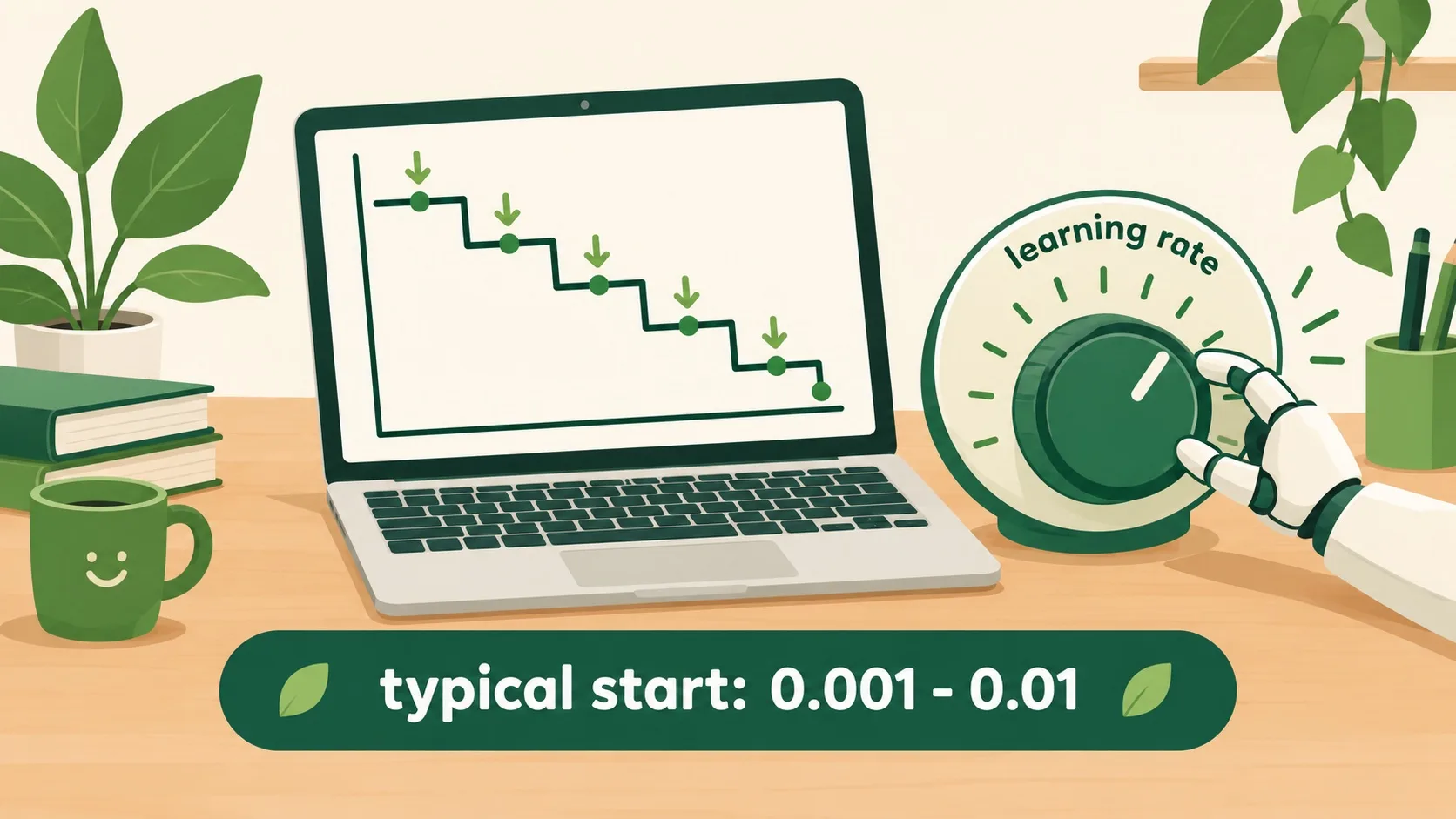
真实训练不看山谷,只看损失曲线一路阶梯式下降。学习率常见起步 0.001 ~ 0.01:太小,曲线磨磨蹭蹭;太大,曲线上下乱跳、甚至炸开。跑顺了还要让学习率慢慢衰减(decay):先大步伐快速靠近,再小步伐精修。老手管这叫“炼丹”——配方(网络)一样,火候(学习率)不同,结果天差地别。Real training doesn't watch a valley — it watches the loss curve step downward. A typical start is 0.001–0.01: too small and the curve crawls; too big and it bounces wildly, even blows up. Once it runs well you decay the learning rate — big strides first, fine polishing later. Practitioners call this “alchemy”: same recipe (the network), different heat (the learning rate), wildly different results.
🎮 你来选步伐(30 秒)🎮 Your turn: pick the step (30 seconds)
道理讲完了。先把三档步伐各看一遍,再选出刚好滑到底的那一档。Theory done. Watch all three strides, then pick the one that glides right to the bottom.
一句话记住它:学习率 = 每一步迈多大:太小磨蹭、太大跳过,刚刚好才到得了。Remember it in one line: the learning rate is how big each step is — too small crawls, too big overshoots, just right arrives.
太小磨蹭:几十步才挪到;太大跳过:来回弹跳、甚至越弹越远Too small crawls for dozens of steps; too big bounces back and forth — or flies further every hop梯度负责方向,学习率负责距离:每次更新权重时迈多远,它说了算The gradient gives the direction, the learning rate gives the distance — how far each weight update goes实战起步 0.001 ~ 0.01,跑顺了再衰减:先快速靠近,再小步精修Start around 0.001–0.01, then decay: big strides first, fine steps later
内容参考 OpenStax 等公开教材,多来源核对 · AI 生成、人工审核 · 发现错误欢迎指正,帮这片叶子长得更好。Based on OpenStax and other open textbooks, cross-checked across sources · AI-generated, human-reviewed · Spotted a mistake? Tell us — help this leaf grow.
 Back to tree