🌀 说谎者悖论:这句话是假的🌀 The Liar Paradox: This Sentence Is False
上一片「鸽巢原理」里,每句话非真即假,推理一路通畅。可有一类句子会反咬自己——“这句话是假的”:说它真,它就假;说它假,它又真。In the last leaf every sentence was true or false, and reasoning rolled along. But some sentences bite back: “This sentence is false.” Call it true and it turns false; call it false and it turns true.
第 1 步:句子咬住了自己的尾巴Step 1: The sentence bites its own tail
先别急着判断——看看它咬住的到底是什么。Hold off on judging — look at what it is biting.
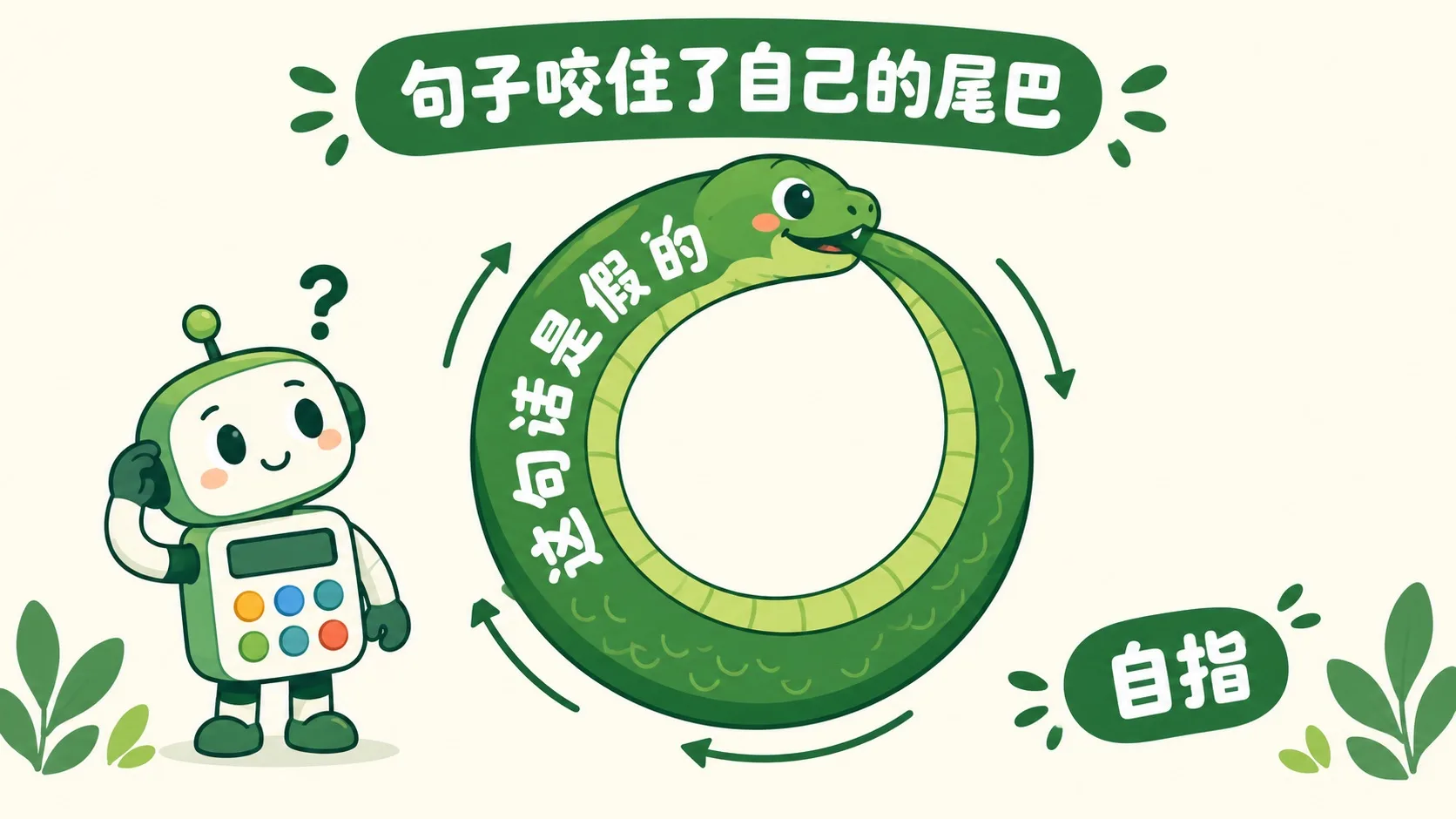
看这条衔尾蛇:句子的一端绕回来咬住了自己。“这句话是假的”谈论的对象不是别的,正是它自己的真假。这种“自己说自己”叫自指(self-reference),是怪圈的入口——尾巴一咬住,是非就绕不出来了。Look at this ouroboros: the sentence curls back and bites itself. “This sentence is false” is not about anything else — it is about its own truth. This talking-about-itself is called self-reference, the doorway into the loop. Once the tail is bitten, true and false can't get out.
顺着推理走两步,看看它会把你带到哪儿。Take two steps of reasoning and see where it leads.
第 2 步:真→假→真,绕不出去Step 2: TRUE → FALSE → TRUE, around and around
假设它为真:它说“我是假的”,那它就该是假——刚才的真被推翻。假设它为假:它说“我是假的”说中了,那它又该是真——假也被推翻。真引向假,假引向真,兜一圈回到原点,永远停不下来。Assume true: it says “I am false”, so it should be false — the true is overturned. Assume false: “I am false” is right, so it should be true — false is overturned too. True leads to false, false leads to true, one lap brings you back to the start, forever.
绕晕了不是你算错——两千多年前的高手也栽在这句话上。Dizzy is not your miscalculation — the best minds of 2,400 years ago got stuck here too.
第 3 步:不是错误,是边界信号Step 3: Not a mistake — a boundary signal
公元前 4 世纪,欧布里德就提出了它。悖论不是算错的产物,而是一个信号:日常语言加上“非真即假”的规则,走到自指这一步会撞墙。后来人们造出分层语言和三值逻辑来修补;罗素悖论、哥德尔不完备定理,都从这堵墙里凿出了新路。Eubulides posed it in the 4th century BCE. A paradox is not a miscalculation but a signal: ordinary language plus the rule “either true or false” hits a wall at self-reference. Later thinkers built layered languages and three-valued logic to patch it — and Russell's paradox and Gödel's incompleteness theorems carved new paths through that wall.
🎮 你来拖真假滑杆(30 秒)🎮 Your turn: the truth knob (30 seconds)
光看不过瘾:亲手把这句话拖成真或假,看它怎么自己绕圈打结;再判断 4 个句子谁打结、谁没打结。Reading is not enough: drag the sentence to true or false and watch it knot itself; then judge which of 4 sentences knot and which don't.
一句话记住它:自指 + 否定 = 真假两头堵;悖论不是错误,是逻辑撞墙的报警器。Remember it in one line: self-reference plus negation blocks both true and false — a paradox is not a mistake but logic's wall alarm.
「这句话是假的」:设真则假,设假则真,无法自洽The liar: true implies false, false implies true — never consistent关键机制是自指:句子谈论自己的真假The key is self-reference: the sentence talks about its own truth悖论是边界信号:逼着人们修补“非真即假”的规则A paradox is a boundary signal: it forces a patch to the “true-or-false” rule
内容参考 OpenStax 等公开教材,多来源核对 · AI 生成、人工审核 · 发现错误欢迎指正,帮这片叶子长得更好。Based on OpenStax and other open textbooks, cross-checked across sources · AI-generated, human-reviewed · Spotted a mistake? Tell us — help this leaf grow.
 Back to tree