🧲 磁场:看不见的力线网🧲 Magnetic Fields: The Invisible Web of Field Lines
上一片把家里的电管得服服帖帖。可电的邻居——磁,还藏着秘密:它看不见、摸不着,却能隔空把小磁针拨得团团转。这一片就把这张看不见的力线网画出来。Last leaf put home electricity in order. But magnetism — electricity's quiet neighbour — still keeps a secret: invisible, untouchable, yet it can swing a compass needle from across the table. This leaf draws that invisible web of field lines.
第 1 步:两极与铁屑画出的网Step 1: Two poles and the web drawn by iron filings
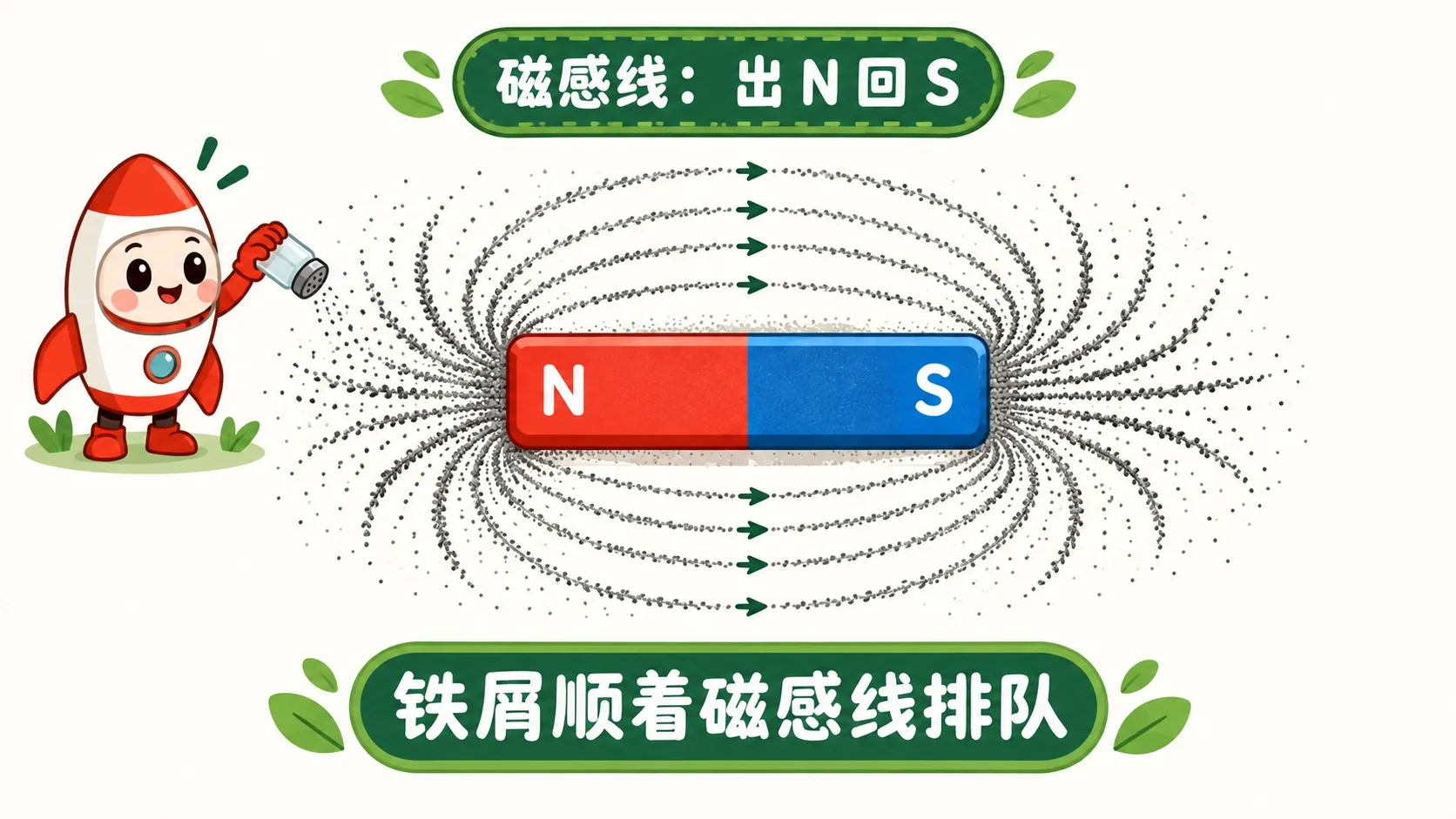
先从一个最小的磁体开始:一根条形磁铁。Start with the smallest magnet there is: one bar magnet.
磁体两端磁极最强,分别叫 N 极和 S 极。把铁屑撒在磁铁周围,铁屑会顺着看不见的力线排队,铺成一张整齐的网——从 N 极出发,绕一大圈回到 S 极。这张网不是画上去的,它是磁场真实存在的样子。两个磁体相遇,规则只有 8 个字:同名磁极相斥,异名磁极相吸。A magnet is strongest at its two ends, called the N and S poles. Sprinkle iron filings around it and they line up along invisible threads, laying out a tidy web — leaving the N pole, looping around, returning to the S pole. The web is not drawn on: it is what the magnetic field really looks like. When two magnets meet, the rule is short: like poles repel, unlike poles attract.
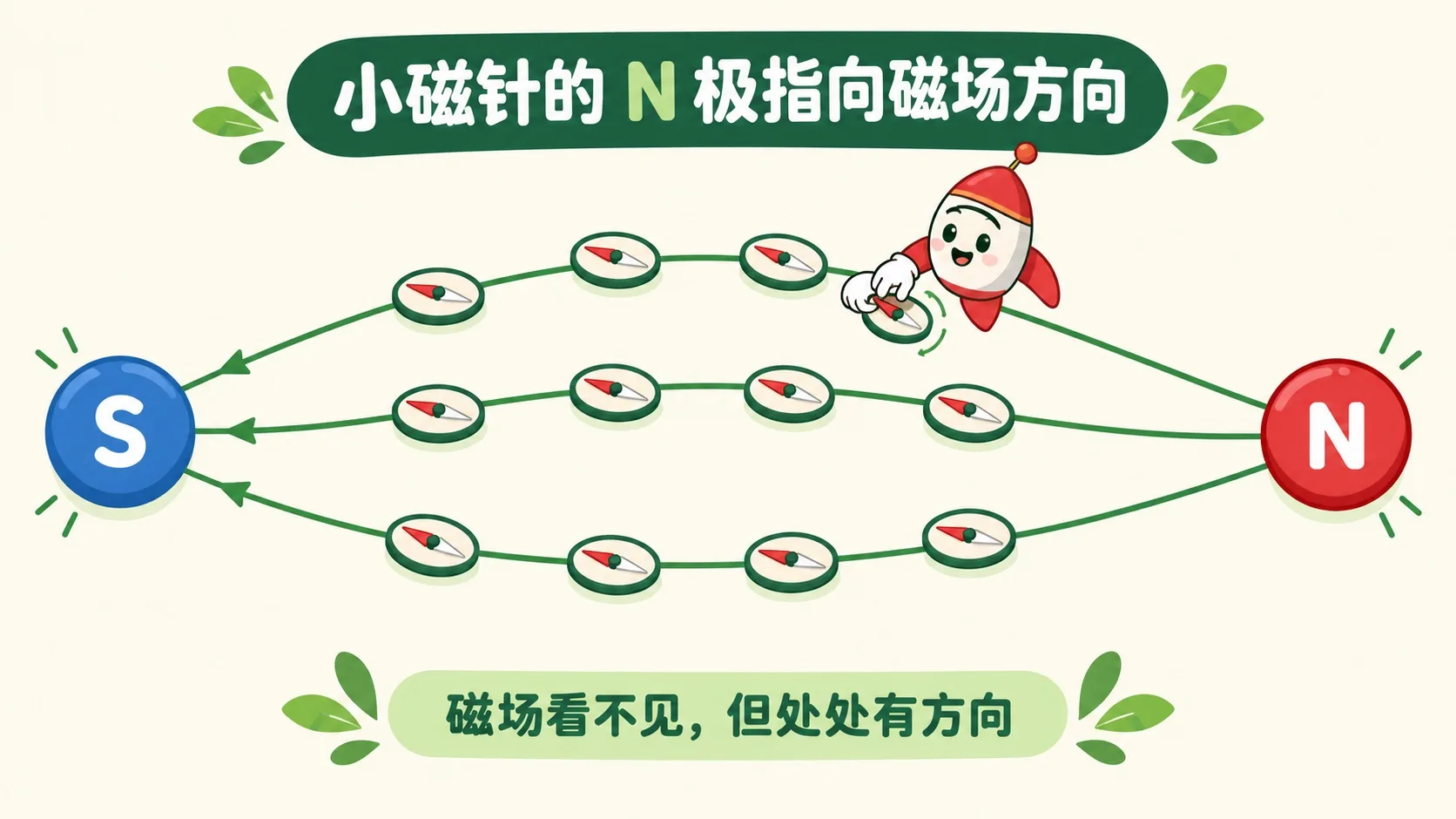
铁屑只能看出形状,怎么知道每一点的磁场朝哪边?Filings show the shape — but how do you tell which way the field points at each spot?
第 2 步:小磁针——磁场的探针Step 2: The compass needle — a probe for the field
用小磁针。它的红色 N 极永远指向所在处的磁场方向:放在磁感线上,它就顺着线排队;换一个位置,它立刻转到新的方向。所以磁场不是「有磁铁的地方才有」的贴纸——它是空间里每一点都有的属性:有方向、也有强弱,两极附近线最密、场最强。磁感线从 N 极出来、回到 S 极,两条线永不相交。Use a compass needle. Its red N tip always points along the field where it sits: place it on a field line and it queues up with the line; move it and it swings to the new direction at once. So the field is not a sticker that only exists near a magnet — it is a property of every point in space: a direction and a strength, with lines crowding tightest near the poles. Field lines leave N and return to S, and two of them never cross.
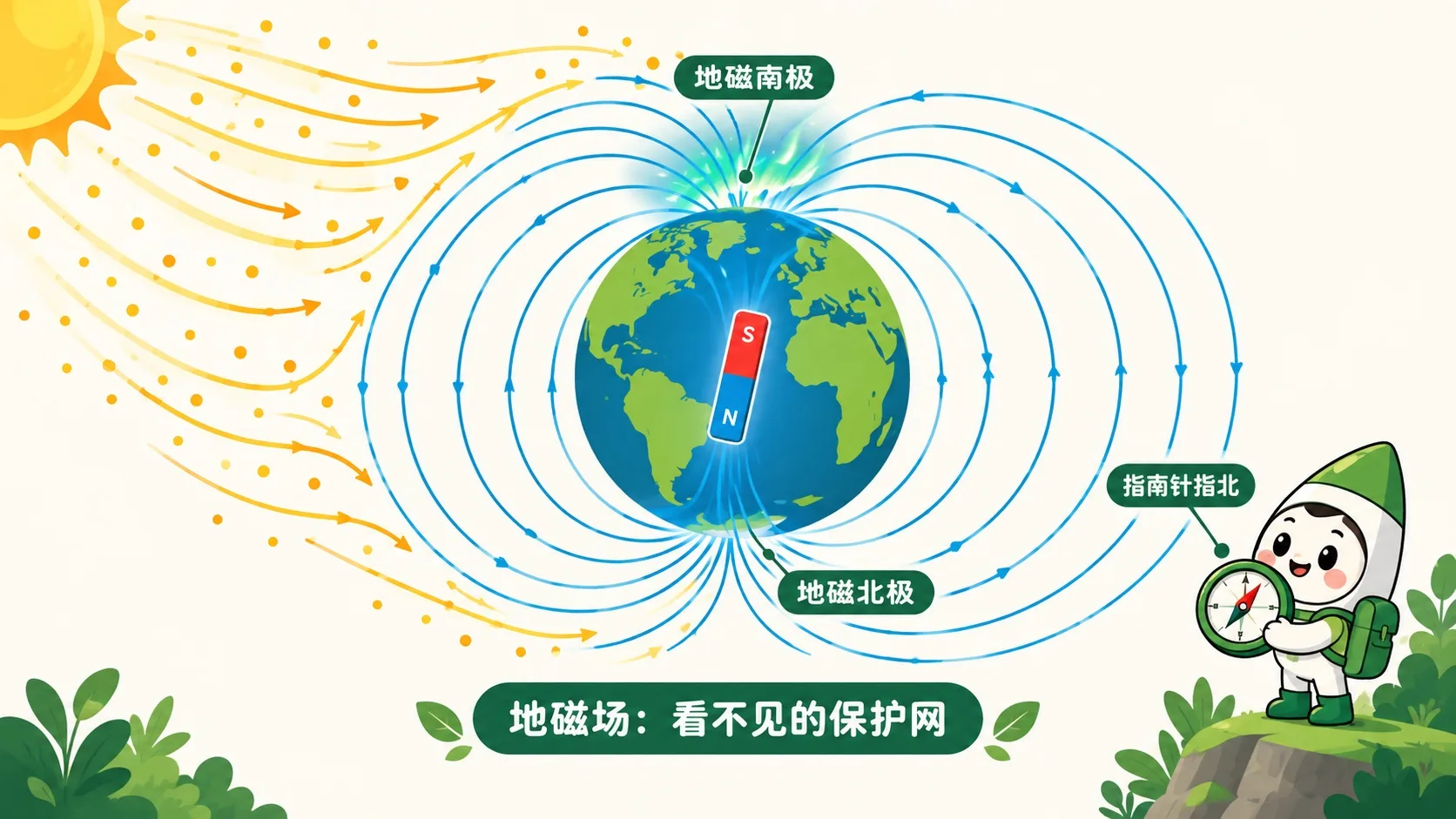
那指南针为什么永远指北?So why does a compass always point north?
第 3 步:地球的大磁铁与保护网Step 3: Earth, the giant magnet and its shield
因为指南针泡在一张更大的网里:地球本身就是个大磁体。地磁的南极在地理北极附近,地磁北极在地理南极附近;指南针的 N 极被地磁南极吸引,所以指向北方。这张网还是地球的防护罩:太阳喷出的带电粒子流(太阳风)被磁场偏转、挡在地球之外,只在两极上空漏进来一点,画出绚丽的极光。从铁屑到指南针,再到星球防护罩——同一张网,从掌心铺到整个地球。Because the needle is soaking in a much bigger web: Earth itself is a giant magnet. Its magnetic south pole sits near the geographic north, and its magnetic north near the geographic south; the needle's N tip is pulled toward the magnetic south, so it points north. This web is also a shield: the charged particles streaming from the Sun (the solar wind) are steered around the Earth, leaking in only above the poles — painting the auroras. From iron filings to compasses to a planet-sized shield: one web, from your palm to the whole Earth.
🎮 你来当磁铁实验室管理员(30 秒)🎮 Your turn: run the magnet lab (30 seconds)
道理讲完了。拖动小磁针,看它沿磁场方向转向;点「铁屑视图」,看磁场线的形状;再完成 4 个任务。Theory done. Drag the compass needle and watch it turn along the field; click "Iron filings" to see the shape of the field lines; then finish 4 tasks.
一句话记住它:磁场看不见,但处处有方向——磁感线出 N 回 S,小磁针 N 极指哪,哪就是磁场的方向。Remember it in one line: the field is invisible but has a direction everywhere — lines leave N and return to S, and a needle's N tip shows the way.
磁体两极最强;同名磁极相斥、异名磁极相吸A magnet is strongest at its poles; like poles repel, unlike poles attract磁体外部,磁感线从 N 极出来、回到 S 极;小磁针 N 极指向该点的磁场方向Outside a magnet, field lines leave N and return to S; a needle's N tip points along the field at that spot磁场是空间属性;地磁场让指南针指北,还挡住太阳风、画出极光The field is a property of space; Earth's field turns compasses north and shields us from the solar wind, painting auroras
内容参考 OpenStax 等公开教材,多来源核对 · AI 生成、人工审核 · 发现错误欢迎指正,帮这片叶子长得更好。Based on OpenStax and other open textbooks, cross-checked across sources · AI-generated, human-reviewed · Spotted a mistake? Tell us — help this leaf grow.
 Back to tree