上一片用经纬度找到了宝藏岛的灯塔。可仓库到灯塔那段路,图上只有 4 厘米——实地到底是多远?🌍 蓝色星球向导掏出了比例尺。Last leaf pinned the Treasure Island lighthouse by its coordinates. But the depot-to-lighthouse walk is only 4 cm long on paper — how far is that on the ground? 🌍 Blue Planet Guide pulls out the scale.
第 1 步:图上 4 厘米 = 实地多远Step 1: 4 cm on paper = how far for real
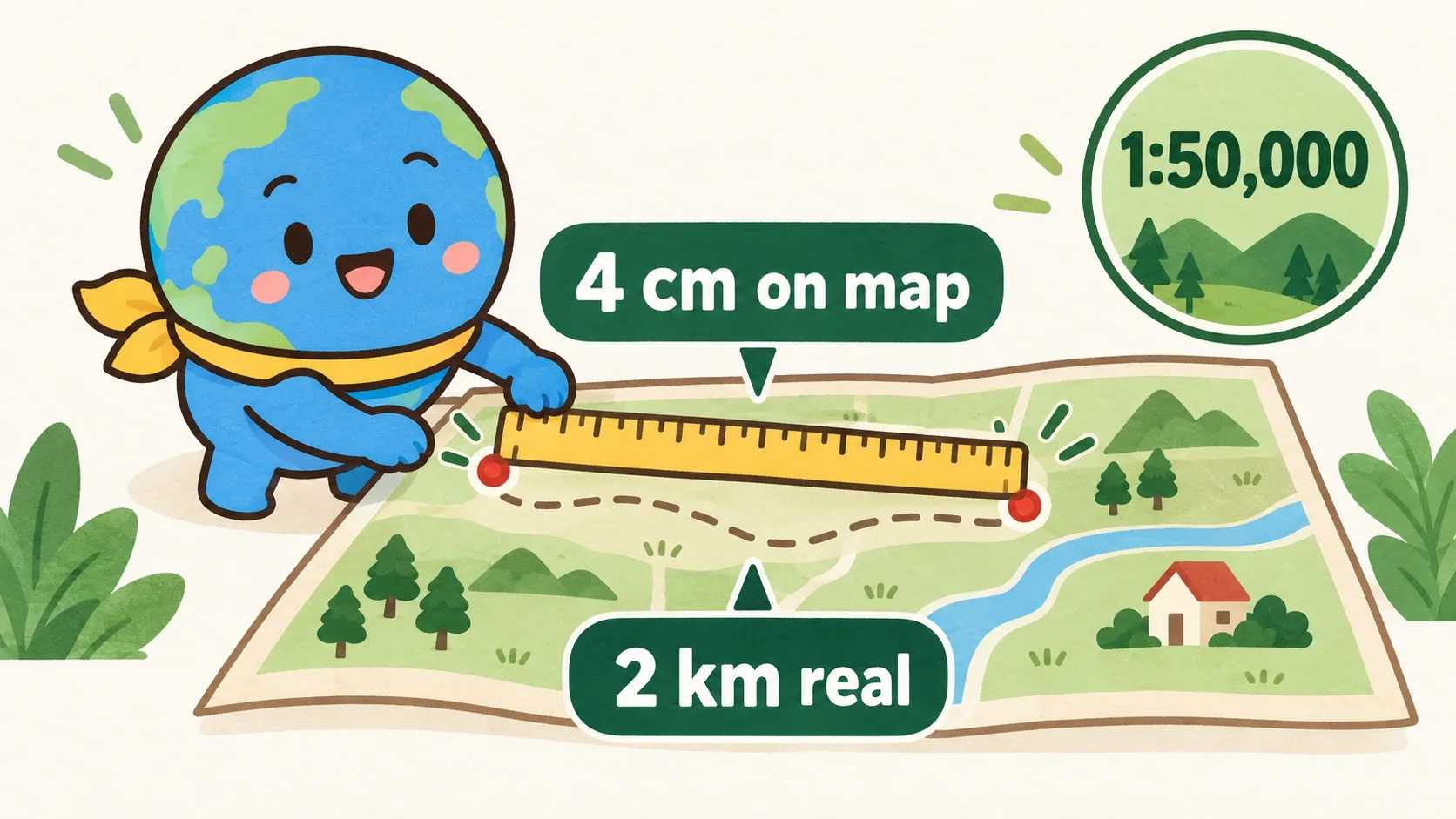
先看地图角落里那个 1:50000 是什么意思。Start with that 1:50,000 stamped in the map's corner.
比例尺 = 图上距离 ÷ 实地距离。1:50000 的意思是:图上 1 厘米,代表实地 50000 厘米。量得图上 4 厘米,就是 4 × 50000 = 200000 厘米。换成千米要除以 100000(1 千米 = 100000 厘米),得 2 千米。地图角落常还画一根线段比例尺,它跟着图一起放大缩小,复印歪了也不会算错。Scale = map distance ÷ real distance. 1:50,000 means one centimetre on the map stands for 50,000 centimetres on the ground. Measure 4 cm and you get 4 × 50,000 = 200,000 cm. Divide by 100,000 to turn centimetres into kilometres (1 km = 100,000 cm): 2 km. Maps also print a bar scale, which shrinks and grows with the map — so even a resized photocopy stays honest.
同一个地方,为什么有的地图画得很细、有的很粗?Same place, so why is one map crammed with detail and another almost bare?
第 2 步:大比例尺 vs 小比例尺Step 2: Large scale vs small scale
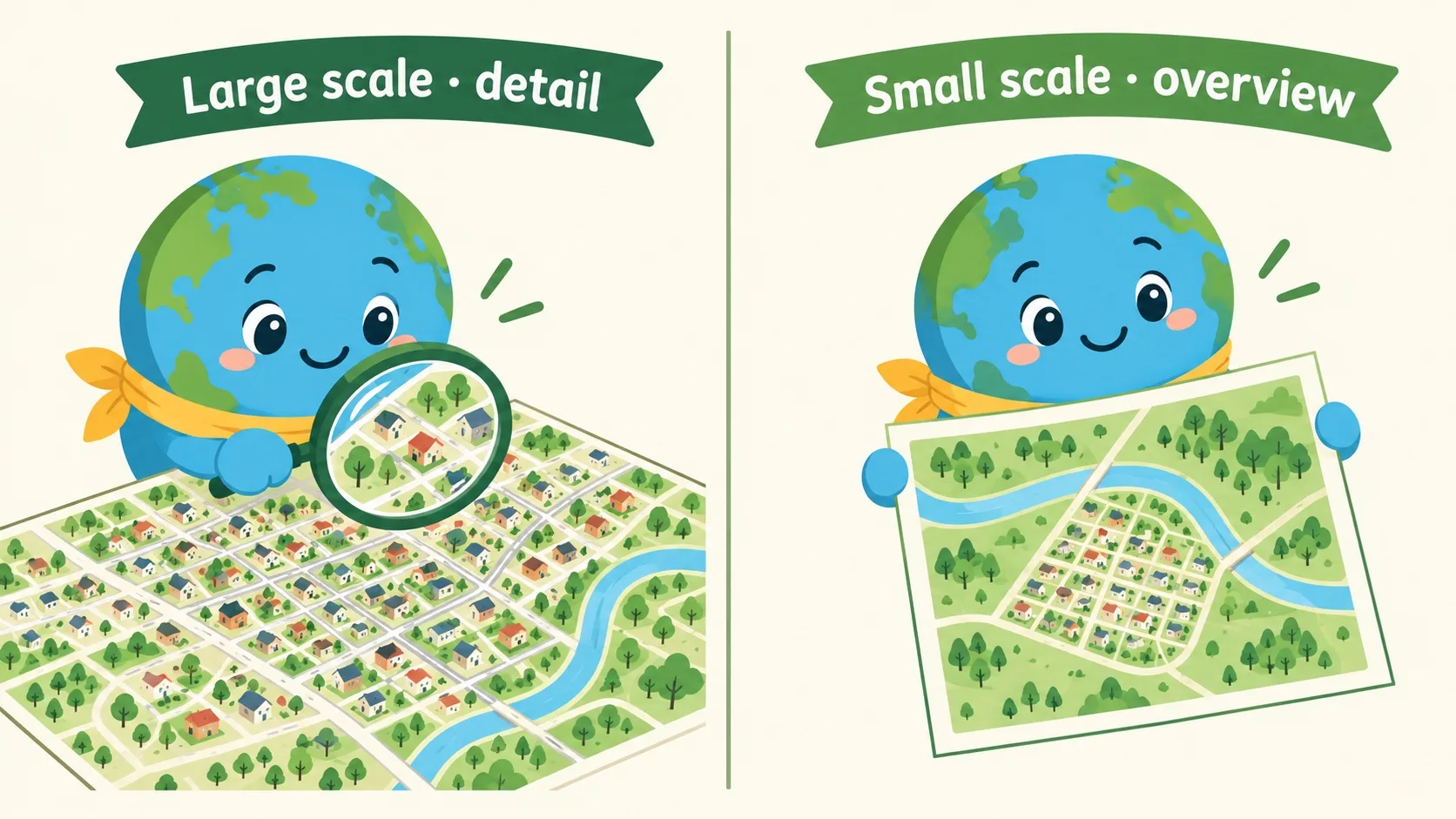
比的是那个分数的大小:1/10000 比 1/500000 大,所以 1:10000 叫大比例尺。大比例尺画的范围小、内容细(校园图、小区平面图);小比例尺画的范围大、内容粗(省图、世界地图)。同样一张纸,装下的地方越大,能留的细节就越少——这是躲不掉的取舍。Compare the fractions: 1/10,000 is bigger than 1/500,000, so 1:10,000 is the large scale. A large scale covers a small area in fine detail (a campus plan, a neighbourhood map); a small scale covers a huge area roughly (a province, the world). On one sheet of paper, the more ground you fit, the less detail survives — an unavoidable trade-off.
手机地图上没印“1:50000”,它的比例尺去哪了?Your phone map prints no “1:50,000” — so where did its scale go?
第 3 步:手机里的比例尺是活的Step 3: On a phone, the scale is alive
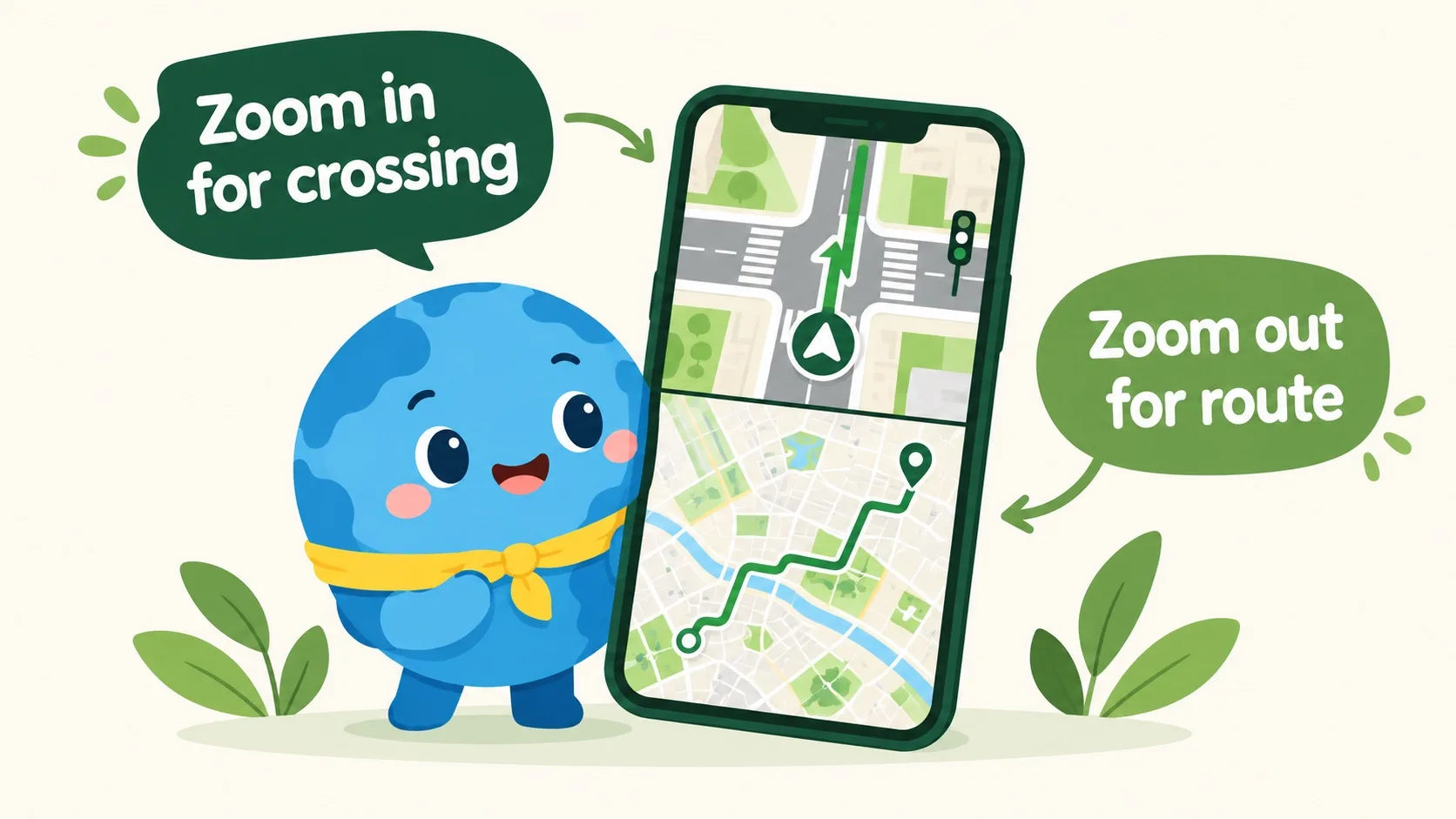
两指一捏,其实就是在换比例尺:屏幕角落那根短线加上“100 米”,就是此刻的线段比例尺。放大是大比例尺,看清路口怎么拐;缩小是小比例尺,看全程有多远。估步行时间、算油量、量跑步路线,背后都是同一个乘法:图上距离 × 比例尺 = 实地距离。Pinching two fingers is exactly a scale change: that short bar in the corner with “100 m” beside it is the current bar scale. Zoomed in you are at a large scale, close enough to see how the junction turns; zoomed out you are at a small scale, seeing the whole trip. Estimating walking time, fuel or a running route all run on the same multiplication: map distance × scale = real distance.
🎮 你来量这 4 段路(30 秒)🎮 Your turn: measure 4 legs (30 seconds)
先拖滑块,看同样的 4 厘米在不同比例尺下变成多远;再按“量一量”,把 4 段路一段段算出来。Drag the slider first to see what the same 4 cm becomes at each scale; then hit “Measure it” and work the 4 legs out one by one.
一句话记住它:比例尺是地图的缩小倍数——图上距离 × 比例尺 = 实地距离。Remember it in one line: a map scale is the map's shrink factor — map distance × scale = real distance.
1:50000 = 图上 1 厘米代表实地 50000 厘米(500 米);厘米换千米除以 1000001:50,000 = 1 cm on the map is 50,000 cm on the ground (500 m); divide cm by 100,000 for km冒号后的数越小,比例尺越大:范围小、画得细;反之范围大、画得粗The smaller the number after the colon, the larger the scale: small area, fine detail — and the reverse线段比例尺跟着图一起缩放;手机地图捏一下就是在换比例尺A bar scale resizes with the map; on a phone, a pinch is a scale change
内容参考 OpenStax 等公开教材,多来源核对 · AI 生成、人工审核 · 发现错误欢迎指正,帮这片叶子长得更好。Based on OpenStax and other open textbooks, cross-checked across sources · AI-generated, human-reviewed · Spotted a mistake? Tell us — help this leaf grow.
 Back to tree