💪 机械功:用力又有位移才算数💪 Mechanical Work: Push AND Move to Count
上一片里,卫星在圆轨道上速度大小始终不变——因为引力始终垂直于运动方向,不做功。这一片就来讲“功”的规矩:为什么有时候你累得满头大汗,物理却说“你没做功”?Last leaf, a satellite kept a steady speed on its circular orbit — because gravity stays perpendicular to its motion and does no work. This leaf is about the rules of work: why can you sweat and strain, yet physics says you did no work at all?
第 1 步:提着箱子走,白累了吗?Step 1: Carry a suitcase — wasted effort?
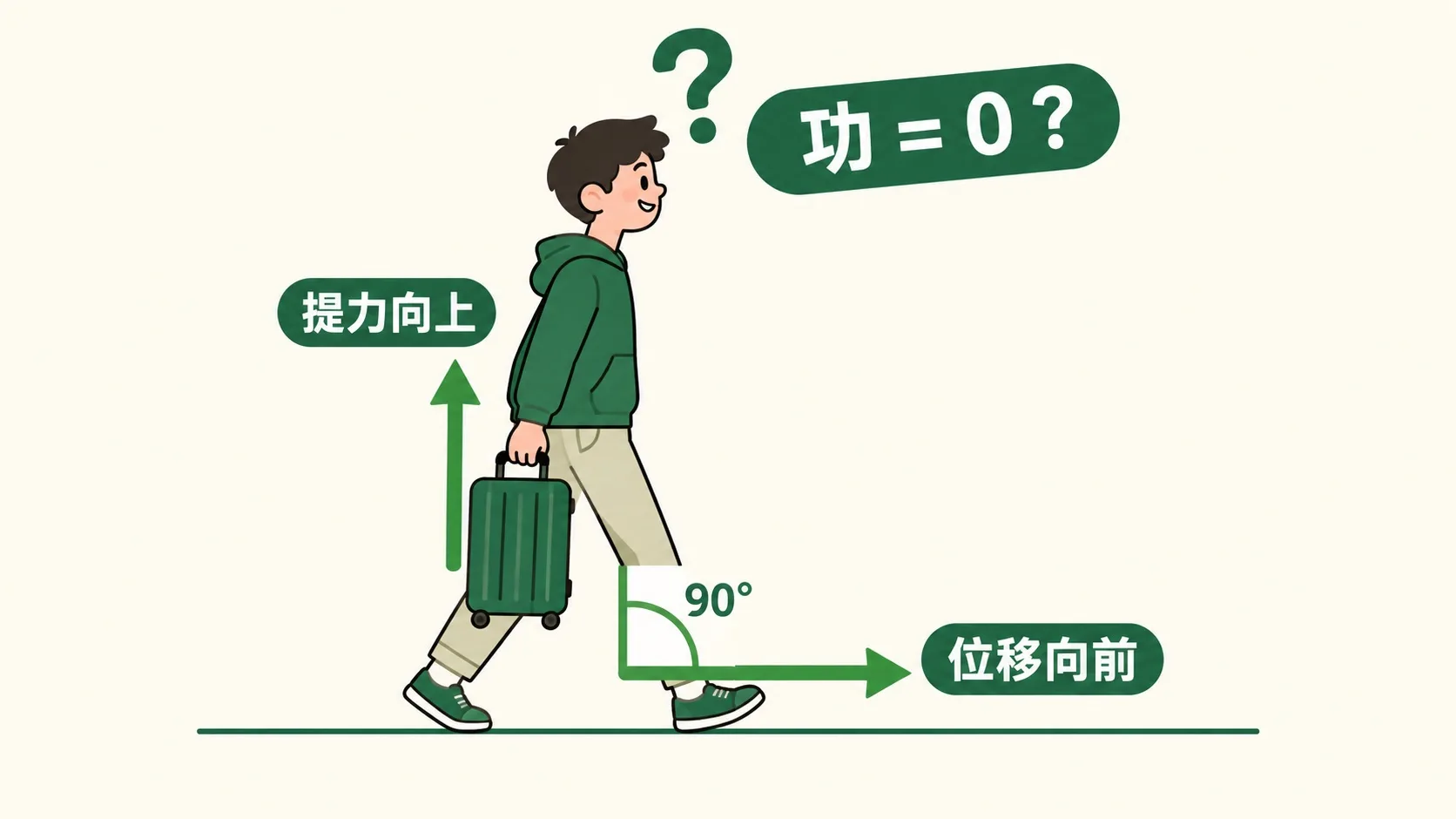
先看最委屈的一幕——小火箭提着箱子,沿水平地面走了一段路。Start with the most unfair-looking scene — the little rocket carries a suitcase along flat ground.
箱子受到的提力向上,走路的方向向前,两者夹角 90°。功的公式是 W = 力 × 位移 × cosθ,cos90° = 0——提力对箱子做的功正好是零!你感到累,是因为肌肉反复收缩在“自己内部做功”;但对箱子来说,力的方向上没有位移,物理就不认这笔账。The lift pulls upward, the walking goes forward — 90° apart. The work formula is W = force × displacement × cosθ, and cos90° = 0, so the lift does exactly zero work on the suitcase! You feel tired because your muscles contract again and again, doing work inside you; but the box never moves along the force, so physics keeps no such account.
那往哪个方向使劲,才算数?Then which direction of effort actually counts?
第 2 步:力的方向上要有位移Step 2: The force needs motion along it
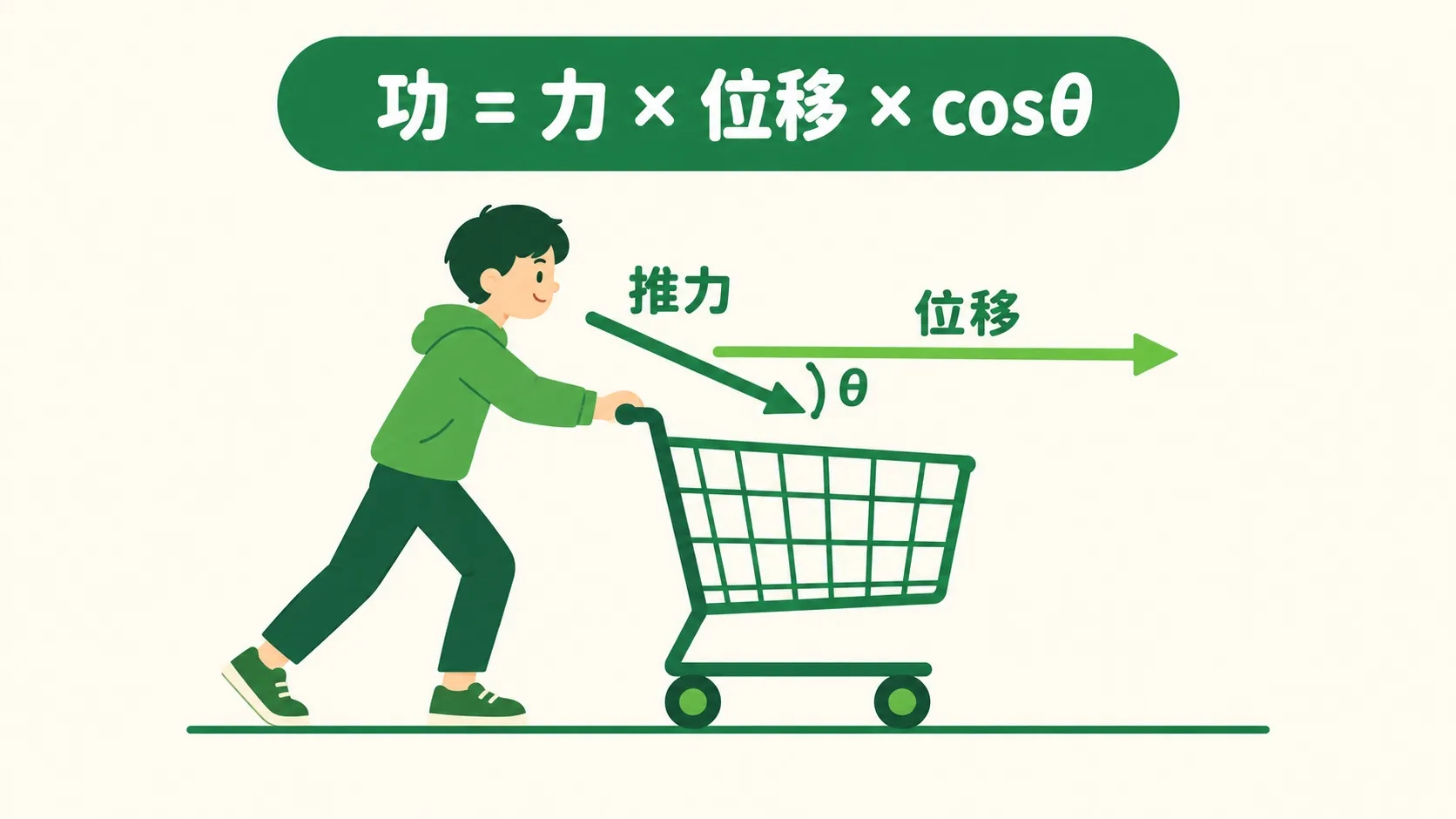
推购物车时,力的方向和前进方向之间夹着角 θ。把力拆开看:只有顺着位移的那部分 F·cosθ 在“干活”,功 = F·s·cosθ。θ 越小越划算:θ = 0° 时全部有效;θ = 90° 时一点不做;θ 超过 90°(比如反着拽),cosθ 变负——功是负的,相当于往外掏能量。Pushing a cart, the force and the motion meet at an angle θ. Split the force: only the part along the motion, F·cosθ, gets the job done. Work = F·s·cosθ. Smaller θ pays better: at 0° every newton counts; at 90° nothing does; past 90° (pulling backwards) cosθ turns negative — negative work, as if you were draining energy out.
工地上的大力士起重机,它的账怎么算?And the strongest worker on the site — how does a crane settle its account?
第 3 步:起重机的账本Step 3: The crane's ledger
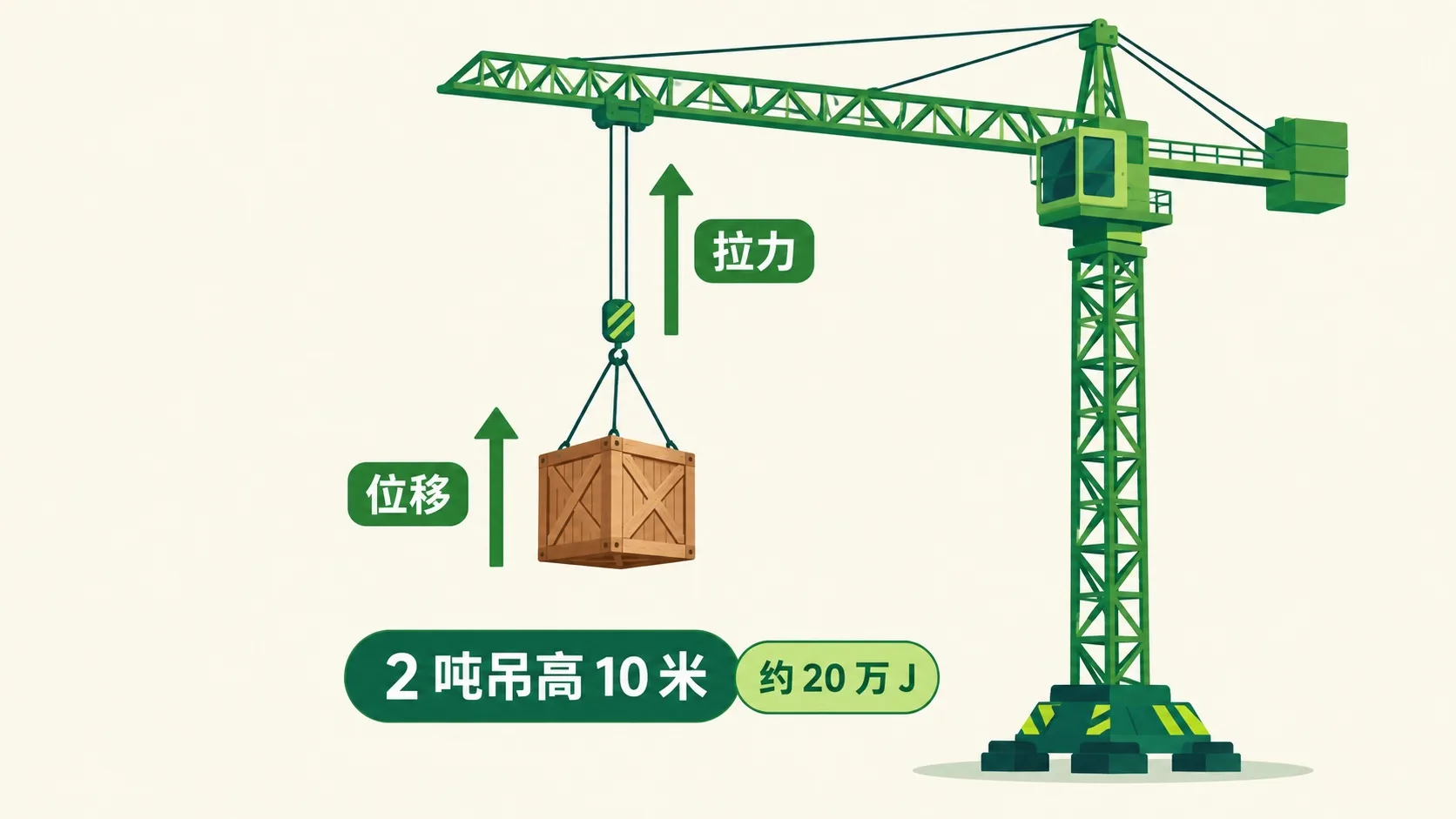
吊起货箱:拉力向上,货箱也向上移动,θ = 0°,功最大 W = F·s。把 2 吨(2000 千克)的货吊高 10 米,拉力约 2×10⁴ N,做的功约 2×10⁵ J。功的单位是焦耳(J),1 J = 1 N·m——把两个苹果举过头顶差不多做 2 J,起重机一下干了十万倍的活。Lifting a crate: the pull is upward, the crate moves upward, θ = 0°, maximum work W = F·s. Hoist 2 tonnes (2000 kg) by 10 m and the cable pulls with about 2×10⁴ N, doing about 2×10⁵ J. The unit of work is the joule (J): 1 J = 1 N·m. Lifting two apples overhead is about 2 J — the crane does a hundred thousand times that in one go.
🎮 你来当搬运员(30 秒)🎮 Your turn: warehouse mover (30 seconds)
道理讲完了。先拖夹角滑块,看功的数值怎么变;再按 4 张任务卡各推一把。Theory done. Drag the angle slider and watch the work value change; then push once for each of the 4 task cards.
一句话记住它:功 = 沿位移方向的力 × 位移(W = F·s·cosθ)——垂直不算,反向倒扣。Remember it in one line: work = the force along the motion × displacement (W = F·s·cosθ) — perpendicular doesn't count, opposite subtracts.
力与位移垂直(cos90°=0)→ 不做功:提箱水平走、卫星绕圈Force perpendicular to motion (cos90°=0) → no work: carrying a case, a satellite circling夹角小于 90° 做正功;大于 90° 做负功(往外掏能量)Angle under 90° does positive work; over 90° does negative work (draining energy)单位焦耳(J):1 J = 1 N·m;吊 2 吨上 10 米约 2×10⁵ JUnit: the joule (J), 1 J = 1 N·m; hoisting 2 t by 10 m is about 2×10⁵ J
内容参考 OpenStax 等公开教材,多来源核对 · AI 生成、人工审核 · 发现错误欢迎指正,帮这片叶子长得更好。Based on OpenStax and other open textbooks, cross-checked across sources · AI-generated, human-reviewed · Spotted a mistake? Tell us — help this leaf grow.
 Back to tree