🧱 多层感知机:从一颗到一张网🧱 Multilayer Perceptron: From One to a Net
前几片里,小机器人学会了称重、过门卫、把信号向前传。但它有个天花板:一颗机器人只会画一条直线。这一片看它怎么组队——把直线变成一张网。The sugar–salt robot has learned to weigh, to pass a gate, and to send signals forward. But it hits a ceiling: one robot draws only a single straight line. This leaf is about teamwork — turning that line into a whole net.
第 1 步:一颗、一排、一张网Step 1: One, a row, a net
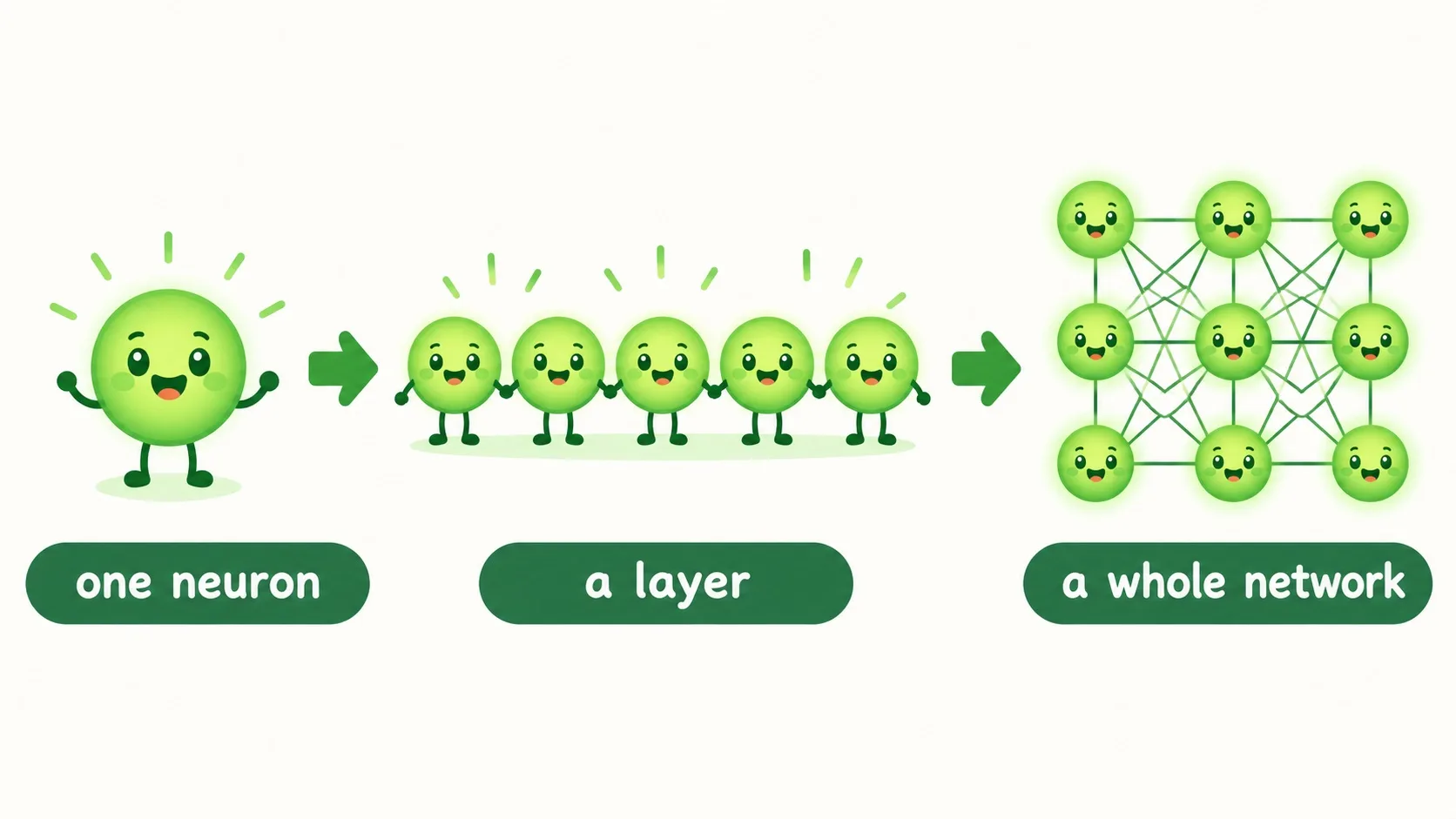
先看规模的三级跳——零件一个没换,能力却换了档。First, the three-level jump — not one part is swapped, yet the power shifts gear.
同一颗小机器人:单独站岗时只能划一条直线;5 颗手拉手排成一层,各自的直线拼出带拐角的折线;三层叠成一张网,笔直的小段被一次次接弯,围出圆环那样的曲线。零件一个没换,只是从单干变成组队——规模上来,能力就换挡。The same little robot: alone, it can only draw a single straight line. Five hold hands into a layer, and their straight lines join into zigzags with corners. Stack three layers into a net, and those straight bits get bent again and again — enough to trace a curve like a ring. Not one part was swapped; it just went from solo work to teamwork. Bigger scale, higher gear.
那它们到底怎么组队?规矩只有一条:拉线。So how does this teamwork actually work? One rule: wires.
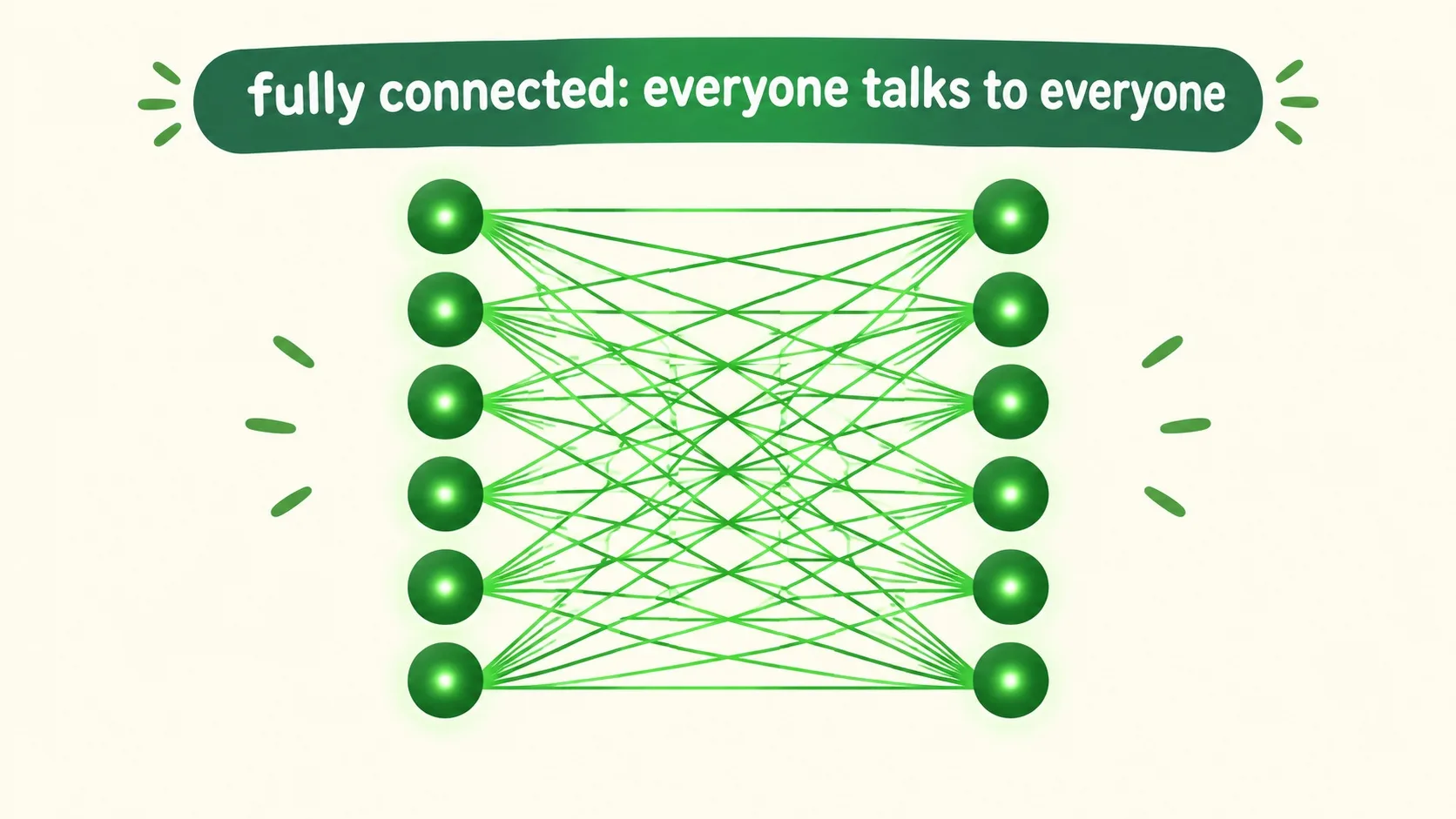
上一层每个输出,都拉一条线给下一层每个神经元,谁也不落下——这就是「全连接」(fully connected)。每条线都是一个权重旋钮:线越多,能调的花样越多。10 颗接 10 颗要 100 条线;1000 接 1000 要 100 万条——参数就是这么涨起来的。Every output of a layer runs a wire to every neuron of the next layer — nobody is left out. That's fully connected. Each wire carries its own weight knob: the more wires, the more ways to tune. Ten dots wired to ten dots take 100 lines; a thousand to a thousand take a million — that's how parameter counts balloon.
可直线一旦连成网,是怎么拐出弯的?But once lines are wired into a net, where do the curves come from?
第 3 步:会拐弯的边界Step 3: Where the bending comes from
一颗 = 一条直线;一层 = 许多直线段,能拼出折线;多层 = 把折线再接再叠,围出任意弯曲的边界。真正的功臣是激活函数:它负责把直线掰弯。没有门卫掰弯,叠多少层都还是直线,等于白叠。所以配方是:全连接层 + 激活函数 = 复杂形状。One neuron draws a line; a layer pieces straight lines into zigzags; stack layers and the zigzags bend further into any curve you like. The real hero is the activation function — it does the bending. Without a gate to bend the lines, stacking layers buys you nothing. So the recipe is: fully-connected layers + activation functions = complex shapes.
🎮 你来搭网(30 秒)🎮 Your turn: build a net (30 seconds)
道理讲完了。下面 4 张靶图,每张挑出「能画出它的最小配置」——选错了会给你小提示。Theory done. Four target shapes below — for each one, pick the smallest setup that can draw it. A wrong pick gets a friendly hint.
一句话记住它:多层感知机 = 把神经元排成层、叠成网。全连接让上一层人人拉线;激活函数让边界拐弯——一颗画直线,一张网画世界。Remember it in one line: a multilayer perceptron stacks neurons into layers and layers into a net: fully connected so everyone wires everyone, with activations doing the bending — one neuron draws a line, a whole net draws the world.
三级跳:一颗画直线 → 一排拼折线 → 一张网围出曲线,零件不变Three levels: one draws a line → a row joins zigzags → a net bends curves, same parts全连接:上一层每个输出都拉线给下一层每个神经元,一线一个旋钮Fully connected: every output wires every neuron of the next layer, one knob per line会拐弯靠激活函数——没有它掰弯,叠多少层都还是直线The bend comes from activation functions — without them, any depth stays straight
内容参考 OpenStax 等公开教材,多来源核对 · AI 生成、人工审核 · 发现错误欢迎指正,帮这片叶子长得更好。Based on OpenStax and other open textbooks, cross-checked across sources · AI-generated, human-reviewed · Spotted a mistake? Tell us — help this leaf grow.
 Back to tree