上一片里,行星们排着队绕太阳转。可也有天体绕着行星转。今晚,🌌 星空向导把望远镜对准离我们最近的一个——月球。Last leaf, the planets queued up around the Sun. But some bodies orbit planets instead. Tonight, 🌌 Star Guide turns the telescope to the nearest one — the Moon.
第 1 步:月球为什么不掉下来Step 1: Why the Moon never falls down
先回答一个傻问题:月球明明被地球拽着,为什么砸不到我们头上?First, a silly question: Earth keeps pulling the Moon — so why doesn't it crash into us?
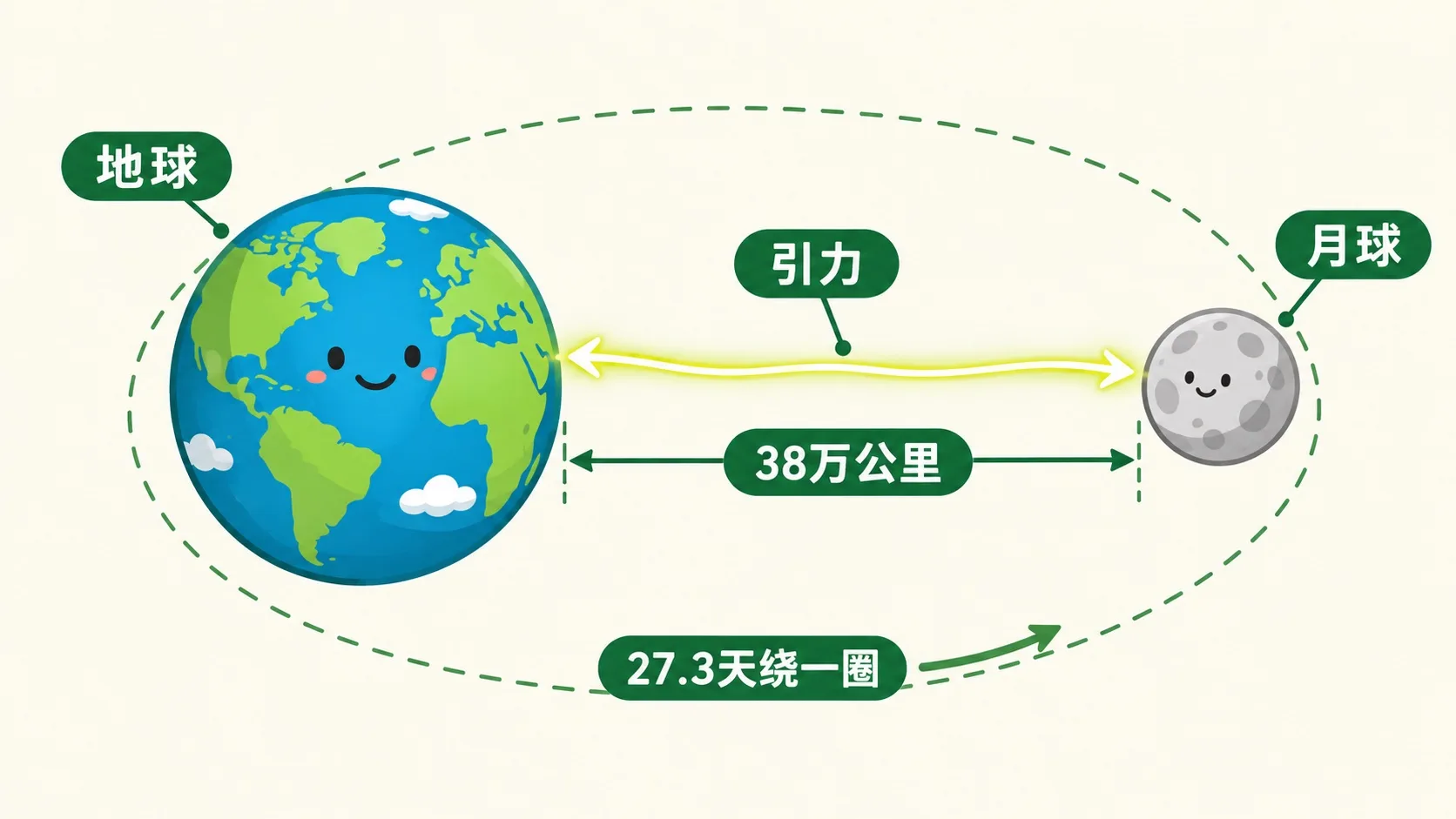
月球其实一直在“掉”向地球。引力拽着它往下掉,可它跑得够快,27.3 天绕一圈,掉的速度正好转成一圈又一圈。它离我们约 38 万公里,差不多是绕地球赤道 10 圈那么远。再看它脸上的深色斑块:那叫月海,一滴水也没有,是几十亿年前岩浆铺成的玄武岩平原。The Moon is actually falling toward Earth all the time. Gravity drags it down, but it runs fast enough — one lap every 27.3 days — that falling turns into circling. It sits about 384,000 km away, roughly ten trips around Earth's equator. Those dark patches on its face are called maria: not a drop of water, just basalt plains paved by lava billions of years ago.
待在身边讲完了。那它为什么有时圆、有时缺?So it stays beside us. But why is it sometimes round, sometimes gone?
第 2 步:月相是一场角度游戏Step 2: Moon phases are an angle game
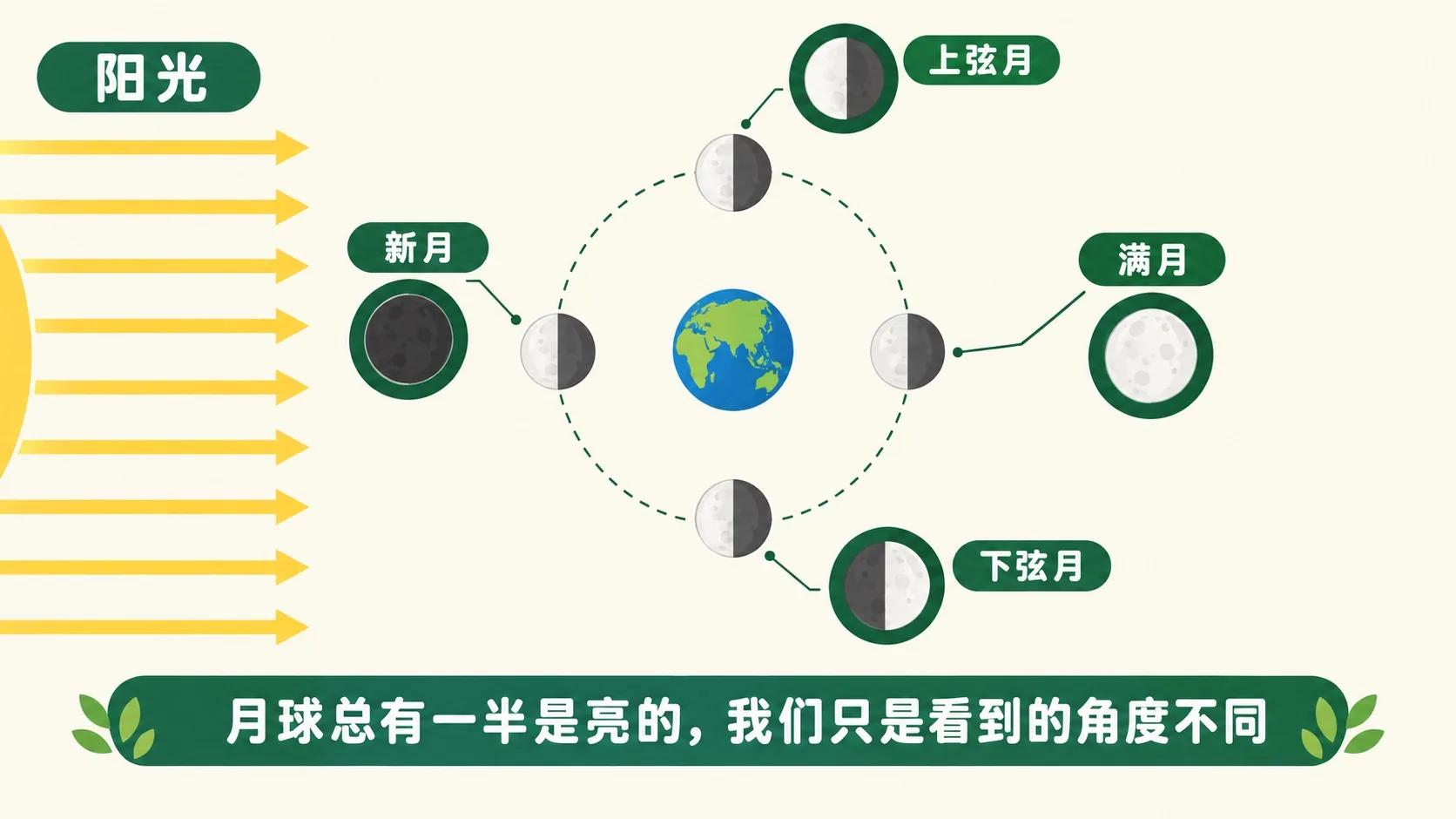
月球自己不发光,我们看到的是它反射的阳光。月球总有一半是亮的,可它 29.5 天绕地球一圈,我们看它的角度天天变。跑到地球和太阳中间时,亮面全背对我们,这叫新月。跑到地球背后时,亮面全朝我们,这叫满月。中间的样子,就是娥眉月、上弦月、下弦月。The Moon makes no light of its own — we see reflected sunlight. Half of it is always lit, but it circles Earth every 29.5 days, so our viewing angle changes daily. Between Earth and the Sun, the lit half faces away: New Moon. Behind Earth, the lit half faces us: Full Moon. Everything between gives crescents and quarters.
可不管圆还是缺,为什么我们总看到同一张“脸”?Round or not, why do we always see the same “face”?
第 3 步:永远只给我们看同一面Step 3: Always the same face toward us
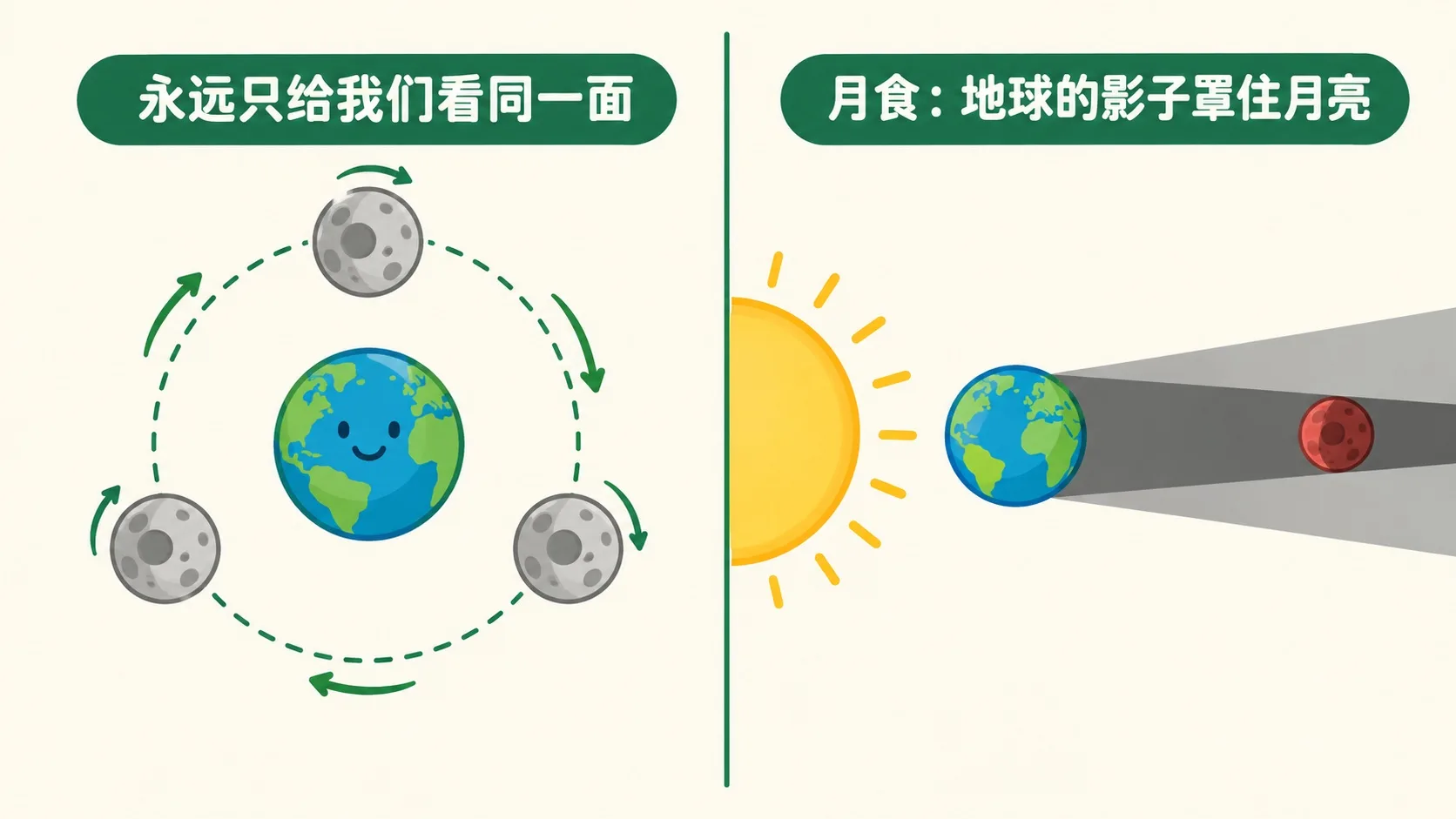
因为月球被地球“锁”住了。它自转一圈和公转一圈都是 27.3 天,转得和走得一样快,所以永远用同一面朝我们。这叫潮汐锁定,背面长什么样,人类直到 1959 年才第一次看到。另外记住:月食才是地球的影子罩住月亮,一年只有一两次,和月相是两回事。1969 年,阿波罗 11 号把脚印留在那张“脸”上。中国的嫦娥工程也已落月探测,还把月壤带回了家。Earth has locked the Moon: it spins once and orbits once in the same 27.3 days, so the same face always looks at us. That's tidal locking — nobody saw the far side until 1959. And remember: a lunar eclipse is Earth's shadow covering the Moon, once or twice a year, a different thing from phases. In 1969, Apollo 11 left footprints on that face. China's Chang'e program has landed on the Moon too, and brought moon soil home.
🎮 和星空向导一起拖月亮(30 秒)🎮 Drag the Moon with Star Guide (30 seconds)
道理讲完了。拖动月球走一圈,看月相怎么变;再找齐新月、上弦月、满月、下弦月四个位置。Theory done. Drag the Moon around once and watch the phases change; then find all four spots: New, First Quarter, Full, Last Quarter.
一句话记住它:月球是被引力拴住的伙伴;月相是角度游戏;它永远用同一面朝我们。Remember it in one line: the Moon is gravity's steady partner; phases are an angle game; it always shows us the same face.
引力拴住它:约 38 万公里外,27.3 天绕一圈;月海是玄武岩平原,没有水Gravity holds it: ~384,000 km out, one lap every 27.3 days; maria are waterless basalt plains月相 = 看亮面的角度:29.5 天一轮,新月 → 满月 → 残月Phases = the angle we see the lit half: a 29.5-day loop, New → Full → waning潮汐锁定只给看同一面;月食 ≠ 月相;阿波罗与嫦娥都到过月面Tidal locking shows one face only; eclipse ≠ phases; Apollo and Chang'e both reached the surface
内容参考 OpenStax 等公开教材,多来源核对 · AI 生成、人工审核 · 发现错误欢迎指正,帮这片叶子长得更好。Based on OpenStax and other open textbooks, cross-checked across sources · AI-generated, human-reviewed · Spotted a mistake? Tell us — help this leaf grow.
 Back to tree