⚡ 神经冲动:沿着神经跑的电流⚡ Nerve Impulse: Electricity on the Run
大脑里 86 亿电报员,靠什么把消息送得又快又准?靠一份不会熄灭的电报。🩺 小医生掏出秒表,🦠 小细胞趴在神经边上——出发!What lets 8.6 billion telegraphers in the brain deliver messages fast and accurately? A telegram that never fades. 🩺 Doc grabs a stopwatch, 🦠 Cellie leans over a nerve — go!
第 1 步:一份会跑的电信号Step 1: An electric signal that runs
神经冲动长什么样?想象一道光点沿着电线奔跑。What does a nerve impulse look like? Picture a spark racing down a wire.
神经冲动就是沿着神经(轴突)奔跑的一小段电流:细胞膜内外电荷瞬间翻转,像推倒的多米诺,一路传到终点。跑得快的能到每秒 120 米——从脚趾传到脊髓不到 0.02 秒。而且它只认“有”和“无”:刺激再强,信号大小也不变,频率才变——这叫全或无。A nerve impulse is a short burst of electricity running down the axon: charges across the membrane flip in an instant, like dominoes toppling to the finish. The fastest reach 120 meters per second — toe to spinal cord in under 0.02 s. And it only knows "on" or "off": however strong the poke, the spike keeps one size — only its frequency changes. All-or-nothing.
同样是电信号,为什么有的跑得飞快,有的慢吞吞?Same electricity — why do some signals fly while others crawl?
第 2 步:髓鞘=绝缘皮,学会跳岛Step 2: Myelin — insulation that island-hops
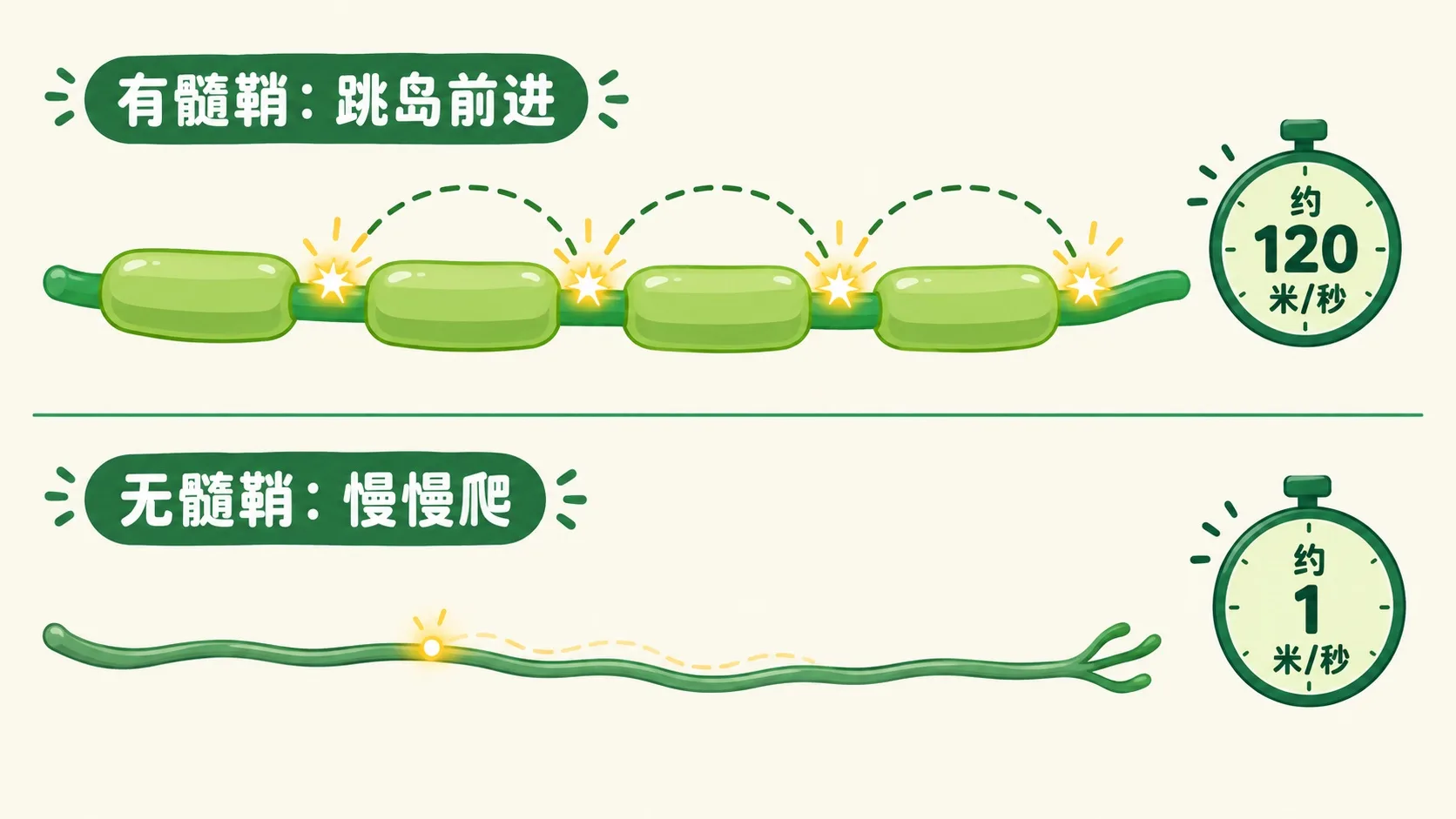
秘密在“绝缘皮”髓鞘上:它一节节裹住轴突,只在缝隙处露线头。信号不用慢慢爬,直接从缝隙跳到下一个缝隙——这叫跳跃传导,速度一下快上百倍。裹了髓鞘约 120 米/秒,光秃秃的只有约 1 米/秒,差距比骑车和蜗牛还大。The secret is myelin, a sleevelike insulator wrapped around the axon in sections, exposing the "wire" only at tiny gaps. The signal doesn't crawl — it leaps from gap to gap. That's saltatory conduction, over a hundred times faster: about 120 m/s wrapped versus about 1 m/s bare — a bigger gap than a bike versus a snail.
这么快的信号,为什么摸到烫的东西时手会先弹开,疼却慢半拍?If signals are that fast, why does your hand pull away before you feel pain?
第 3 步:缩手反射——先撤手,后喊疼Step 3: The withdrawal reflex — hand first, "ouch" later
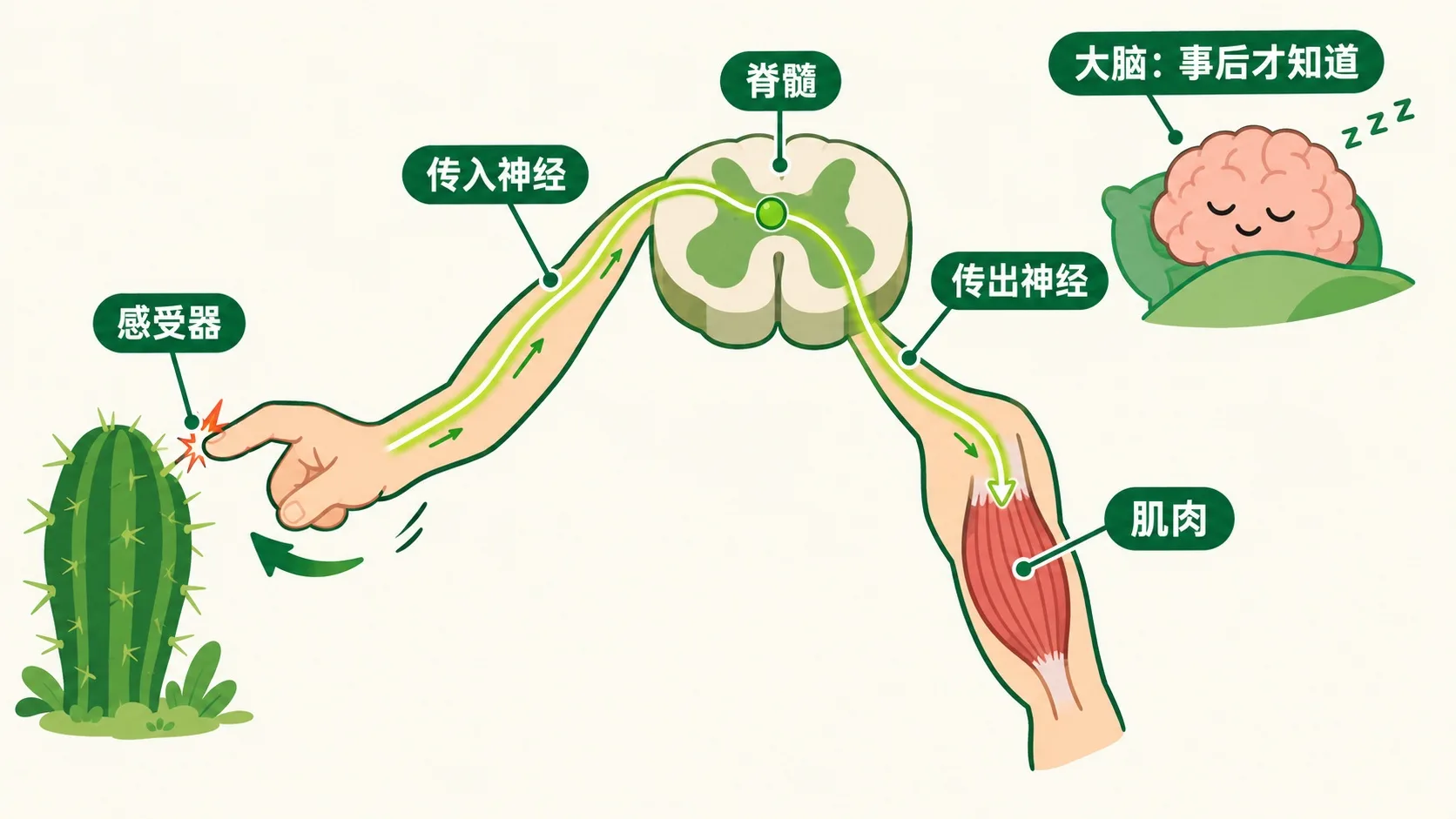
因为紧急情况走的是“近路”:手指的警报沿传入神经直达脊髓,脊髓当场拍板,命令沿传出神经直达肌肉——手先弹开。这份“疼”的报告还要再爬一段路才到大脑,所以你总是先撤手、后觉得疼。这条近路叫反射弧,是身体自带的保命快捷键。Because emergencies take the shortcut: the alarm races along a sensory nerve straight to the spinal cord, which decides on the spot and sends the order down a motor nerve to the muscle — hand away first. The "ouch" report still has to travel further up to the brain, so you always pull back before you feel pain. This shortcut is the reflex arc — your body's built-in survival hotkey.
🎮 你来当信号调度员(30 秒)🎮 Your turn: signal dispatcher (30 seconds)
上半场先看一场赛跑:有髓鞘 vs 无髓鞘;下半场接 🩺 小医生的 4 张任务单,把缩手反射一步步排对。First watch the race: myelinated vs unmyelinated. Then take 🩺 Doc's 4 tickets and line up the withdrawal reflex step by step.
一句话记住它:神经冲动 = 沿着神经奔跑的电流,全或无、只看频率;髓鞘是绝缘皮,让信号跳岛快上百倍;紧急时脊髓走近路先撤手,大脑事后才知道疼。Remember it in one line: a nerve impulse is electricity sprinting down a nerve — all-or-nothing, coded by frequency; myelin sleeves make it island-hop a hundred times faster; in emergencies the spinal cord takes the shortcut and pulls the hand away before the brain even knows.
神经冲动沿轴突传播,最快约 120 米/秒;信号只有“有/无”,强弱靠频率Impulses race down axons at up to ~120 m/s; the spike is on/off — strength is coded by frequency髓鞘=绝缘皮,缝隙间跳跃传导,比无髓鞘快百倍(120 vs 1 米/秒)Myelin = insulation; saltatory hopping is ~100× faster than bare axons (120 vs 1 m/s)反射弧:感受器→传入神经→脊髓→传出神经→肌肉,脊髓先斩后奏Reflex arc: receptor → sensory nerve → spinal cord → motor nerve → muscle — cord first, brain later
内容参考 OpenStax 等公开教材,多来源核对 · AI 生成、人工审核 · 发现错误欢迎指正,帮这片叶子长得更好。Based on OpenStax and other open textbooks, cross-checked across sources · AI-generated, human-reviewed · Spotted a mistake? Tell us — help this leaf grow.
 Back to tree