📐 三角函数:角度转成比例值📐 Trigonometric Functions: Turning Angles into Ratios
上一片里,🧮 小算盘机器人用圆的方程画出了摩天轮的大圆盘。现在它想知道:吊舱转过一个角度后,到底离地面多高?答案藏在三角函数里——它专门把「角度」翻译成「比例值」。Last leaf, the little calculator robot used the circle equation to draw the Ferris wheel's big rim. Now it asks: after the cabin turns by some angle, how high above the ground is it? The answer hides in trigonometry — the subject that translates angles into ratios.
第 1 步:给转盘配一张“高度表”Step 1: A height table for the dial
先回到最简单的直角三角形:sin 和 cos 其实就是两条边的比值。Back to the simplest right triangle: sin and cos are just ratios of two sides.
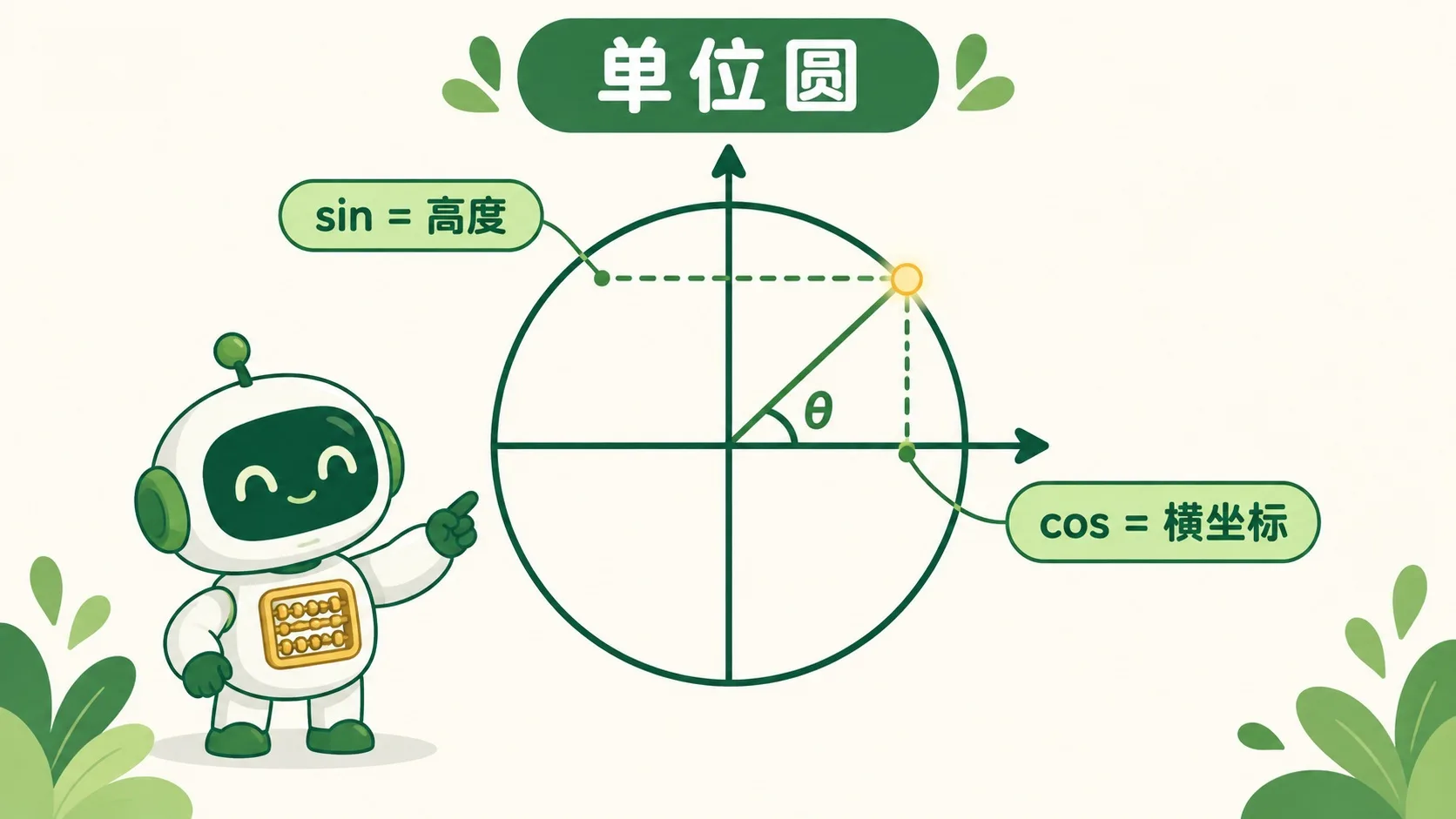
把转盘想成半径是 1 的单位圆:转过的角度记作 θ,圆上那个点的「高度」就是 sin θ,「横坐标」就是 cos θ。角度一变,两个值跟着变:高度在 −1 到 1 之间上下,横坐标也一样。这不是新魔法——sin 就是「对边 ÷ 斜边」、cos 就是「邻边 ÷ 斜边」,两条老规律被单位圆搬到了所有角度上。Think of the dial as a unit circle with radius 1: the point at angle θ has height sin θ and horizontal position cos θ. As the angle changes, both follow — the height swings between −1 and 1, and so does the horizontal. No new magic: sin is “opposite ÷ hypotenuse” and cos is “adjacent ÷ hypotenuse”, two old right-triangle rules carried by the unit circle to every angle.
把每个角度的高度都记下来、连成线,会发生什么?Write down the height for every angle and join the dots — what happens?
第 2 步:转一圈,画出一条波浪Step 2: One full turn draws a wave
摩天轮转一圈,吊舱高度先升后降,画出来正好是一条 sin 波浪线。这就是波动现象的数学语言:声音的振动、水面的起伏、光波的振荡,全都用这条曲线描述。所以三角函数也叫“圆函数”——波浪,就是转圈投下的影子。As the wheel turns one full circle, the cabin rises and falls — and the trace it leaves is exactly a sine wave. This is the language of everything that waves: sound vibrations, water ripples, light oscillations. That is why trigonometry is also called the study of circles: a wave is a spinning circle's shadow.
高度看 sin、横向看 cos,那“陡不陡”谁来管?sin handles height and cos handles width — but who judges steepness?
第 3 步:山坡陡不陡,tan 说了算Step 3: How steep? tan decides
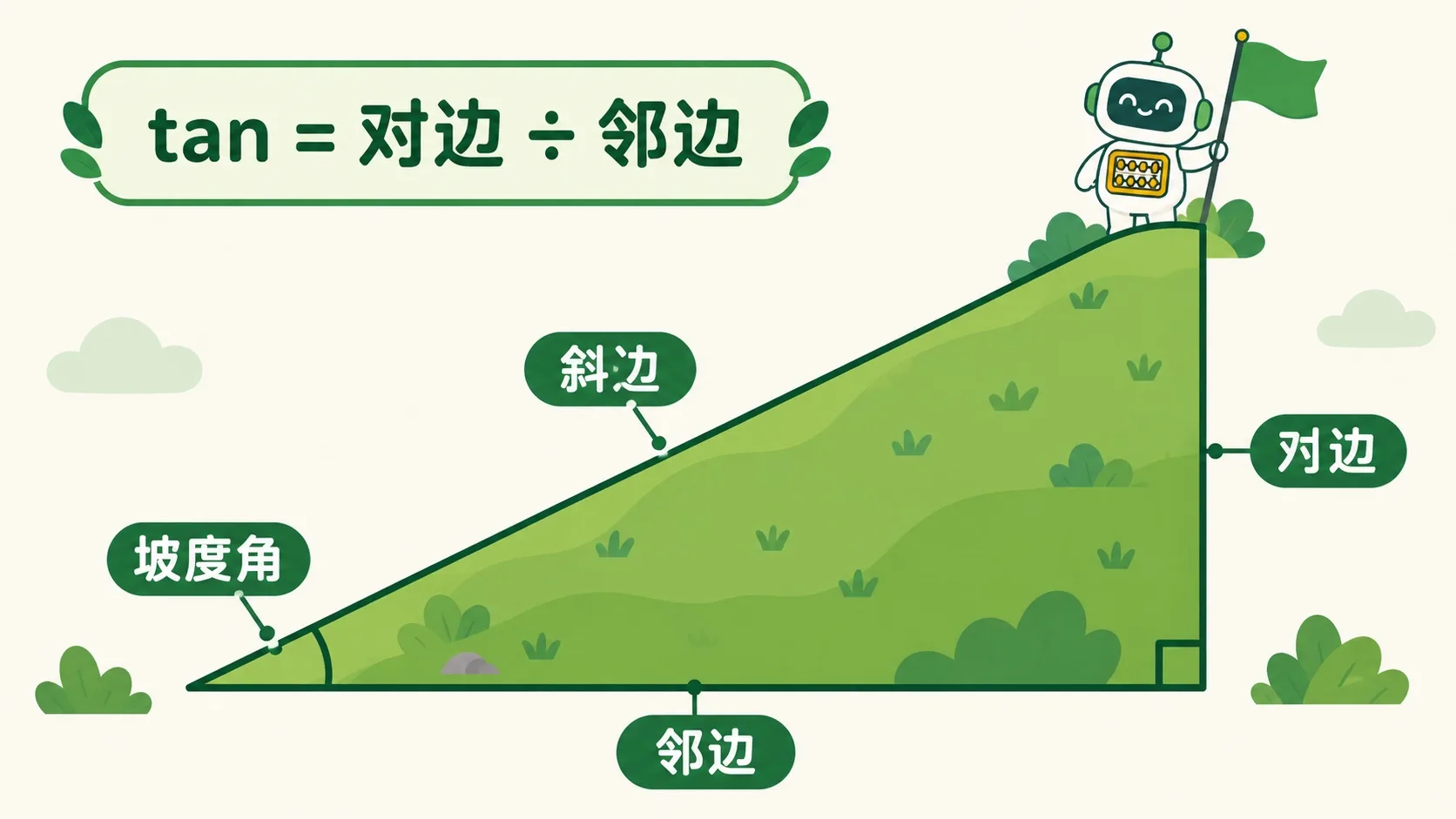
坡度角的正切 tan = 对边 ÷ 邻边,也就是“升高 ÷ 前进”。走 10 米升高 3 米,坡度就是 0.3。修路、架桥、测楼高,工程师都用它把“陡不陡”变成一个好算的数字。sin、cos、tan 三兄弟:角度一进,比例一出。The tangent of a slope angle is tan = opposite ÷ adjacent — “rise ÷ run”. Climb 3 metres over 10 metres forward and the slope is 0.3. Road builders, bridge engineers and surveyors all use it to turn “steep or gentle” into a number you can calculate. sin, cos and tan: feed in an angle, get out a ratio.
🎮 你来转一转(30 秒)🎮 Your turn: give it a spin (30 seconds)
道理讲完了。拖动单位圆上的金点,完成 4 个小任务:把点转到指定的 sin 或 cos 位置。Theory done. Drag the golden dot on the unit circle and finish 4 small quests: park it at the required sin or cos value.
一句话记住它:三角函数 = 把角度翻译成比值的词典。sin 管高度、cos 管横向、tan 管陡峭;单位圆一转,波浪就画了出来。Remember it in one line: trigonometry is the dictionary that translates angles into ratios. sin rules height, cos rules width, tan rules steepness — and one spin of the unit circle draws the wave.
sin = 对边 ÷ 斜边,也等于单位圆上点的高度sin = opposite ÷ hypotenuse, also the height on the unit circlecos = 邻边 ÷ 斜边,也等于单位圆上点的横坐标cos = adjacent ÷ hypotenuse, also the horizontal on the unit circletan = 对边 ÷ 邻边;sin 曲线是声音、光、潮汐的通用语言tan = opposite ÷ adjacent; the sine wave is the native language of sound, light and tides
内容参考 OpenStax 等公开教材,多来源核对 · AI 生成、人工审核 · 发现错误欢迎指正,帮这片叶子长得更好。Based on OpenStax and other open textbooks, cross-checked across sources · AI-generated, human-reviewed · Spotted a mistake? Tell us — help this leaf grow.
 Back to tree