上一片知道:加速度是速度每秒的变化量。如果这个变化量从头到尾保持不变呢?运动就变得特别好算——它叫匀变速直线运动。小火箭的实验车,今天全程保持同一个加速度。Last leaf: acceleration is the change of speed each second. What if that change never changes? The motion becomes easy to compute — uniform acceleration. Today the rocket's test car holds one constant acceleration the whole way.
第 1 步:加速度不变的运动会怎样Step 1: What constant acceleration looks like
先看看这种运动长什么样:小球沿光滑斜面下滑。First, look at it in action: a ball sliding down a smooth ramp.
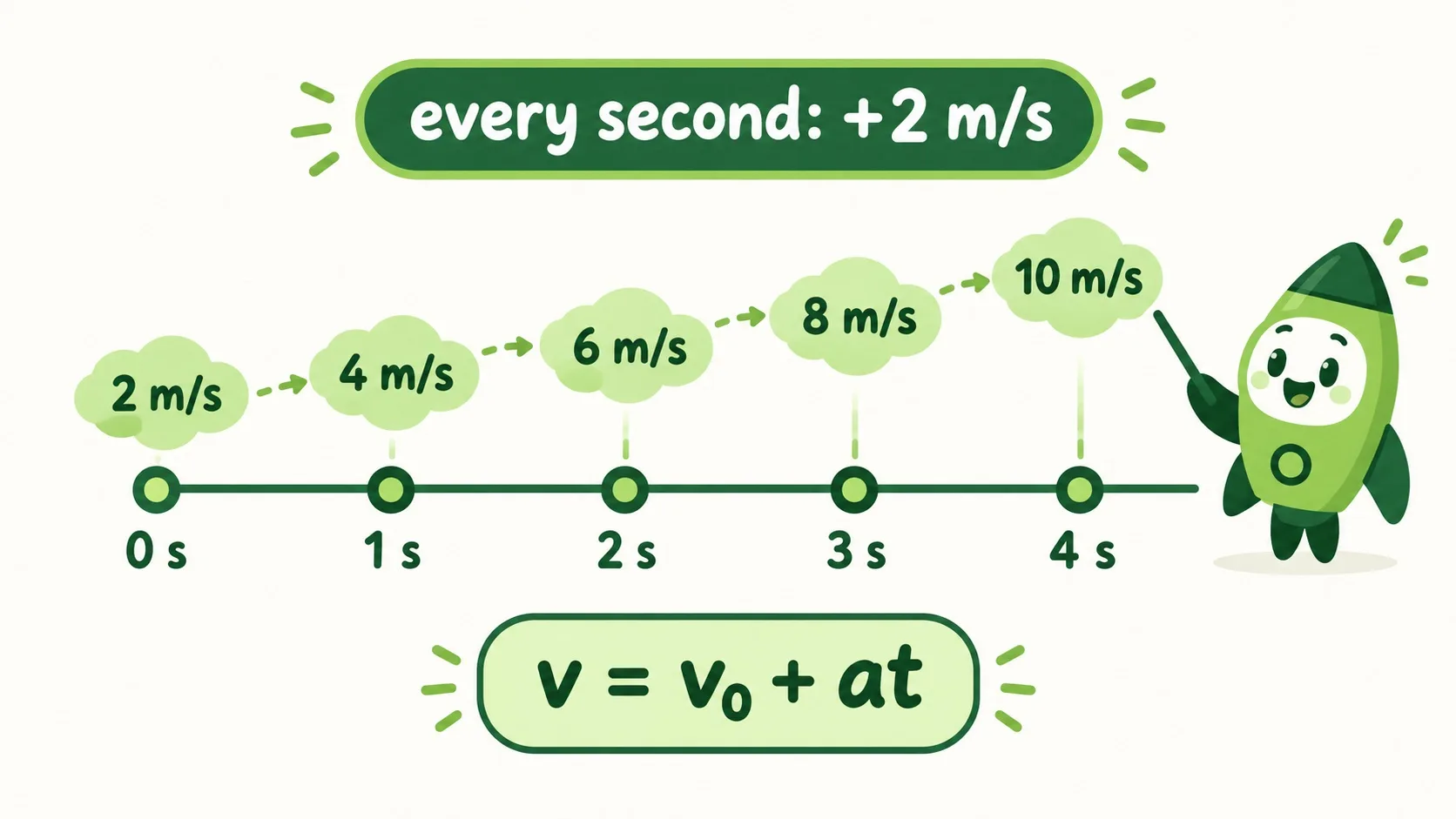
小球下滑时,每秒增加的速度都一样——比如每秒 +2 m/s。这就是匀变速直线运动:加速度恒定。看它的位置标记:间隔越来越大——速度均匀地涨,但走的路越来越长,越滑越猛。As the ball slides, it gains the same speed every second — say +2 m/s each second. That's uniform acceleration: constant a. Watch the dotted marks: they spread farther apart — the speed grows evenly, but the distance covered keeps lengthening.
既然速度每秒加的量一样,速度是不是可以直接算出来?If speed gains the same amount every second, can we compute it directly?
第 2 步:速度的账本:v = v₀ + atStep 2: The speed ledger: v = v₀ + at
加速度 a = 2 m/s² 时,速度每 1 秒加 2:0、2、4、6、8、10……排成等差数列。所以 v = v₀ + at:初速度 v₀,加上「每秒变化 a × 时间 t」。初速度 4、a = 2、t = 5 秒时:v = 4 + 2×5 = 14 m/s。With a = 2 m/s², speed grows by 2 every second: 0, 2, 4, 6, 8, 10… an arithmetic sequence. So v = v₀ + at: initial speed v₀ plus “change per second a × time t”. With v₀ = 4, a = 2, t = 5 s: v = 4 + 2×5 = 14 m/s.
那这 5 秒走了多远?公式里的 ½at² 看着吓人,画成图就明白了。So how far did it travel in those 5 s? The ½at² in the formula looks scary — but a picture tames it.
第 3 步:v-t 图的面积 = 位移Step 3: The area under the v-t graph = displacement
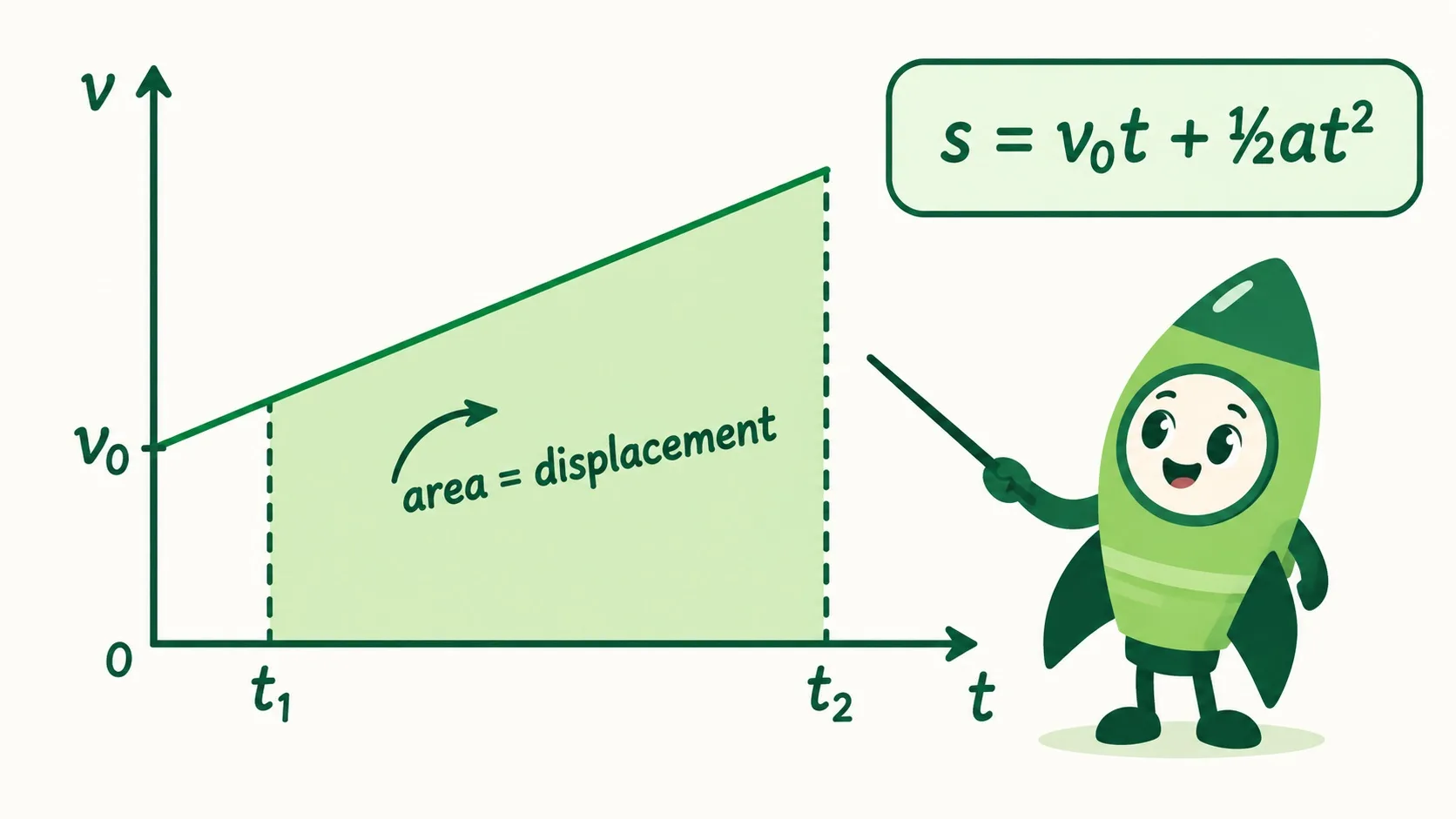
匀变速的 v-t 图是一条直线:初速度位置到 5 秒末速度,围出一个梯形。下面的矩形是 v₀t,上面的三角形是 ½at²,拼起来正好是位移 s = v₀t + ½at²。诀窍:v-t 图下方的面积,就是走过的距离。A uniform-acceleration v-t graph is a straight line, fencing off a trapezoid. The rectangle below is v₀t, the triangle on top is ½at² — together they give s = v₀t + ½at². The trick: the area under a v-t graph is the distance travelled.
🎮 你来当实验员(30 秒)🎮 Your turn: lab assistant (30 seconds)
拖动 v₀ 和 a,看直线的斜率和梯形面积怎么变;再用面积法完成 4 关。Drag v₀ and a to watch the slope and trapezoid area change — then finish 4 challenges with the area method.
一句话记住它:匀变速直线运动 = 加速度恒定,速度均匀地变。v = v₀ + at 算速度,s = v₀t + ½at² 算位移,v-t 图是直线、面积就是位移。Remember it in one line: uniform acceleration = constant a, evenly changing speed. v = v₀ + at for speed, s = v₀t + ½at² for displacement — and the area under a straight v-t line is the displacement.
匀变速:加速度恒定,速度每秒增加相同的量,排成等差数列Uniform acceleration: constant a, speed gains the same amount each second — an arithmetic sequencev = v₀ + at 算速度;s = v₀t + ½at² 算位移v = v₀ + at for speed; s = v₀t + ½at² for displacementv-t 图是一条直线,图像下方的面积 = 位移(矩形 + 三角形)The v-t graph is a straight line; area under it = displacement (rectangle + triangle)
内容参考 OpenStax 等公开教材,多来源核对 · AI 生成、人工审核 · 发现错误欢迎指正,帮这片叶子长得更好。Based on OpenStax and other open textbooks, cross-checked across sources · AI-generated, human-reviewed · Spotted a mistake? Tell us — help this leaf grow.
 Back to tree