⚖️ 欧姆定律:I = U ÷ R 的三者平衡⚖️ Ohm's Law: the Balance of I = U ÷ R
上一片里,电阻像路上的窄管,拦住电流。可管子、水压、水流不是三件各管各的事——它们被一个公式锁在一起:I = U ÷ R。这就是欧姆定律。Last leaf, resistance was the narrow pipe holding current back. But pipe, pressure and flow are not independent — one formula locks them together: I = U ÷ R. That is Ohm's law.
第 1 步:三个角色的平衡Step 1: Three characters in balance
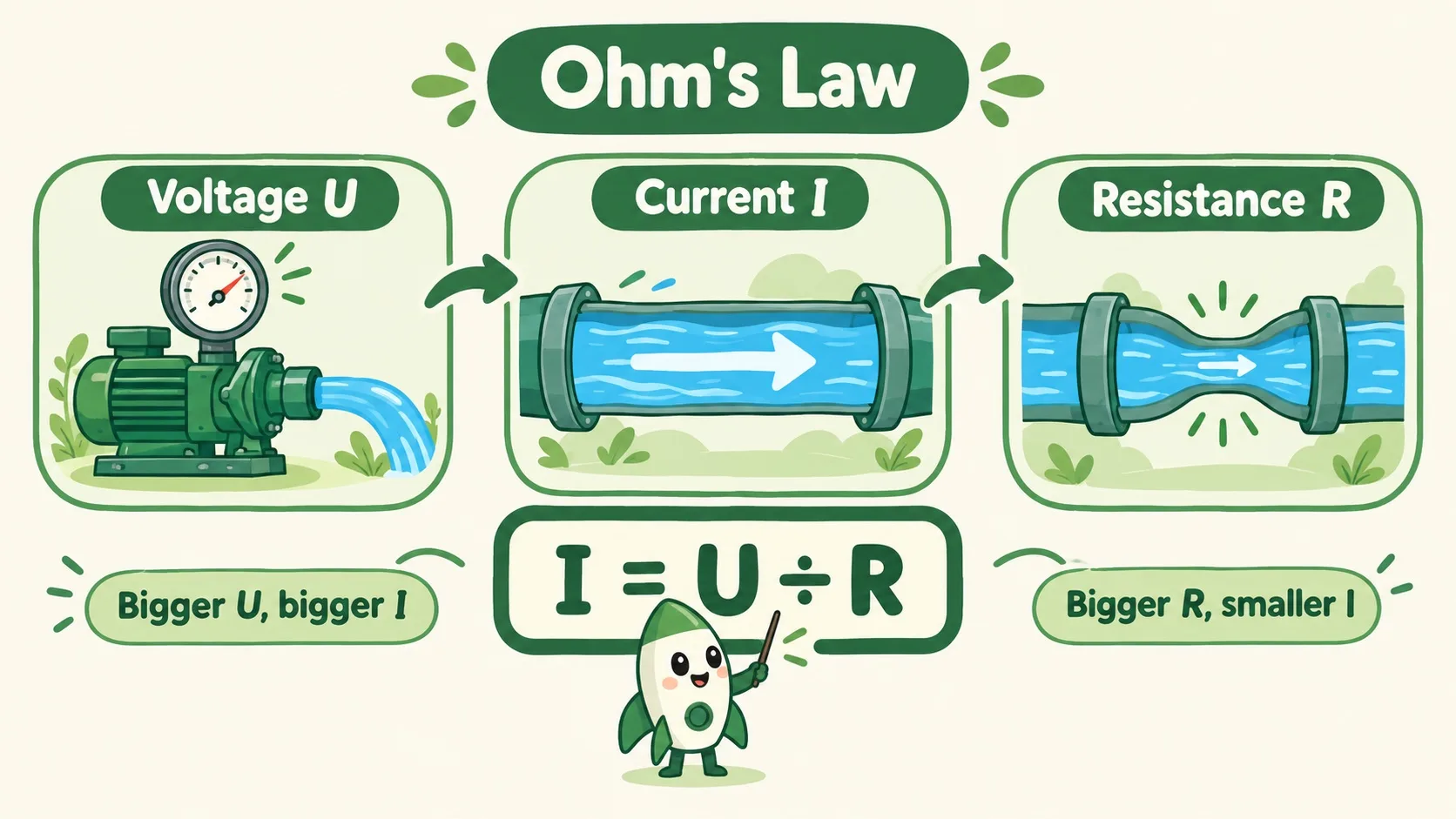
小火箭把三个量摆上同一张实验台:电压是推力,电阻是阻力,电流是结果。The little rocket put all three on one bench: voltage pushes, resistance holds back, current is the result.
欧姆定律:电流与电压成正比,与电阻成反比。同一个电阻上,电压翻倍,电流也翻倍;电压不变时,电阻翻倍,电流减半。三个量,知道两个就能算第三个。Ohm's law: current is proportional to voltage and inversely proportional to resistance. On the same resistor, double the voltage and the current doubles; keep voltage fixed and double the resistance and the current halves. Know two values, and you can find the third.
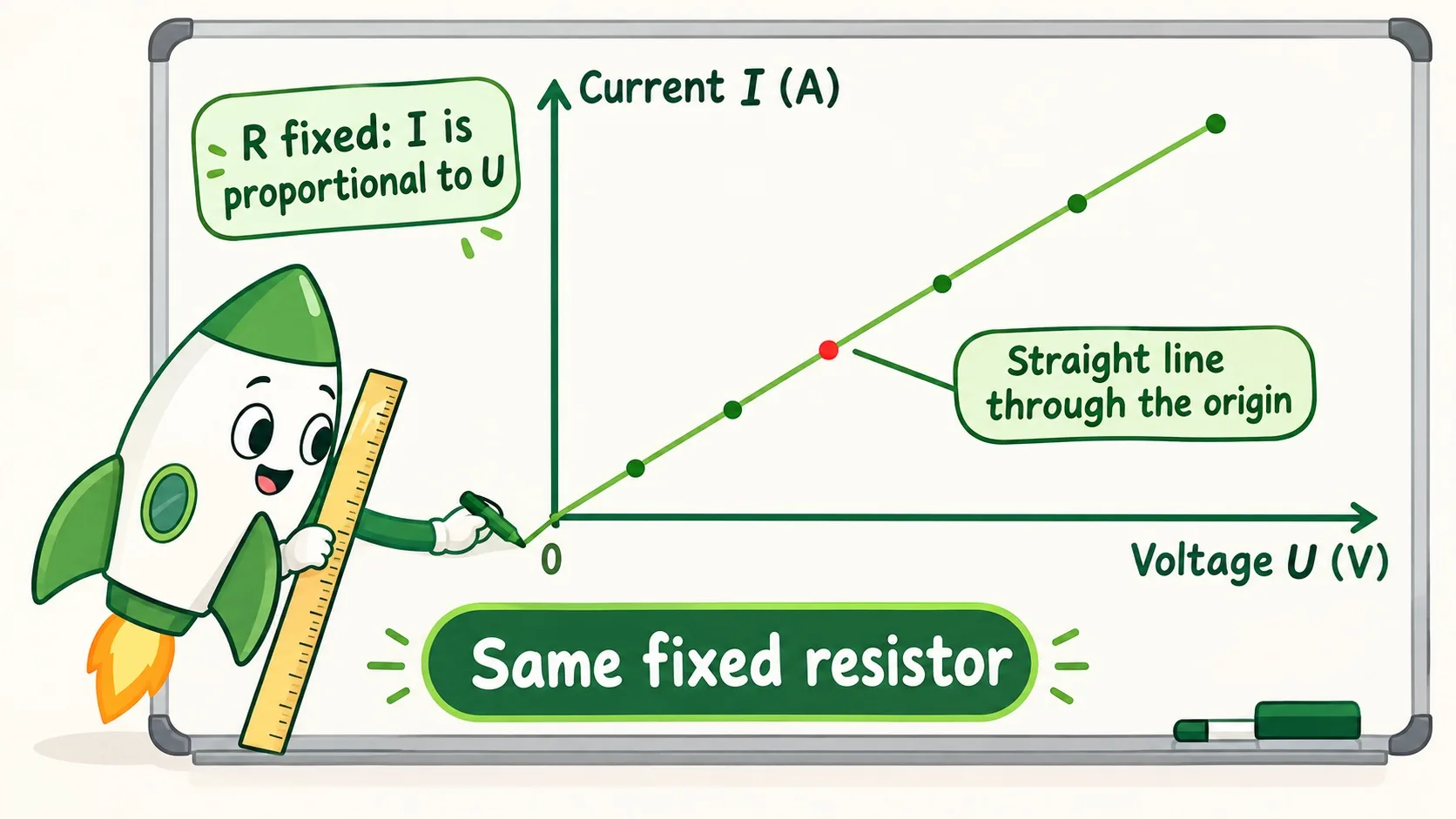
口说无凭——把一组组数据画成图,会是什么形状?Words are cheap — what shape do the measured points trace on a graph?
第 2 步:U-I 图像为什么是直线Step 2: Why the U-I graph is a straight line
小火箭固定 R = 5 Ω,一组组改变电压、记下电流。因为 I = U ÷ R,R 不变时电流跟着电压走:U-I 图像是一条过原点的直线,说明 I 与 U 成正比。直线越陡,电阻越小。The rocket fixed R = 5 Ω, changed the voltage step by step and wrote down each current. Because I = U ÷ R, with R fixed the current follows the voltage: the U-I graph is a straight line through the origin, so I is proportional to U. A steeper line means a smaller resistance.
想亲手验证?电表该怎么接?Want to check it yourself? How do the meters go?
第 3 步:实验台怎么接Step 3: How to wire the bench
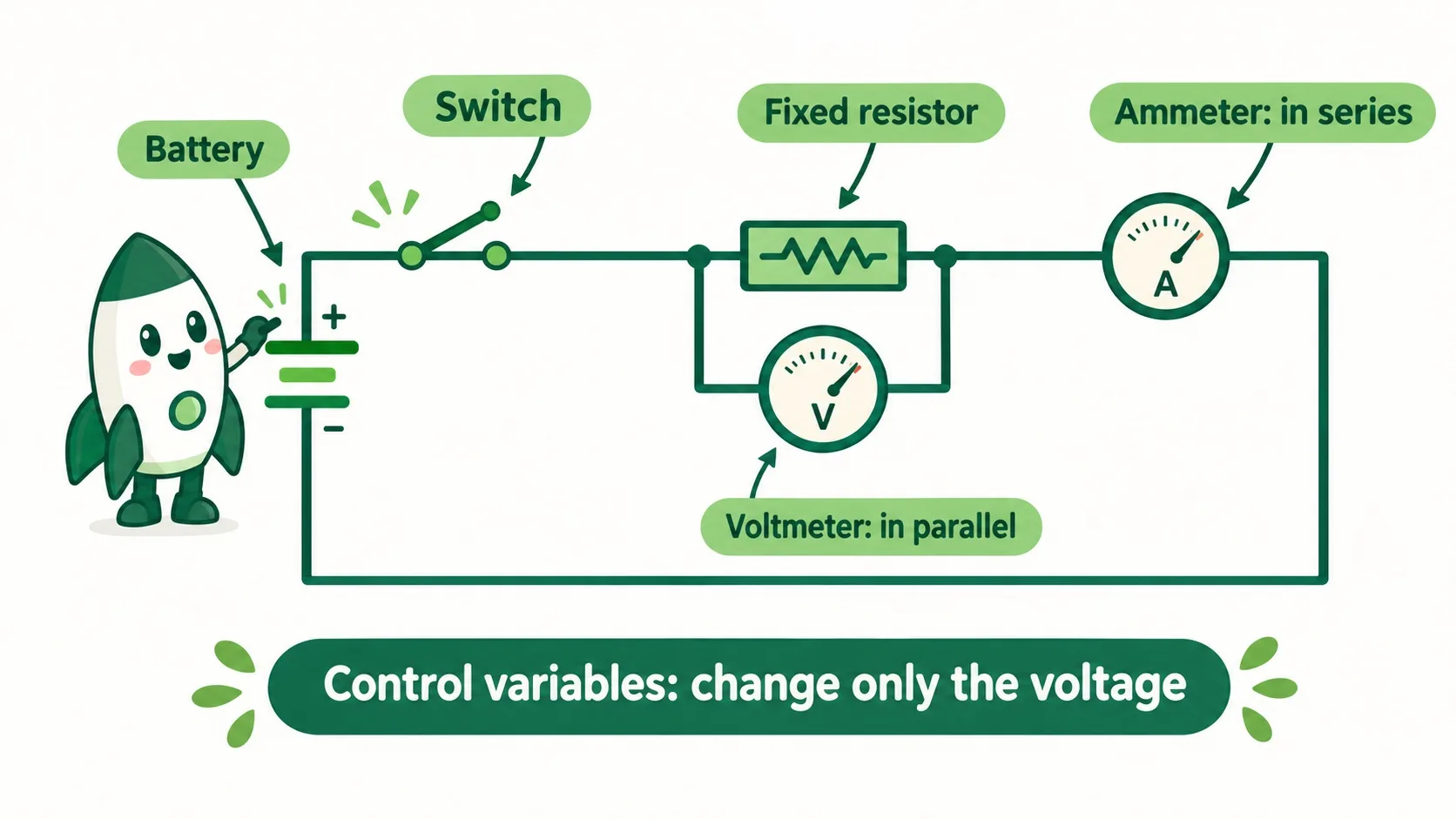
测电流与电压的关系,要用控制变量法:保持电阻不变,只改电压。电流表串联在电路里,电压表并联在电阻两端。换一个电阻,直线就换一个斜率——这正是欧姆定律的签名。To study how current depends on voltage, use control variables: keep the resistance fixed and change only the voltage. The ammeter goes in series; the voltmeter goes in parallel across the resistor. Swap the resistor and the line takes a new slope — that is Ohm's signature.
🎮 你来当实验员(1 分钟)🎮 Your turn: lab assistant (1 minute)
道理讲完了。拖三个滑块看 I 怎么跟着 U、R 走,再做 4 道题。Theory done. Drag the three sliders to watch I follow U and R, then take the 4 challenges.
一句话记住它:I = U ÷ R——电压是推力、电阻是阻力、电流是结果;知道两个量,就能算出第三个。Remember it in one line: I = U ÷ R — voltage pushes, resistance holds back, current is the result; two values give you the third.
I = U ÷ R;变形:U = I × R,R = U ÷ II = U ÷ R; rearranged: U = I × R and R = U ÷ I同一定值电阻的 U-I 图像是过原点的直线(I 与 U 成正比)For one fixed resistor the U-I graph is a straight line through the origin (I ∝ U)实验用控制变量法;电流表串联、电压表并联Experiments use control variables; ammeter in series, voltmeter in parallel
内容参考 OpenStax 等公开教材,多来源核对 · AI 生成、人工审核 · 发现错误欢迎指正,帮这片叶子长得更好。Based on OpenStax and other open textbooks, cross-checked across sources · AI-generated, human-reviewed · Spotted a mistake? Tell us — help this leaf grow.
 Back to tree