🔀 串联与并联:一条路还是两条路🔀 Series & Parallel: One Path or Two?
上一片欧姆定律管的是“一段路”上的 U、I、R。可电器往往不止一个——把它们接起来有两条路数:串成一串,或并排多条。这决定了灯怎么亮、坏一只会怎样。Last leaf, Ohm's law ruled the U, I and R of a single stretch of wire. But you rarely have just one device — wire them together and there are two ways to go: strung in a row, or side by side. That choice decides how they light up and what happens when one dies.
第 1 步:串联——一条路走到底Step 1: Series — one path all the way
先看把两只灯“串成一串”的接法。Start with the two bulbs strung in a row.
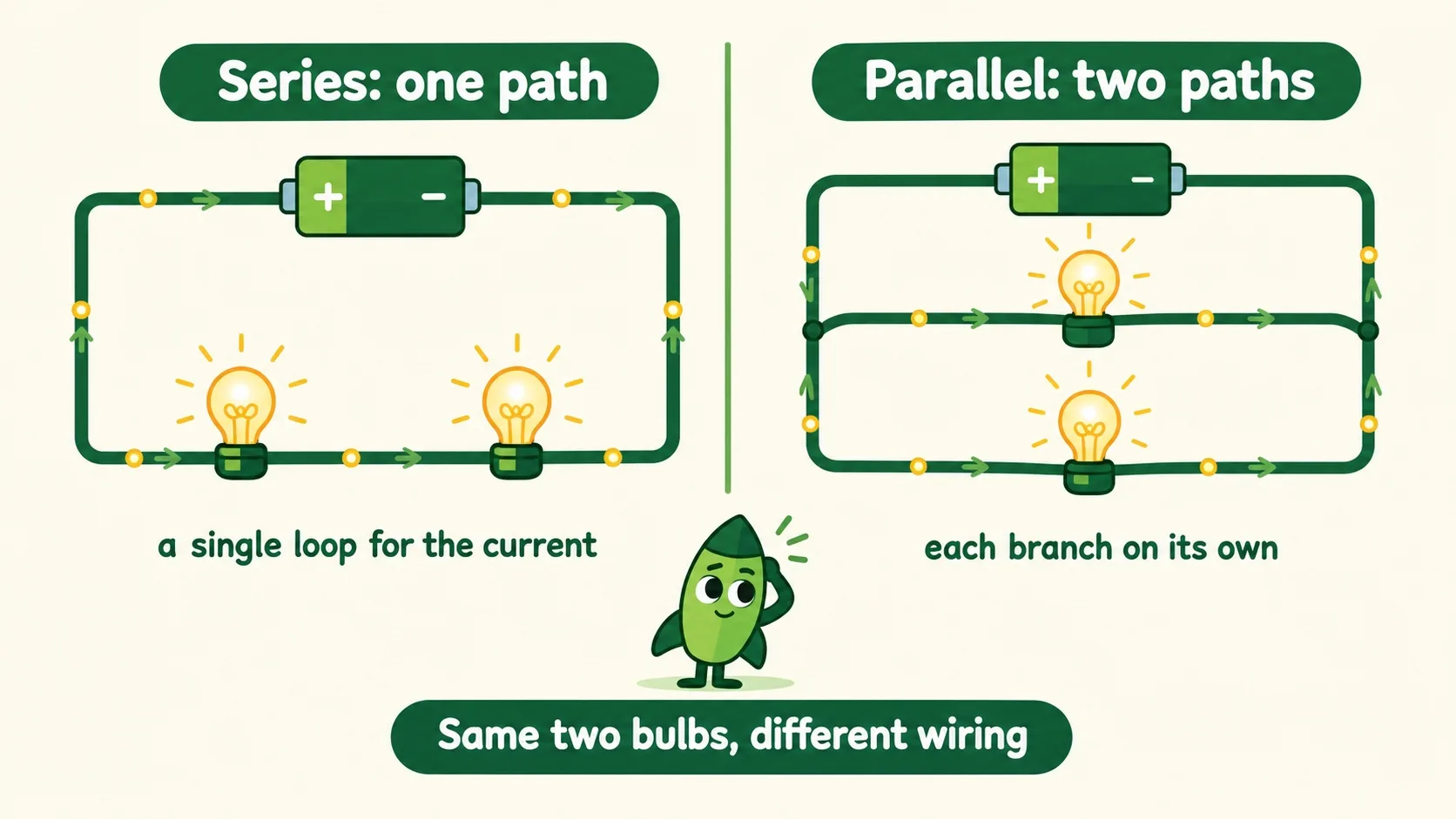
串联把电池和两只灯接成一条环路:电流处处相等,一条路走到底;电压被两只灯分掉,所以每只灯都比单独接时暗。最要命的是:任意一处断开(开关没合、灯丝烧了),整条路都断——“一个坏,全灭”。In series the battery and both bulbs form one single loop: the current is the same at every point, and the voltage is shared between the bulbs, so each one is dimmer than alone. And the killer feature: break the loop anywhere — an open switch, a burnt filament — and everything goes dark. One failure kills all.
那要是想让两盏灯各开各的呢?就得给每只灯一条自己的路——But what if the lamps should switch on and off independently? Give each one its own path —
第 2 步:并联——各走各的路Step 2: Parallel — each on its own path
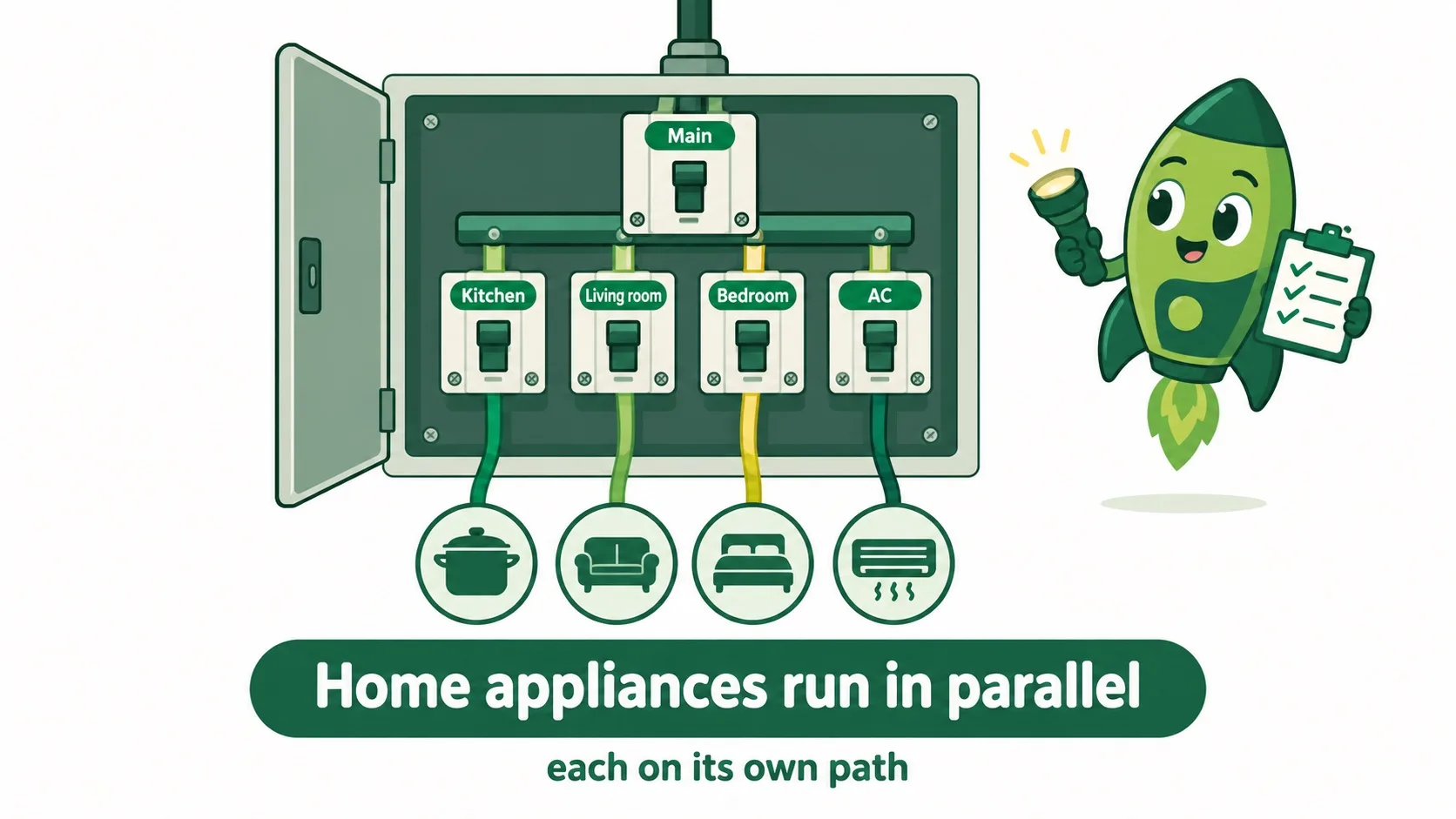
并联把电器挂在同一对电线之间:每条支路的电压都等于电源电压,所以灯更亮;电流在分叉处各走各的,干路里的总电流等于各支路之和。每路有自己的开关,互不影响。家里的配电箱就是这样:总闸进来,分成厨房、客厅、卧室、空调好几路——全是并联。中国家庭电压 220 V,指的就是每条支路拿到的电压。Parallel hangs every device across the same pair of wires: each branch gets the full supply voltage (so bulbs glow brighter), and the current splits at the junction — the main wire carries the sum of the branches. Each branch has its own switch, no interference. Your home breaker box works exactly this way: the main line splits into kitchen, living room, bedroom, AC — all in parallel. Mains voltage (220 V in China, 120 V in the US) is what every branch receives.
两种接法,现实中差在哪?圣诞灯串给过一个著名的教训。So how much does this matter in real life? Holiday lights gave us a famous lesson.
第 3 步:圣诞灯串的教训Step 3: The holiday-light lesson
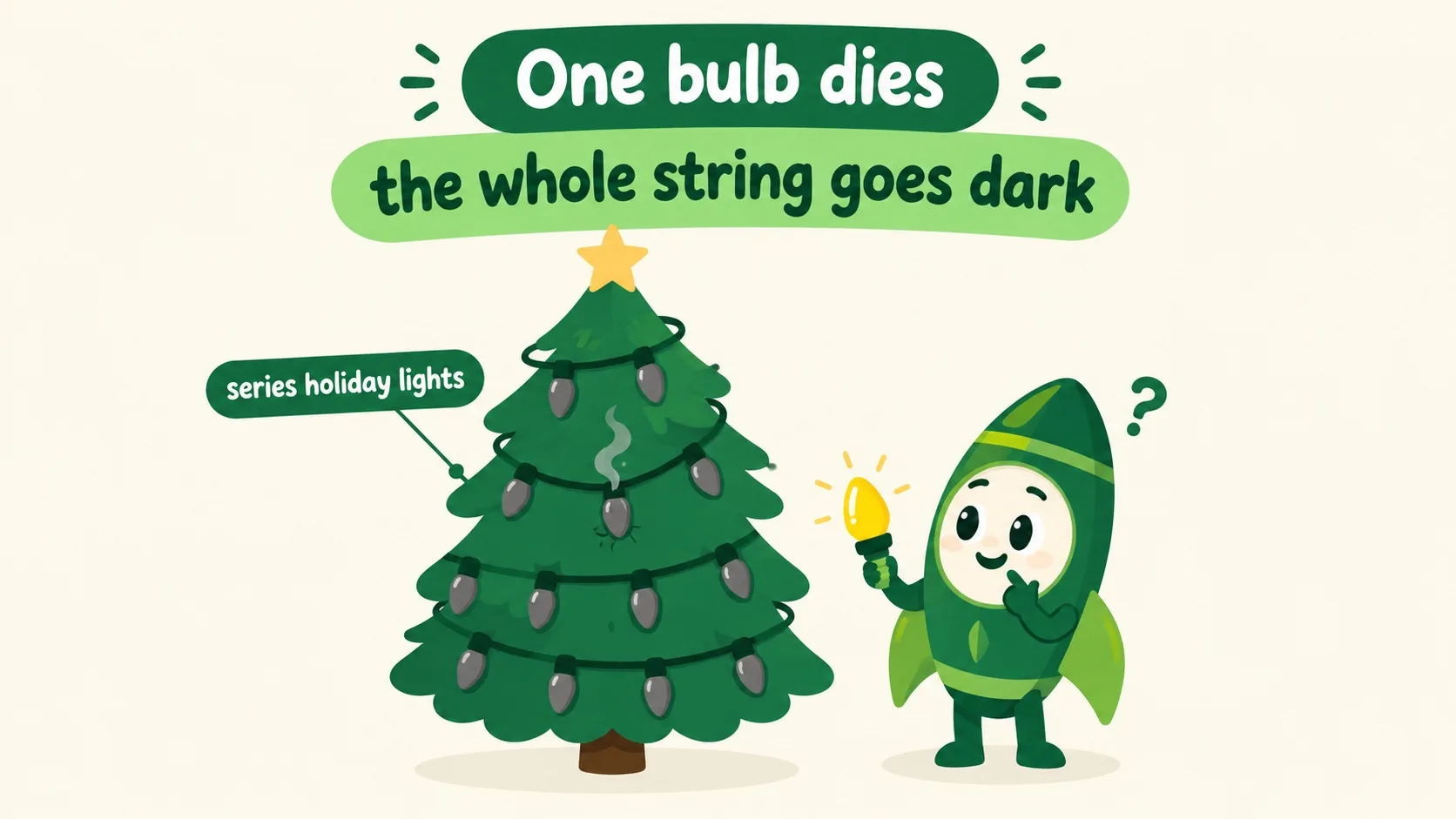
老式圣诞灯串是串联的:一只灯泡烧了,整串全灭,还得挨个拧下来试。现在的灯串改成并联,或给每只灯配一条“备用通道”(灯丝断了电流仍绕过去),坏一只,其余照亮。所以:要“同生共死”用串联(开关、保险丝就要这个效果);要“各自独立”用并联。Old holiday strings were series-wired: one dead bulb and the whole string went dark, so you twisted out bulbs one by one. Modern strings run in parallel, or give each bulb a tiny bypass so current flows around a broken filament — one dies, the rest stay lit. The rule: use series when things must live and die together (switches, fuses); use parallel when they must work independently.
🎮 你来搭电路(30 秒)🎮 Your turn: build the circuit (30 seconds)
道理讲完了。先切换串联 / 并联、拨拨开关,看灯泡亮度和电流走的路;再拿下 4 张检修单。Theory done. Switch between series / parallel, flip the switches and watch the brightness and the current paths; then clear 4 repair tickets.
一句话记住它:串联是“一条路走到底”(电流处处相等、电压分掉、一断全灭);并联是“多条路各走各的”(电压相同、电流分开、互不影响)。家里全是并联。Remember it in one line: series is one path for all (same current, shared voltage, one gap kills all); parallel is many paths side by side (same voltage, split current, independent). Homes are wired in parallel.
串联:电流处处相等;电压分给各元件;一处断、全灭Series: same current everywhere; voltage shared; one gap kills all并联:各支路电压相同;电流各走各的;可单独开关Parallel: same voltage per branch; current splits; independently switchable家庭电路全并联;串联留给“必须一起”的场合(开关、保险丝、老式灯串)Homes run in parallel; series is for “together or not at all” jobs (switches, fuses, old light strings)
内容参考 OpenStax 等公开教材,多来源核对 · AI 生成、人工审核 · 发现错误欢迎指正,帮这片叶子长得更好。Based on OpenStax and other open textbooks, cross-checked across sources · AI-generated, human-reviewed · Spotted a mistake? Tell us — help this leaf grow.
 Back to tree