🛰️ 卫星导航:手机怎么知道你在哪🛰️ Satellite Navigation: How Your Phone Knows Where You Are
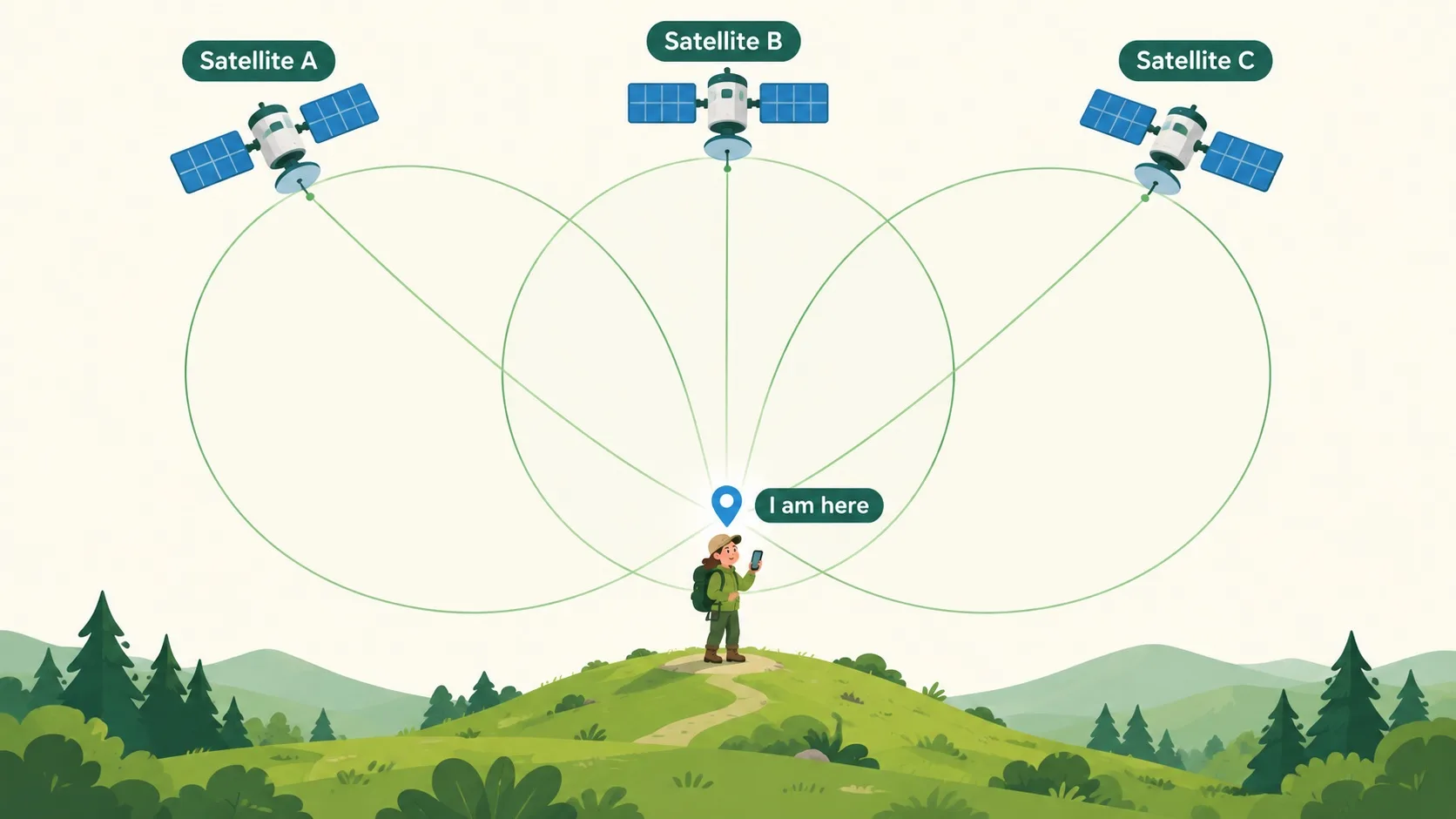
等高线看懂了,路也选好了。可半山腰起了雾,🌍 蓝色星球向导忽然说不清自己站在图上哪个点。抬头——天上正有一群卫星,等着回答这个问题。The contours made sense, the route was chosen. Then fog rolled over the slope, and 🌍 Blue Planet Guide could no longer say which dot on the map they were standing on. Look up — a flock of satellites is waiting to answer exactly that.
第 1 步:卫星只告诉你一件事——离我多远Step 1: A satellite tells you one thing — how far away it is
先看一颗卫星能给你什么。Start with what a single satellite can give you.
每颗导航卫星一刻不停地广播三件事:我是谁、现在几点、我在哪儿。美国的叫 GPS,中国的叫北斗,名字不同,道理一样。手机收到后把时间一减,就知道信号在路上走了多久;再乘光速(每秒约 30 万千米),算出的就是「我离这颗卫星多远」。可是只知道距离,你可能在以它为球心的一整个球面上——还是「某处」。Every navigation satellite broadcasts three things, nonstop: who I am, what time it is, where I am. America's system is called GPS and China's is called BeiDou — different names, same idea. Your phone subtracts the timestamp from its own clock to learn how long the signal was travelling, multiplies by the speed of light (about 300,000 km per second), and gets one number: how far away that satellite is. But a distance alone leaves you anywhere on a whole sphere around it — still just “somewhere”.
一颗只能给个「某处」,那要几颗才够?One satellite only gives you “somewhere”. So how many are enough?
第 2 步:三颗交出一个点Step 2: Three of them cross at a single point
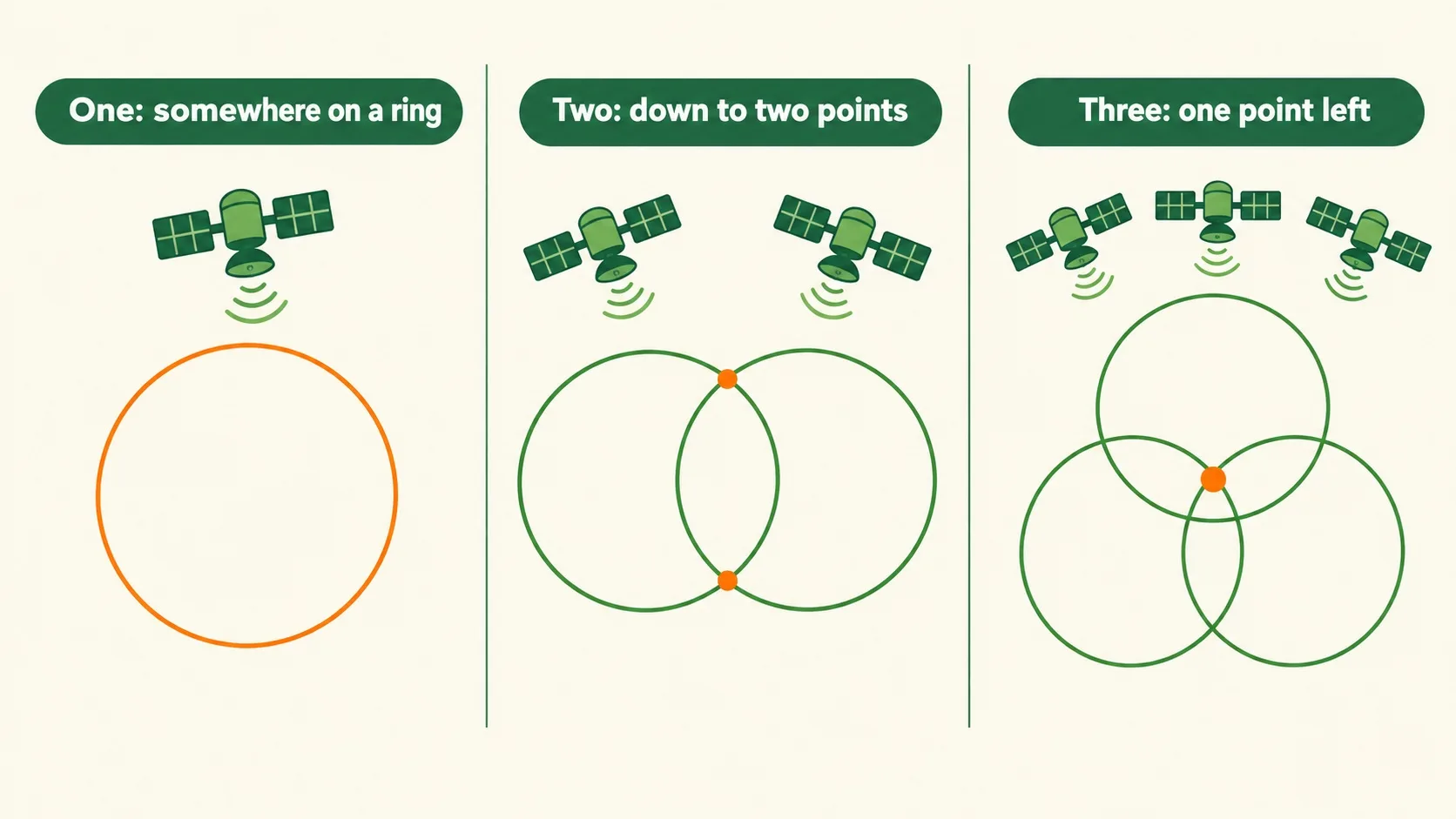
第二颗再给一个球面,两个球面相交是一个圈;第三颗再切一刀,圈上只剩两个点,其中一个在高空或地球另一侧,排掉——剩下的那个就是你。这个办法叫交会定位。摊平到地图上看更清楚:一颗是一个圈,两颗剩两个点,三颗只交在一处。卫星在天上分得越开,交得越干脆,位置越准。A second satellite adds another sphere, and two spheres meet in a circle. A third slices that circle down to just two points — one of them is out in the sky or on the far side of the Earth, so it is thrown away, and the one left is you. That is called trilateration. Flattened onto a map it is easier to see: one satellite gives a ring, two leave two points, three meet at one spot. The wider apart the satellites sit in the sky, the cleaner the crossing and the sharper the fix.
既然三颗就够,手机为什么常说「已连上 8 颗卫星」?If three is enough, why does your phone brag about tracking eight satellites?
第 3 步:第四颗管时间,峡谷里会飘Step 3: The fourth one fixes the clock — and canyons make the dot drift
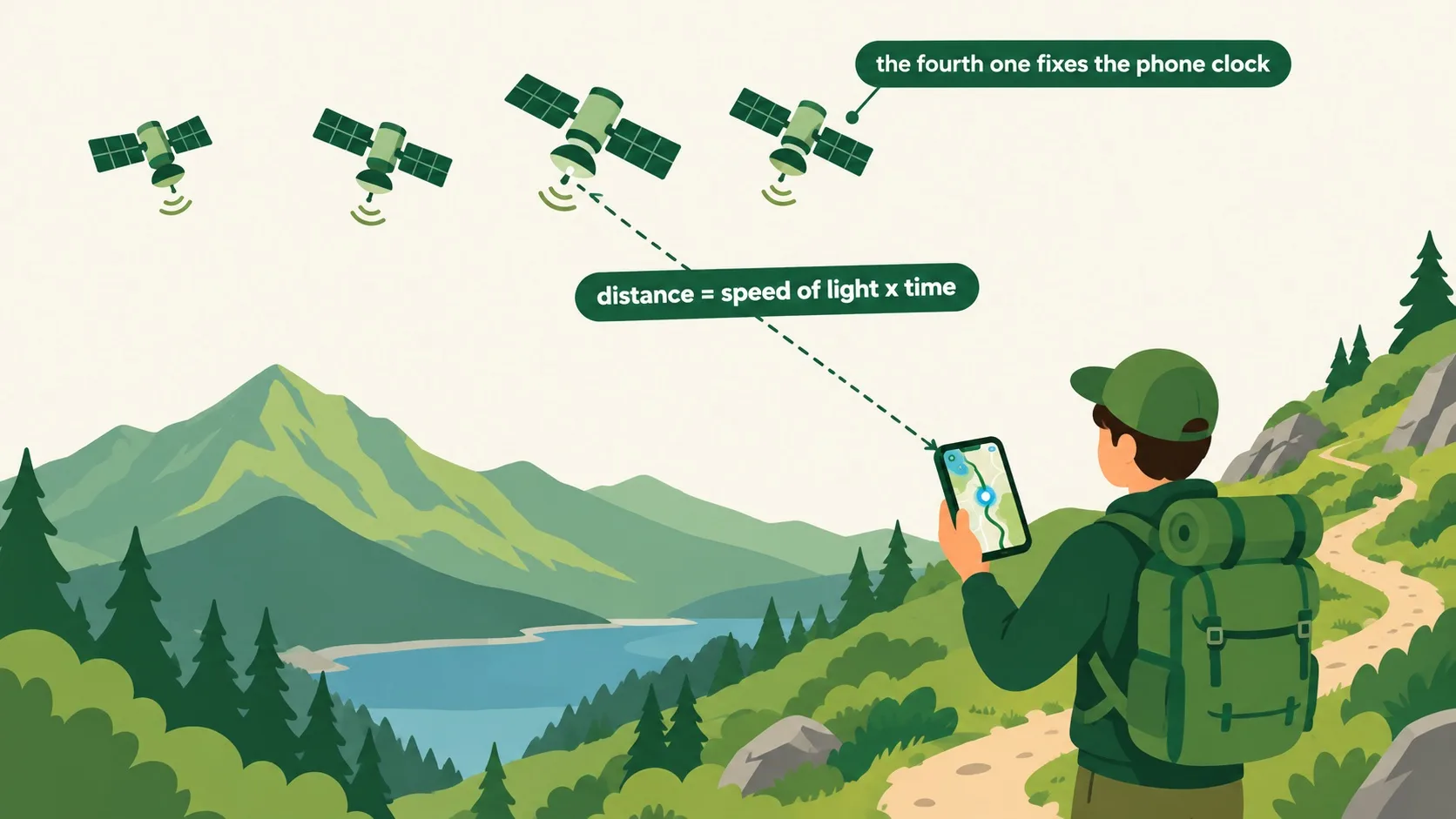
因为距离 = 光速 × 时间,而光速太快了:手机的钟只要差百万分之一秒,算出来的距离就差 300 米。卫星上装的是原子钟,手机装不起,所以需要第四颗卫星——它多给一个方程,顺手把手机的钟校准。多收几颗就更稳。高楼缝里、峡谷里、密林下,信号被挡住或被墙面反射,蓝点就会乱飘;进了隧道更彻底,头顶全被盖住,一颗也收不到,只能先用最后的位置顶着。这时手机还会拉上基站、Wi-Fi 和自带的运动传感器一起凑答案。Because distance = speed of light × time, and light is brutally fast: if the phone's clock is off by a millionth of a second, the distance is off by 300 metres. Satellites carry atomic clocks; your phone cannot. So a fourth satellite joins in — it supplies one more equation and sets the phone's clock straight along the way. More satellites make the fix steadier still. Between tall buildings, inside canyons or under thick forest the signal is blocked or bounced off walls, and the blue dot starts to wander; inside a tunnel it is total — the sky is fully covered, no signal at all, so the phone coasts on its last known spot. That is when the phone also leans on cell towers, Wi-Fi and its own motion sensors to fill the gap.
🎮 你来定位(30 秒)🎮 Your turn: get the fix (30 seconds)
先一颗一颗打开卫星,看可能的位置怎么从一整片缩成一个点;再接 4 次求救,自己点出交会的地方。First switch the satellites on one at a time and watch the possibilities shrink from everywhere to one point; then take 4 distress calls and click the meeting spot yourself.
一句话记住它:卫星导航 = 量距离 + 交会定位。一颗卫星给一个球面,三颗交出一个点,第四颗负责把手机的钟对准。Remember it in one line: satellite navigation is measuring distances and crossing them. One satellite gives a sphere, three cross at a point, and a fourth keeps the phone's clock honest.
距离 = 光速 × 信号走的时间;一颗卫星只能说明你在某个球面上Distance = speed of light × travel time; one satellite only says you are somewhere on a sphere三个球面交出一个点(排掉天上那个不合理的解),这叫交会定位Three spheres cross at one point once the impossible one is discarded — that is trilateration第四颗校准手机的钟:钟差百万分之一秒,位置就差 300 米;峡谷高楼里信号被挡,蓝点会飘;隧道里一颗也收不到,只能先用最后的位置顶着The fourth satellite sets the phone's clock: a millionth of a second means 300 m of error; blocked signals in canyons make the dot drift; in a tunnel there is no signal at all, so the phone coasts on its last known spot
内容参考 OpenStax 等公开教材,多来源核对 · AI 生成、人工审核 · 发现错误欢迎指正,帮这片叶子长得更好。Based on OpenStax and other open textbooks, cross-checked across sources · AI-generated, human-reviewed · Spotted a mistake? Tell us — help this leaf grow.
 Back to tree