上一片里,🧮 小算盘机器人给积木量了体积、算了表面积。量着量着,它盯上了积木本身:这些形状叫什么?身上有几个面、几条棱、几个尖?这一片,把每块积木拆开来数个遍。Last leaf, the little calculator robot measured volume and worked out surface area. Then it stared at the blocks themselves: what are these shapes called? How many faces, edges and corners does each one have? This leaf, we take every block apart, face by face.
第 1 步:积木家族三大门派Step 1: Three clans of the block family
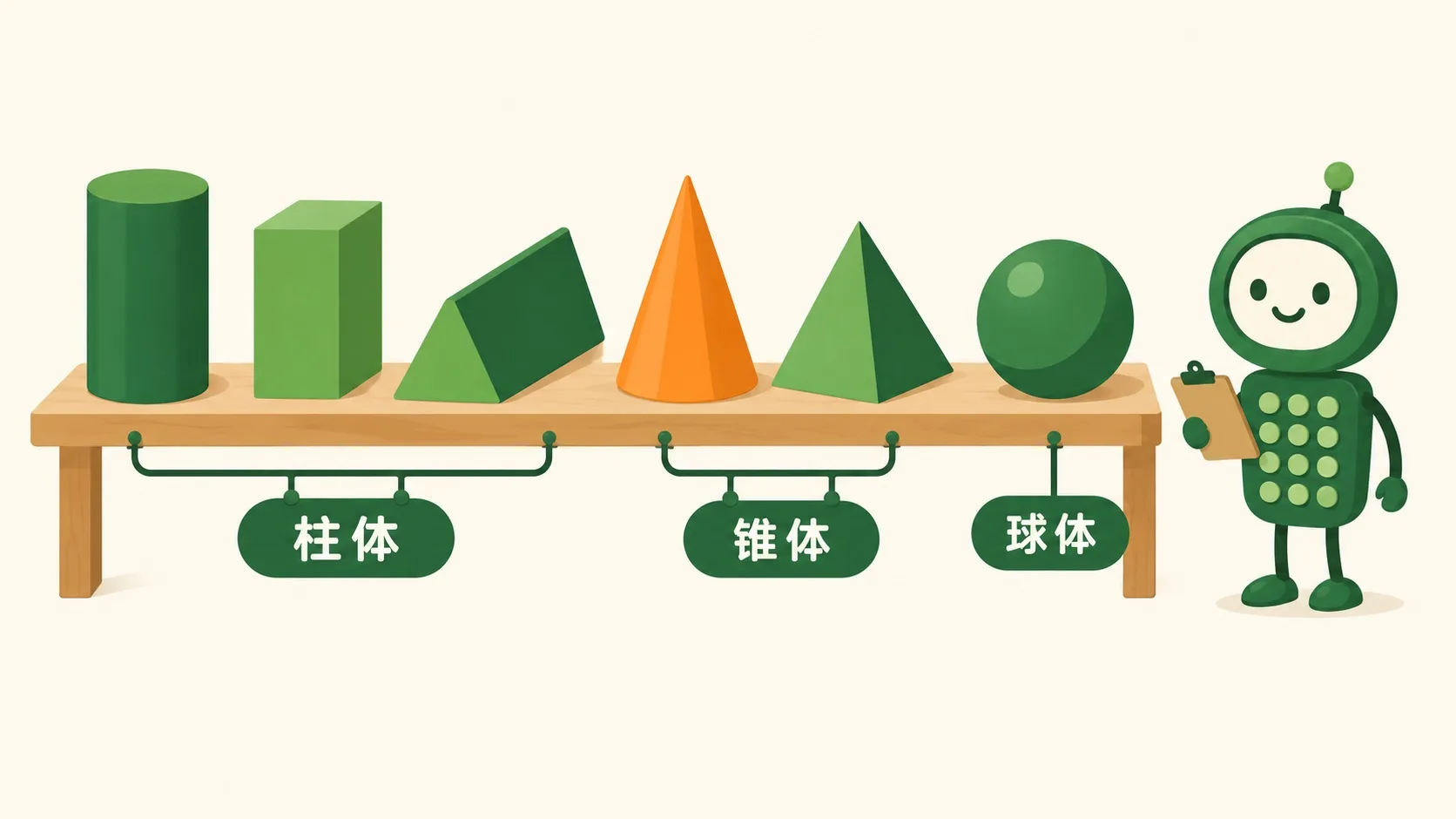
先看看货架上都站着谁——按“上下一样”和“有没有尖”,它们分成三派。Meet the shelf first — two questions sort them all: do top and bottom match, and is there a point?
柱体像叠起来的硬币:上下两个面一模一样,稳稳站住——圆柱、长方体、三棱柱都属这一派。锥体长着尖脑袋:把柱体的上面缩成一个点,就变成了锥体——圆锥、三棱锥都是。球体处处圆滑:没有平面,没有棱,也没有尖,滚得动、捏不住。Prisms and cylinders stack like coins: top and bottom faces match exactly, so they stand steady — cylinders, cuboids and triangular prisms all belong here. Cones and pyramids wear a pointed cap: shrink a prism's top down to a single point and you get this clan. The sphere is smooth everywhere: no flat face, no edge, no corner — it rolls and won't be pinched.
你可能会想:这些形状身上到底有哪些零件?You might ask: what parts is a solid actually made of?
第 2 步:面、棱、顶点,数一数Step 2: Faces, edges, vertices — count them
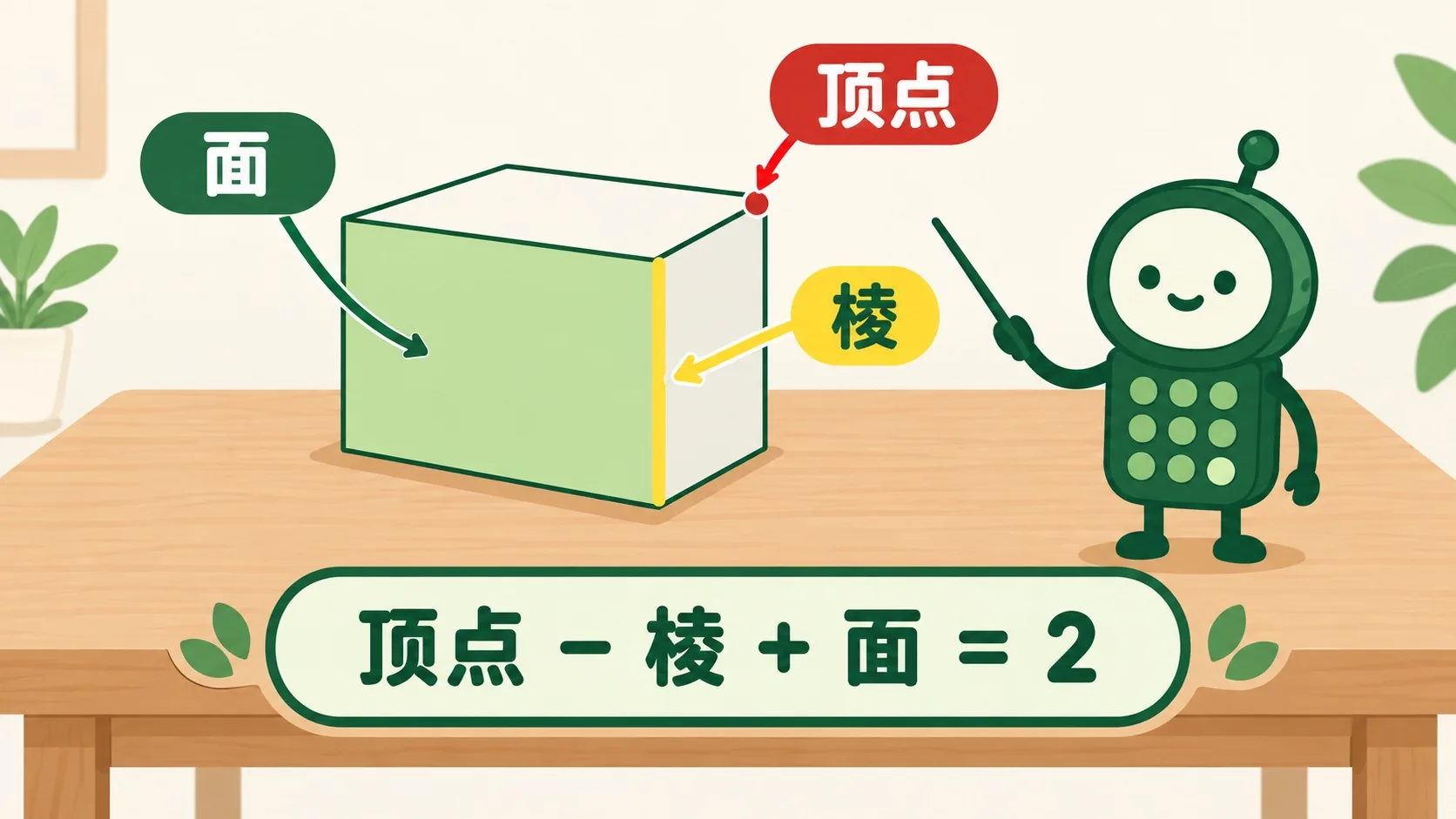
平平的面叫“面”;两个面相交的线段叫“棱”;几条棱碰头的尖角叫“顶点”。拿长方体当样本:6 个面、12 条棱、8 个顶点。机器人还发现一个魔法:顶点 − 棱 + 面 = 8 − 12 + 6 = 2,换成任何“没有洞”的立体都成立——这叫欧拉公式(Euler's formula)。A flat side is a face; the line where two faces meet is an edge; the sharp corner where edges meet is a vertex. A cuboid has 6 faces, 12 edges and 8 vertices. The robot even found a magic spell: V − E + F = 8 − 12 + 6 = 2 — and it works for every solid with no holes. It is called Euler's formula.
数完了零件,快递站裁纸板的问题来了:平平的纸板,怎么变成有棱有角的盒子?Parts counted — now the parcel shop needs a box: how does a flat sheet become a box with edges?
第 3 步:把盒子拆开:展开图Step 3: Open the box: nets
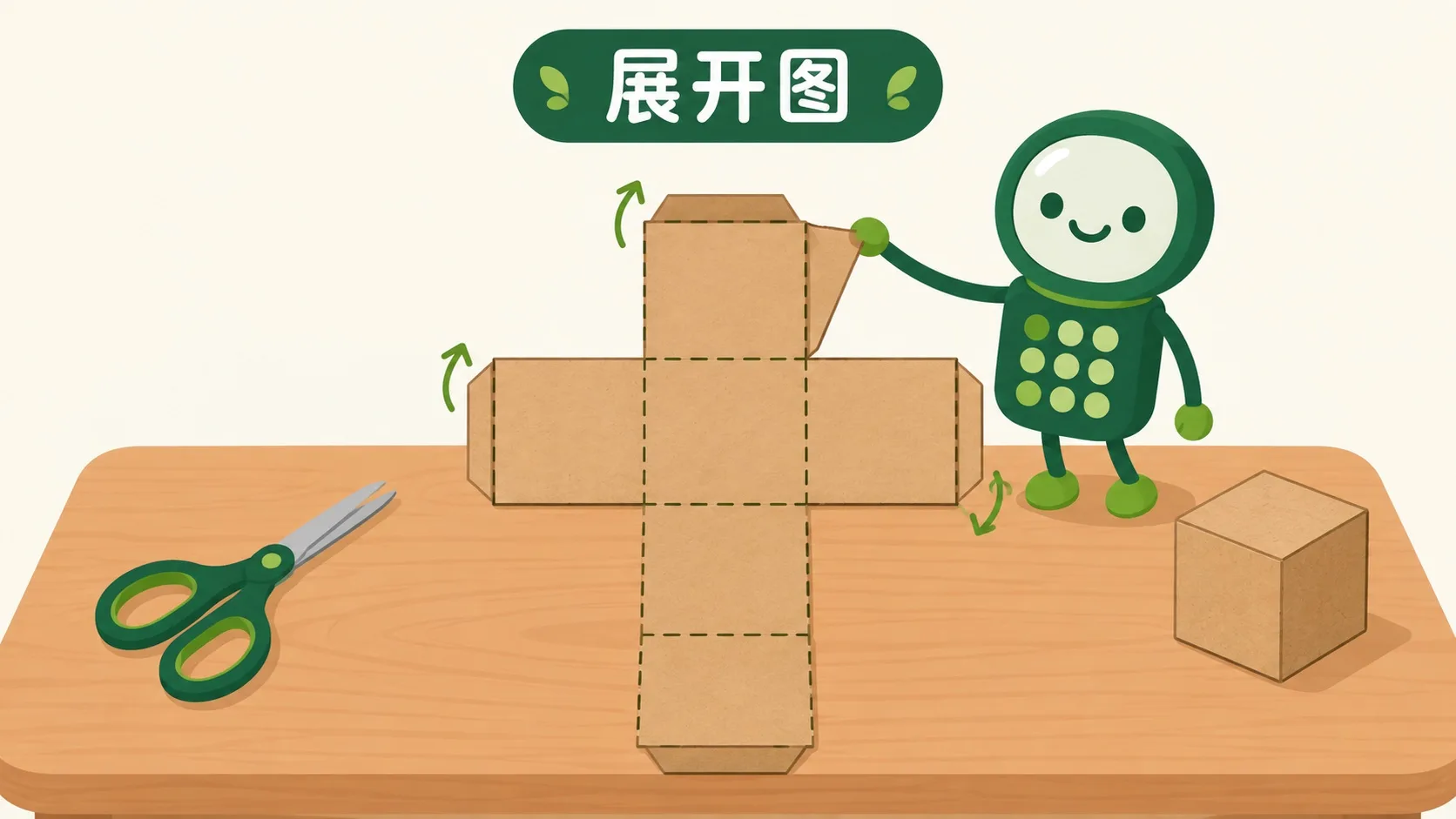
沿棱把纸盒剪开、摊平,就得到展开图(net):6 个正方形排成十字形,虚线是折痕,折起来又变回盒子。同一个立体,剪法不同,展开图也不同——单是正方体,就有 11 种展开图。Cut a box along its edges and flatten it, and you get a net: six squares laid out in a cross, dashed lines marking the folds — fold it back up and the box returns. Slice differently and the net changes: a cube alone has 11 possible nets.
🎮 你来当鉴定师(30 秒)🎮 Your turn: the shape examiner (30 seconds)
道理讲完了。把 4 块积木放上鉴定台:数面、数棱、数顶点、认名字——每答对一题,就多一枚徽章。Theory done. Four blocks go on the judging table: count faces, count edges, count vertices and name the shape — one badge per correct answer.
一句话记住它:立体图形的零件只有三种——平平的面、面与面相交的棱、棱碰头的顶点;柱体上下一样,锥体有尖,球体处处圆滑;沿棱剪开摊平,就是展开图。彩蛋:欧拉公式 V − E + F = 2 对所有“没洞”的立体成立。Remember it in one line: every solid is built from just three parts — flat faces, edges where faces meet, and vertices where edges meet. Prisms match top to bottom, cones and pyramids wear a point, spheres are smooth everywhere; cut along the edges and flatten for a net. Bonus: Euler's formula V − E + F = 2 holds for every solid without holes.
面、棱、顶点:长方体样本 = 6 个面、12 条棱、8 个顶点Faces, edges, vertices: a cuboid has 6 faces, 12 edges, 8 vertices分类看两点:上下两个面是否一样、有没有一个尖Classify by two clues: do the top and bottom match, and is there a point?沿棱剪开摊平 = 展开图;欧拉彩蛋 V − E + F = 2Cut along edges and flatten = a net; the Euler bonus V − E + F = 2
内容参考 OpenStax 等公开教材,多来源核对 · AI 生成、人工审核 · 发现错误欢迎指正,帮这片叶子长得更好。Based on OpenStax and other open textbooks, cross-checked across sources · AI-generated, human-reviewed · Spotted a mistake? Tell us — help this leaf grow.
 Back to tree