🔊 声波:空气里的纵波接力🔊 Sound Waves: A Relay Race in the Air
上一片里,波绕过缝隙继续前进;这一片换主角——声音本身。它到底是怎么从扬声器跑到你耳朵里的?Last leaf, waves bent around gaps and carried on. This leaf stars sound itself — how does it get from a speaker to your ears?
第 1 步:声音是一场“推挤接力”Step 1: Sound is a push-and-pull relay
先凑近扬声器,看看它的纸盆在干什么。Come close to a speaker and watch its cone.
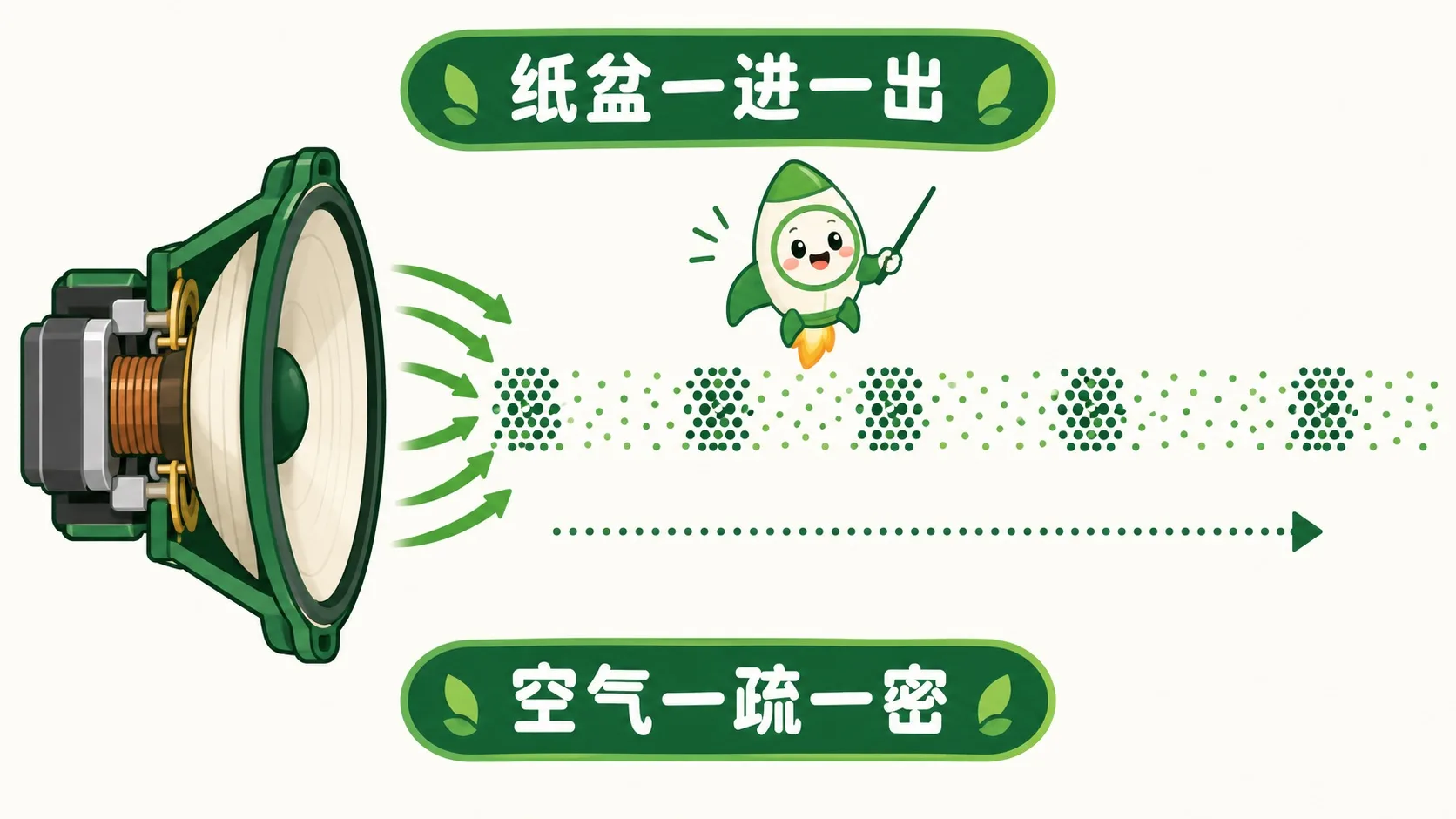
扬声器纸盆一进一出:推进去,把身边的空气挤密;拉出来,那团空气又变疏。这一挤一松沿着空气一层层传下去,像看台上的人浪——每个人只晃了一下,波动却跑得很远。振动方向和传播方向相同的波,叫纵波(longitudinal wave)。The speaker cone moves in and out: push in, and it squeezes the nearby air; pull back, and that patch thins out. The squeeze and stretch pass along from layer to layer of air like a wave in a stadium crowd — each person only sways, yet the wave travels far. A wave whose vibration is along the direction of travel is called a longitudinal wave.
你可能会想:把接力的人全部撤走,会怎样?You might ask: what if we remove every relay particle?
第 2 步:没有空气,就没有声音Step 2: No air, no sound
真空罩里的铃铛照样在敲,但罩里没有空气分子来接力,振动传不出来——声音消失。所以宇航员在月球上不能直接对话,只能靠无线电:电波不需要介质,而声波必须有介质(气体、液体、固体都行)。A bell inside a vacuum jar still swings, but with no air molecules to pass the push along, the vibration never gets out — the sound vanishes. That's why astronauts on the Moon can't chat directly: radio waves need no medium, but sound must have one (gas, liquid or solid).
那声音在不同介质里,谁跑得快?So how fast does sound travel in different media?
第 3 步:声速三段位与分贝刻度Step 3: Sound speed in three media, and the decibel scale
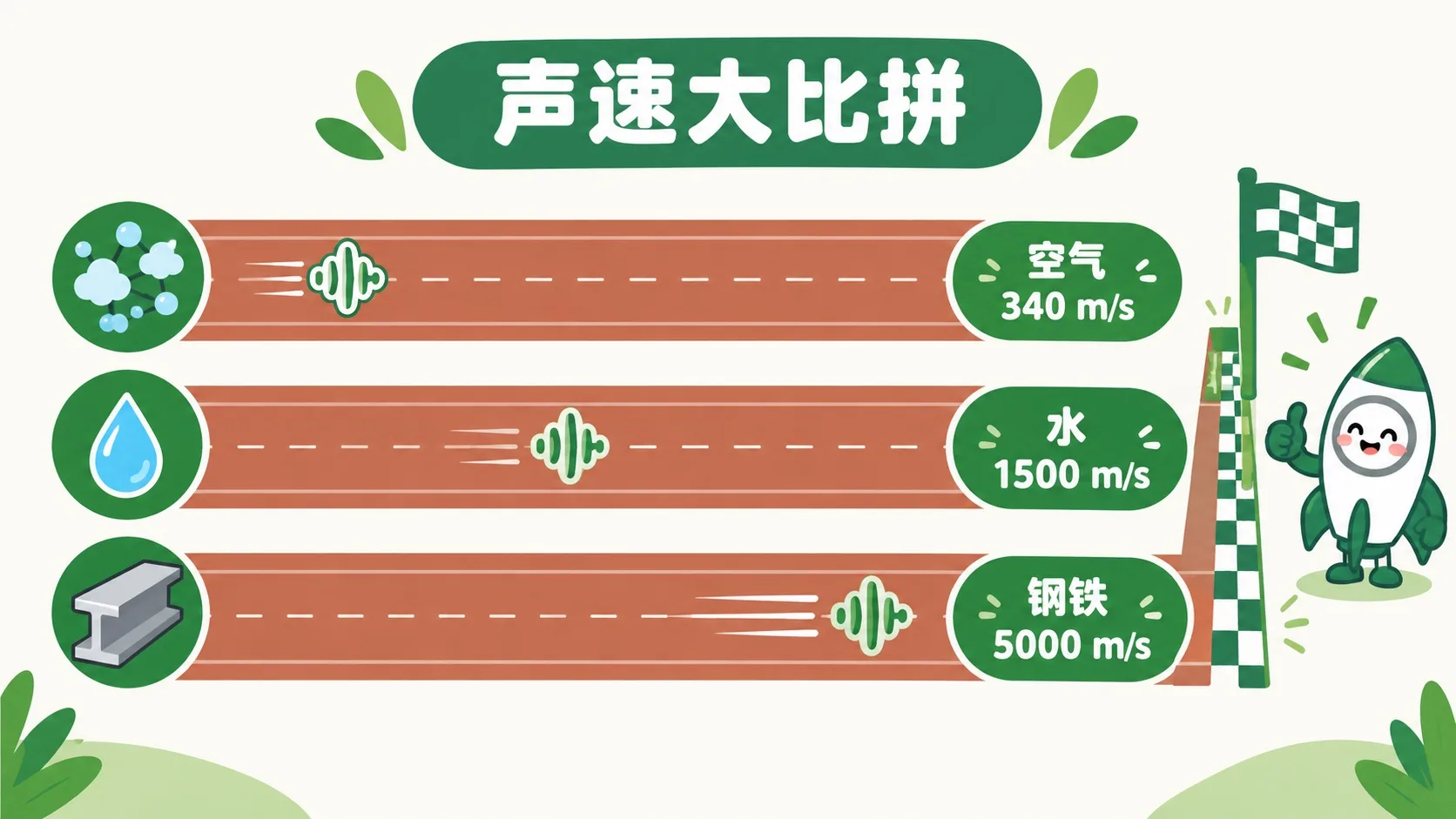
空气约 340 m/s,水约 1500 m/s,钢铁约 5000 m/s——分子挨得越紧,接力越快。声音的“响度”则用分贝(dB)量:耳语约 30 dB、普通说话约 60 dB、地铁进站约 100 dB;每加 10 dB,响度大约翻一倍,130 dB 以上会刺痛耳朵。Air about 340 m/s, water about 1500 m/s, steel about 5000 m/s — the tighter the molecules, the faster the relay. Loudness is measured in decibels (dB): a whisper is about 30 dB, ordinary talk about 60 dB, a subway train about 100 dB; every +10 dB roughly doubles the loudness, and past 130 dB it hurts.
🎮 你来当实验员(30 秒)🎮 Your turn: run the lab (30 seconds)
道理讲完了。切换空气、水、钢铁、真空,看粒子接力跑得快慢;4 个实验任务在等你。Theory done. Switch between air, water, steel and vacuum to watch the particle relay — then finish 4 experiments.
一句话记住它:声波是纵波——纸盆推挤空气,一疏一密向前传;它必须有介质,真空中没有声音。Remember it in one line: sound is a longitudinal wave — the cone squeezes the air into tight and loose zones; it must have a medium, so a vacuum is silent.
纵波:空气分子沿传播方向来回振动,形成疏密相间的波Longitudinal wave: air molecules vibrate along the travel direction, forming tight and loose zones需要介质:真空里没有分子接力 → 没有声音Needs a medium: no particles in a vacuum → no sound声速:空气约 340 m/s < 水约 1500 m/s < 钢铁约 5000 m/s;响度用分贝Speeds: air ≈ 340 m/s < water ≈ 1500 m/s < steel ≈ 5000 m/s; loudness in decibels
内容参考 OpenStax 等公开教材,多来源核对 · AI 生成、人工审核 · 发现错误欢迎指正,帮这片叶子长得更好。Based on OpenStax and other open textbooks, cross-checked across sources · AI-generated, human-reviewed · Spotted a mistake? Tell us — help this leaf grow.
 Back to tree